Recommendation
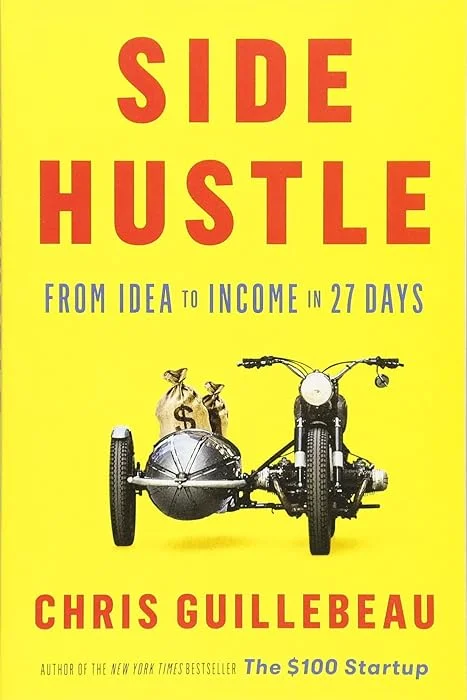
Chris Guillebeau opens Side Hustle with three stories. A British construction manager writes fish-tank reviews on an obscure website on weekends and a few years later they are still earning him $700 a month while he sleeps. A San Diego government employee photographs a friend’s wedding for fun and ends up making an extra $3,500 a month shooting one ceremony at a time. A Pennsylvania oil-and-gas sales rep posts decorating photos on Pinterest in the gaps of her workday and earns $40,000 over three years. None of these people quit their jobs. None of them call themselves entrepreneurs. All of them built what Guillebeau calls a side hustle: a second source of income that runs alongside a primary job, generated by skills the person already has and deployed with minimal capital.
The book is useful for three kinds of reader. The Ethiopian diaspora-remittance recipient who gets $300 or $500 a month from a relative in the United States, Saudi Arabia, or Dubai and watches it dissolve into household consumption rather than seeding a business. The ESSLCE graduate who did not enter university and is searching for a first income while their classmates leave for AAU. And the salaried government or NGO worker in Addis Ababa or Mekele who has a stable paycheck but feels its ceiling and wants something they own outside of it. Guillebeau wrote the book for the American office worker, but the 27-day plan transfers cleanly.
What separates Side Hustle from the usual entrepreneurship literature is what Guillebeau refuses to do. He does not ask the reader to quit their job. He does not ask them to take on debt. He does not ask them to write a business plan or assemble a team or pitch investors. He asks for 27 days of small, sequential actions, each one finishable in under an hour, ordered so that idea becomes offer becomes income before the calendar turns. Read it once for the framework. Come back to a single day’s instruction when your own hustle is stuck on that exact step.
Take-aways
- A side hustle is not entrepreneurship. It is an additional income source that runs while you keep your job. The frame is multiplication, not replacement.
- The new job security is multiple paychecks. A worker with three income streams does not depend on the goodwill of any single employer.
- You already have the skills you need. Almost every side hustle in the book uses an ability the person had been giving away for free.
- Ideas are screened by three qualities. A good side-hustle idea is feasible (you can start now), profitable (you can predict the margin), and persuasive (it solves a problem someone is willing to pay to fix).
- Forecast profit on the back of a napkin. If you cannot estimate the margin in five minutes with a pen, the idea is too complicated for a side hustle.
- An offer is a promise plus a pitch plus a price. Three components, not one. Most side hustles stall because the maker has a product but not an offer.
- Launch before you feel ready. The right time is usually before total confidence. Confidence arrives from selling, not from preparing.
- Frame your first dollar. The first dollar of revenue is not a financial event. It is a psychological one. Treat it like a milestone.
Summary
The book is a 27-day plan structured as five weeks: build an arsenal of ideas, select the best idea, prepare for liftoff, launch to the right people, regroup and refine. Each day takes under an hour. The structure is the argument: most side hustles fail not because the idea was wrong but because the maker never sequenced the work. Guillebeau’s contribution is the sequence.
What a side hustle is, and is not
Guillebeau opens with a definition that matters more than it looks. A side hustle is income alongside a primary job, not income replacing it. The framing is multiplicative. You do not quit. You do not bet the house. You do not write a business plan. You build a second small income stream in 27 days, then a third, then a fourth, and the security that comes from being employed by yourself in three different ways is what he calls the new job security. The argument is empirical rather than aspirational. Guillebeau spent years interviewing people who had built second incomes, and almost none of them set out to be entrepreneurs. They had skills they were already giving away, they sequenced a few actions over a few weeks, and they ended up with $500 or $5,000 a month flowing into a bank account that was not their employer’s deposit. The book teaches the sequence.
The distinction matters because the entrepreneurship literature has trained readers to think in binary terms: you are either an employee or you are a founder, and the journey from one to the other requires resigning the first to commit to the second. Guillebeau rejects the binary. He treats the day job as an asset, not a constraint. The paycheck pays the rent while the hustle finds its market. Health insurance covers the family while the second income stabilizes. The hustle is judged not against the day job’s hourly rate but against zero, which is what the hustler was earning from that activity the day before they started. The bar is not “is this more profitable than my career?” The bar is “does this produce real money now?” Almost any side hustle, run for 27 days, clears that bar by a wide margin.
Week 1: build an arsenal of ideas
Guillebeau’s controlling metaphor for the first week is the Money Tree. Parents tell children that money does not grow on trees, and Guillebeau argues that those parents are only half right. Money does grow on trees; you simply have to plant the right seeds in the right soil. The seeds are ideas, the soil is the market that already exists for those ideas, and the patience required is shorter than most adults assume. Twenty-seven days, in Guillebeau’s accounting, is enough time to plant, water, and see the first leaves. The first week of the plan is about generating a portfolio of seeds so that the strongest one can be selected in the second week.
The first week generates ideas and weighs them. Day 1 asks a single question: 27 days from now, what will be different about your life? The answer becomes the destination. Day 2 introduces what Guillebeau calls the Money Tree: the metaphor that money does grow on trees, but only when seeds are planted in the right soil. Day 3 forces brainstorming of at least three possibilities, on paper, before any of them is evaluated. Guillebeau’s rule is that idea generation and idea evaluation are separate cognitive modes and combining them kills both. Day 4 weighs each idea against obstacles and opportunities. Day 5 forecasts the profit on the back of a napkin: if you cannot estimate the margin with a pen and a paper napkin in under five minutes, the idea is structurally too complicated to run alongside a day job. The napkin is the gate. Ideas that pass the napkin move forward. Ideas that fail get parked.
Week 2: select your best idea
The second week filters the arsenal. Day 6 introduces the Side Hustle Selector, a simple tool that ranks each candidate idea on three dimensions: feasibility (can you start it now with what you have?), profitability (will it produce more cash than it costs?), and persuasion (is there a real person willing to pay for the solution?). Day 7 asks the would-be hustler to become a detective: study three people already doing something similar, identify what they do well, and find one thing you can do better or differently. Day 8 has the hustler imagine a coffee with the single ideal customer, naming that customer specifically and describing what their day looks like. Day 9 transforms the idea into an offer, which Guillebeau insists has three components and not one: a promise (what will change for the customer), a pitch (how you describe it in one sentence), and a price (a specific number). Day 10 writes the origins story. Every side hustle, like every comic-book hero, needs a short history that the customer can repeat to others.
Week 3: prepare for liftoff
The third week assembles the operational machinery. Day 11 sets up the nuts and bolts: a domain name, a payment processor, a simple landing page, a way to collect customer information. Guillebeau is clear that this should take an evening, not a quarter. Day 12 chooses a price using the cost-plus model and two simple guidelines: include all costs (including your time at a reasonable hourly rate), and price at the upper end of what feels comfortable rather than the lower end. Day 13 lists every tool, deliverable, and supply the hustle needs to operate. Day 14 sets up payment infrastructure, which in 2017 meant PayPal or Stripe and in Ethiopia means CBE Birr, Telebirr, or chapa.co. Day 15 designs the first workflow: the explicit sequence from customer-clicks-buy through cash-in-account through deliverable-in-hand. Day 16, a bonus step, instructs the hustler to spend ten percent more time on the two highest-value tasks (usually selling and delivering) than on the dozens of smaller ones that fill time without producing money.
Week 4: launch your idea to the right people
The fourth week is where most plans go to die. Guillebeau argues that the right time to launch is before the maker feels confident, because confidence is generated by selling, not by preparing. Day 17 publishes the offer publicly even if it is imperfect. Day 18 instructs the hustler to sell like a Girl Scout: ask, directly, without elaborate justification. Day 19 asks ten specific people for help in the first week, naming them: a friend who runs a relevant business, a family member who knows the target customer, a coworker who can pass the offer along. Day 20 tests three or four variations of the offer or the pitch and keeps a record of which one converted. Day 21, the “burn down the furniture store” day, runs a deliberate promotional sale to generate the first wave of revenue and the first wave of testimonials in the same week. Day 22 frames the first dollar earned. Literally. Print the receipt or the payment confirmation and put it on the wall. The act marks the transition from idea to business and the hustler will need to remember the moment when the next setback comes.
Week 5: regroup and refine
The fifth and last week assumes the hustle is alive and asks what to do next. Day 23 tracks the most crucial metrics, which Guillebeau argues are revenue, profit, and time spent, in that order. The hustler who tracks revenue without tracking time discovers, six months in, that they are earning $1,000 a month at the cost of forty hours, which is below their day-job wage. Guillebeau is clear that hours spent must be visible on the dashboard or the hustle quietly becomes unprofitable. Day 24 grows what works and lets go of what does not, ruthlessly. Most hustlers cling to their first idea past the point where the data is asking them to pivot. Day 25 looks for money lying under a rock: adjacent offers, second products for existing customers, the obvious extension that the busy hustler has not seen yet. If you sell wedding photography, you already have access to brides who need engagement photos a year earlier and family portraits a year later. The rock has money under it; you simply have to bend down. Day 26 gets the systems out of the hustler’s head and into a document, a spreadsheet, or a checklist, so that the business can survive a week without its founder taking a single call. Day 27 returns to the question Day 1 asked. Compared to where you were 27 days ago, what is different? The hustler is now operating one of three things: a first hustle that should be parked because it is not generating enough, a first hustle that should be grown because it is, or a first hustle that has finished its job and freed the maker to start a second one alongside it. The book closes by reminding the reader that the goal is not a side hustle. The goal is a portfolio of them, layered over years, so that no single employer or no single product can interrupt the household’s income.
About the Author
Chris Guillebeau is an American writer and entrepreneur who has visited every country in the world (193 of them) and built a career out of unconventional career advice. His earlier books The Art of Non-Conformity (2010), The $100 Startup (2012, a New York Times bestseller), The Happiness of Pursuit (2014), and Born for This (2016) trace the same theme from different angles: people can build lives around the work they actually want, with smaller capital and less risk than they assume. Side Hustle (2017) is his most prescriptive book, designed to take a reader from idea to income in 27 sequential days. Guillebeau hosts the daily podcast Side Hustle School and runs the annual World Domination Summit in Portland, Oregon, where he lives.