Recommendation
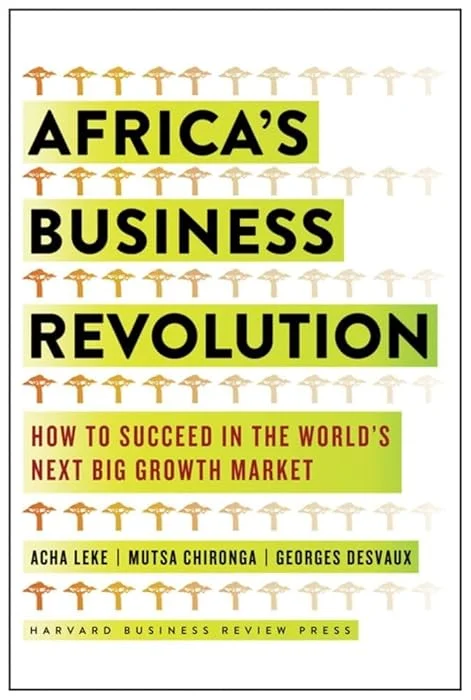
Africa’s Business Revolution is the McKinsey case for treating Africa as the world’s most underestimated growth market. Its authors are three senior McKinsey partners, two of them African-born, who have spent decades inside the continent’s economic story. The book opens with a simple question to test the reader’s mental map. How many companies in Africa earn annual revenues of one billion dollars or more? The most common answer from surveyed executives is zero to fifty. The actual number is four hundred. On average those four hundred firms grow faster and earn higher profits than their global peers. Most outsiders, including most investors, do not know this.
The book is for three kinds of reader. Ethiopian executives and small-business owners considering expansion into other African markets. Diaspora professionals trying to decide whether to return home and build something. Anyone who has read a Western newspaper story about Africa and wondered whether the picture is more complicated. The book is also written, almost in passing, for the Atenu reader who lives in Africa and is rebuilding their own mental map of the continent.
What makes the book useful is its concreteness. It does not argue for African opportunity in the abstract. It names companies (Dangote, Ethiopian Airlines, MTN, Jumia, Equity Bank), people (Aliko Dangote, Sara Menker, Mitchell Elegbe, Donald Kaberuka), specific deals, specific revenues, specific failures. The framework that emerges is clean. There are five big growth trends shaping Africa’s future. There are four imperatives any company must master to translate those trends into a real business. Read the book once for the data, the second time for the strategy. The diagrams will stay with you.
Take-aways
- Africa has 400 billion-dollar companies, not zero. McKinsey surveyed executives globally and almost no one knew this. The continent’s largest firms grow faster and earn more than their global peers.
- The mental map most Westerners carry is wrong. Africa is becoming the fastest-urbanizing region in the world. It will have a larger working-age population than China or India by 2034.
- The Big Five Growth Trends. Population and urbanization, industrialization, infrastructure build-out, resource wealth, and digital leapfrog. Each is real. Each has a structural difficulty that has kept lazy investors away.
- Lions and prey. Companies in Africa split sharply into outperformers and underperformers. Top-quintile African banks earn 37 percent return on equity. Bottom-quintile banks earn a quarter of that. The difference is strategy, not the continent.
- The Four Imperatives. Map your Africa strategy. Innovate your business model. Build resilience for the long term. Unleash Africa’s talent. Companies that do all four win. Companies that do three and skip one often lose.
- Unmet needs are the opportunity, not the obstacle. Africa has too few retail stores, too few banks, too little power, too little internet. Each gap is a business waiting to be built by someone with the imagination to see it.
- Long-term commitment is non-negotiable. Almost every successful company in the book made a multi-decade bet. The investors who try Africa for two years and leave are the ones who lose money.
- The continent rewards local knowledge. The fastest-growing businesses are run by people who live in Africa, hire from Africa, and understand the politics and language of the cities they operate in.
Summary
Why Africa, why now
The opening anecdote in the book is small and useful. A Korean conglomerate’s chairman, looking at a McKinsey presentation, points out that the map has “two countries called Congo.” It does. There is the Democratic Republic of the Congo (87 million people, vast minerals, conflict-ridden) and the Republic of the Congo (5 million people, a major oil producer). The book uses this to make a wider point. Africa has 54 countries, 1.2 billion people, over a thousand languages, and huge variation in income, infrastructure, and business sophistication. Most outsiders cannot hold this complexity in their heads. The instinct, the authors write, is to underestimate Africa’s size and overestimate the difficulty of doing business there.
The book corrects the picture with data. Four hundred billion-dollar companies. Banks growing revenues at double the global rate and earning twice the profit of developed-market banks. The continent moving steadily toward majority urbanization by 2037. 122 million active users of mobile financial services, with smartphone connections forecast to reach 636 million by 2022. Adult literacy up ten percentage points since 1990. Life expectancy rising. The share of Africans living in poverty fell from 56 percent in 1990 to 43 percent in 2012.
The authors are not arguing that the gloomy headlines are wrong. The kidnappings, conflicts, and corruption stories run by the New York Times are accurate. They are arguing that those stories are partial, and that the partial picture has cost foreign companies the ability to see Africa clearly enough to act.
The Big Five Growth Trends with a Twist
The frame for understanding the opportunity is what the authors call the Big Five. Each is a megatrend with a structural difficulty attached.
Trend 1: Fast-growing urbanizing population. Africa will account for one-fifth of humanity by 2025 and double its population by mid-century. The working-age population is expanding while the rest of the world’s ages. By 2034 the continent will have a larger labor force than China or India. The twist: average incomes remain low by Western standards and inequality is high. The opportunity reads differently for a company selling premium cars than for one selling affordable basics.
Trend 2: Industrialization. Africa runs a trillion-dollar trade gap in manufactured goods. The continent imports almost everything from cement and glass bottles to processed food. The opportunity to build local production capacity is enormous. The twist: power outages, trade barriers between African countries, and productivity gaps mean industrialization requires patient capital and infrastructure that is not always there.
Trend 3: Infrastructure build-out. Governments and the private sector are pushing hard on electricity, transport, and water. The twist: the backlog is vast. Africa’s electricity gap alone runs into hundreds of billions of dollars. Companies that show up to build it have a multi-decade runway.
Trend 4: Resource abundance. Agriculture, mining, oil, and gas remain enormous sectors. Africa holds a sizable share of the world’s arable land. The twist is that resource wealth has not historically translated to broad prosperity, and the companies that succeed in extractive industries must navigate environmental, political, and social complexity that wealthier-country competitors are not prepared for.
Trend 5: Digital leapfrog. Mobile phones reached most of Africa before reliable landlines. Mobile money reached most of Africa before bank branches. Digital adoption is happening faster on the continent than it was in any prior region. The twist: building the necessary technical talent and investment scale to capture this opportunity requires deliberate effort.
The authors’ central argument across these five trends is that the twists are exactly what keeps competition low. Companies with the imagination to solve the structural difficulties capture the upside.
Map your Africa strategy
The first imperative in the strategic guide is the most basic. Almost every company that fails in Africa fails because of a poorly designed entry strategy. The book offers four navigation tools.
Set a clear aspiration for growth. Decide what scale of business you want to build, by when, in which countries. Vague aspirations produce vague results. The most successful African companies (Dangote, MTN, Ethiopian Airlines) set explicit multi-decade growth targets.
Prioritize the markets that matter most. Africa is not one market. It is 54 of them, with widely varying GDP per capita, regulatory environments, languages, and consumer behaviors. The book offers a portfolio approach: select a small set of markets where your sector has the strongest tailwinds, and concentrate resources there before expanding.
Define how you will achieve scale and relevance. Some businesses scale through organic growth. Others through mergers and acquisitions. Others through joint ventures with local partners. The authors are clear that no single approach works everywhere. They use SABMiller’s African expansion as a case study of intelligent scale-building through acquisition.
Build the ecosystem you need to thrive. No business in Africa succeeds alone. The book emphasizes suppliers, distributors, government relationships, and community partnerships. The companies that win build a network of dependable local relationships before they need them.
Innovate your business model
The second imperative is innovation, but not the Silicon Valley kind. The authors mean innovation in the McKinsey sense: rethinking how the business creates and delivers value. Four practices stand out.
Create products and services that fulfill Africa’s unmet needs. The Roha glass-bottle plant in Debre Birhan, Ethiopia, is the kind of example the authors return to repeatedly. African beverage makers were importing 90 percent of their bottles. A US entrepreneur partnered with the Development Bank of Ethiopia and a South African glass company to build local production. The opportunity sat in plain view for years until someone with the right framework saw it.
Rethink your business model to truly engage with customers. African consumers are not Western consumers with less money. They are consumers with different cash flow patterns, different trust relationships with brands, and different access to channels. Companies that adapt win. Companies that import their existing model lose.
Get lean to drive down cost and price points. Africa’s consumers are price-sensitive. The companies that win build operations lean enough to serve the broad middle of the market, not just the affluent top.
Harness technology to unleash the next wave of innovation. The book features Interswitch (Nigerian payments), Jumia (e-commerce), M-Kopa (off-grid solar with mobile-money financing), and Gro Intelligence (the Wikipedia-for-agriculture founded by Sara Menker). Each is using technology to deliver something that was previously economically impossible at African income levels.
Build resilience for the long term
The third imperative is the one that distinguishes the lions from the prey: a deliberate strategy for surviving the volatility that comes with African markets. Four cornerstones.
Take a long-term view and ride out short-term volatility. Currency devaluations, commodity shocks, regulatory changes, and political transitions are part of doing business in Africa. The companies that succeed plan for them rather than assume stability. Dangote operates through three or four economic cycles. Tiger Brands tried to enter Nigeria, hit a currency crisis, and exited within three years for one dollar. The difference was time horizon, not strategy.
Diversify to build a balanced portfolio. Both geographic diversification (multiple countries) and sectoral diversification (multiple business lines) reduce single-point-of-failure risk.
Integrate up and down your value chain. Many African markets have weak or expensive supplier networks. Companies that take more of the value chain in-house, even when it adds initial cost, gain reliability that outweighs the cost.
Understand local context and engage with governments. This is the most uncomfortable cornerstone for foreign executives. African governments are more involved in business decisions than Western executives expect. Companies that build patient, transparent, long-term relationships with regulators, ministries, and state-owned enterprises do better than companies that treat government as an obstacle.
Unleash Africa’s talent
The fourth imperative is people. The continent has a young, growing labor force. Most of it is undertrained for the jobs that fast-growing businesses are creating. Three imperatives.
Build vocational skills for frontline workers. Trade schools, apprenticeships, and on-the-job training programs produce the welders, electricians, machinists, and call-center workers African businesses need. Companies that build these capabilities in-house typically have to, because public systems do not yet produce enough graduates.
Create robust processes to grow talent from within. Senior management positions filled by African nationals rather than expatriates are now table stakes for credibility. Building the pipeline takes a decade of investment in graduate hiring, rotation programs, and mentorship.
Harness the power of inclusion, particularly women’s advancement. McKinsey’s gender-diversity research applies across regions. African gender gaps in corporate seniority are wider than the global average. Companies that systematically advance women into leadership outperform those that do not.
Do well by doing good
The closing argument of the book ties the strategic frameworks back to a moral case. Africa’s biggest business opportunities, the authors argue, sit at the intersection of profit and impact. Connecting people to financial services. Providing clean water and reliable power. Delivering affordable health care. Educating the workforce. These are the largest markets on the continent, not corporate-social-responsibility line items.
The authors are explicit that they are not naive. Some companies will not do well by doing good. Some will simply do good for a while and then run out of money. The book’s argument is that the structural alignment between commercial opportunity and social need in Africa is unusually strong, and that the companies that act on it have a tailwind that companies in other regions do not.
About the Authors
Acha Leke is a senior partner and chairman of McKinsey’s Africa office. Born in Cameroon and trained at Stanford with engineering degrees through the doctoral level, he co-leads McKinsey’s work across the continent and has helped publish McKinsey Global Institute’s Lions on the Move reports on Africa’s economic transformation. Mutsa Chironga is Zimbabwean, formerly a McKinsey partner and now in senior banking leadership in South Africa. Georges Desvaux is a senior partner at McKinsey based in the firm’s Africa practice and previously led McKinsey’s Asia work for many years. Africa’s Business Revolution was published by Harvard Business Review Press in 2018 and draws on three thousand McKinsey consulting engagements across Africa and a survey of more than one thousand business executives globally.