Recommendation
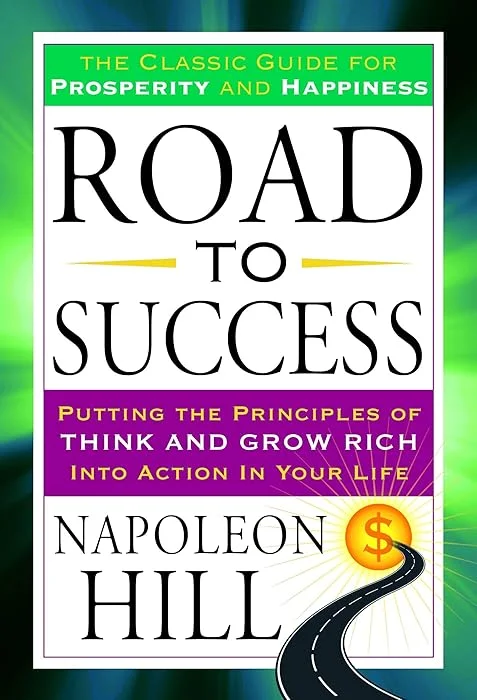
Road to Success is the book Napoleon Hill wrote before he wrote the book he is famous for. The articles inside were typed in the 1920s for two small magazines he edited, Napoleon Hill’s Magazine and Hill’s Golden Rule Magazine, and they sat in old typesetting for ninety years before the Napoleon Hill Foundation collected them between covers. The articles are valuable for one reason. They are Hill working out, in real time, the philosophy that would later become Think and Grow Rich, the best-selling self-help book of the twentieth century. The framework is rougher here, more biblical, more autobiographical. Carnegie’s twenty-year assignment to Hill (find a philosophy of success that ordinary people can use) is still in front of him, not behind him. The reader sees the system being built.
The book is useful for three kinds of reader. The Ethiopian university student or apprentice who has never sat down and written what they want in one sentence and signed their name to it. The small-business owner who has been “trying hard” for years without ever specifying what they are trying to reach. And the Orthodox or Muslim reader who is uncomfortable with the secular tone of most modern productivity literature and would prefer a foundational text that speaks of prayer, service, and the Golden Rule as central concepts rather than as decoration. Hill is unapologetically religious. He treats the Bible as a primary source for psychology, and he treats success as a moral achievement before it is a financial one.
What separates Road to Success from Think and Grow Rich is that the principles here are illustrated by long biographical articles: Edwin Barnes, who arrived in East Orange on a freight car and built a fortune working for Edison; Booker T. Washington, who walked from West Virginia to Hampton with fifty cents in his pocket and was admitted to school by sweeping a room four times; Andrew Carnegie, who arrived in America as an immigrant child with no schooling and gave away $350 million by the time he died. Hill calls his fifteen principles billboards, in the literal sense of road signs. Each chapter is one billboard on the road from where you are to where you want to be. Read the book once for the framework. Come back to one chapter on any week when the road feels obscure.
Take-aways
- Definite aim is the first billboard. Most people want success vaguely. The few who get there have written down what they want, in one sentence, and signed their name to it.
- Desire is different from wish. A wish is a seed left on the kitchen table. Desire is the same seed in fertile soil with sun and rain. The first does not grow.
- Self-control beats every other virtue. A leader who can be angered is a leader who can be controlled. The lawyer who cross-examines you tries to make you angry because anger ends judgment.
- Render more service than you are paid for. Edwin Barnes rode a freight car into East Orange and offered to work for Edison without salary during a trial period. He retired wealthy. The principle is universal.
- Failure is education in disguise. The man who has never failed has never tried anything worth mentioning. Hill treats failure as a tuition payment for the next attempt.
- The Golden Rule is a business slogan, not a Sunday-school slogan. Treating customers, suppliers, and employees as you would be treated produces measurable financial returns, not just spiritual ones.
- Concentration and prayer use the same muscle. Both are sustained attention on a single thing, and what you concentrate on, you become.
- Persistence is the bridge between desire and arrival. Most people quit one step before the gold. Hill spent twenty years collecting interviews before he published his first principle.
Summary
Hill’s framework is a road with fifteen billboards. The metaphor is taken literally: each billboard is a principle painted in large letters that a traveler reads from the seat of a Model T Ford and remembers for the next mile. The fifteen are clustered into five mental moves: clarify the destination, build the inner discipline, get into motion, serve more than you are paid to serve, and train the mind to hold the road. Parts II, III, and IV at the end of the book elaborate on success, leadership, and what Hill calls the power of extended vision. The book reads as a series of mid-1920s articles, because that is exactly what it is, and the reader feels the dust of the typewriter on every page.
Billboard one: the definite aim
Hill’s first principle is the one he comes back to in every later chapter. Write down what you want in one paragraph, in present-tense affirmative voice, sign your name to it, and read it aloud to yourself for twelve consecutive nights before sleep. The exercise sounds trivial. Hill insists that it is the single most consequential thing a person can do. The reason is not magical. It is that most working adults cannot finish the sentence “I want to…” in fewer than thirty seconds, and the few who can finish it sharply are the same few who get there. The definite aim is a contract with the self. Once signed, it begins to organize attention. The book the student reads, the friends they keep, the conversations they accept and decline, all begin to filter through the question: does this serve my aim? Hill quotes Booker T. Washington walking from his shanty in West Virginia to Hampton with fifty cents and a “burning desire” to be educated, and the school principal admitting him by asking him to sweep a single room. He swept it four times. He went over every inch four more times with a cleaning rag. No dust was found. “I guess you’ll do to enter this school,” said the principal. The principle here is not effort. It is desire converted into a specific aim that the body can act on.
Billboards two and seven: self-confidence and self-control
Self-confidence and self-control are Hill’s twin pillars of inner discipline. Confidence is the belief, before evidence, that you can do what you have decided to do. Hill quotes Theodore Roosevelt: “I never won anything without hard labor and the exercise of my best judgment and careful planning and working long in advance. I had to train myself painfully and laboriously, not merely as regards my body, but as regards my soul and spirit.” Confidence is trained, not granted. Self-control is the more demanding of the two. Hill devotes the longest article in the book to it, framed as a personal inventory of his own thirty-six years of mistakes. The chapter reads as confession. He has been quick to anger, quick to slander, quick to “exact his pound of flesh” from those who wronged him, and every one of those impulses cost him more than he gained. The lesson he extracts is precise. Anger is a state of insanity. A person who can be angered can be controlled by the person who angered them. The lawyer who cross-examines a witness tries first to make the witness angry, because anger ends judgment and the witness becomes useful to the opposing counsel. Self-control is therefore the precondition for leadership, not its reward.
Billboards three, four, five, six: initiative, imagination, enthusiasm, action
The middle group of billboards is about motion. Initiative is the trait that distinguishes the worker who sees what is needed and does it without being told from the worker who waits at the desk for instructions. Hill argues that initiative is the single most valuable quality a young employee can demonstrate, because it costs the employer nothing to grant additional responsibility to a worker who has already started using it. Imagination, in Hill’s definition, is the workshop of the mind where ideas not yet visible in the world are tried out before being attempted in physical action. Hill insists imagination is not daydreaming. It is the deliberate construction of a future state in such detail that the body knows what to do next. The architect imagines the building before the foundation is poured. The farmer imagines the harvest before the seed is planted. Enthusiasm is the energy that lifts the people around you. Hill calls it the most contagious quality a person can carry into a room, and he argues that the salesman who believes in the product sells more of it than the salesman who knows the technical specifications. Action is the final stage where intention becomes effect, and Hill repeats throughout the book that average plans vigorously executed beat brilliant plans never started. Hill illustrates the cluster with the Edwin Barnes story. Barnes arrived in East Orange, New Jersey, on a freight train, found Thomas Edison’s factory, and asked to work in any capacity. Edison hired him as a janitor. Barnes did the janitorial work well, then started doing more than was asked. He stayed late. He learned the Edison Dictating Machine, which the factory had built but was struggling to sell. He had imagined, before arriving in East Orange, that he would be Edison’s business partner one day, and he held that image even while sweeping the factory floor. He proposed to Edison that he sell the machine. Edison agreed. Barnes built the entire sales operation for the Ediphone in three American cities and retired with a fortune by age forty. Hill’s point is that Barnes had no advantage over the seven down-and-out men Hill once interviewed in Chicago who blamed the world for not giving them a chance. Barnes simply went where the opportunity was, imagined the role he wanted, and acted as if he already had the job. The imagination preceded the offer by years. The offer came because the imagination had been doing its work the whole time.
Billboard eight: rendering more service than paid for
Hill returns to this principle more often than any other. It is the law he believes operates with the most consistency across all his interviews. The person who renders more value than they are compensated for becomes, over time, the person who is compensated above what they render. The first happens before the second. The second never happens without the first. Hill traces it through Barnes, through Carnegie (who started below market wages at a textile factory and was promoted three times in two years for doing other people’s work), and through his own life. He once offered to work for General Rufus Ayers, one of the richest men in southwest Virginia, without salary during a three-month trial. Ayers hired him on those terms. Hill came early, stayed late, learned every part of the business, and was paid above market by the end of the year. The principle has a corollary. The person who delivers exactly what they are paid for, no more and no less, is a person whose ceiling is exactly what they are paid for now.
Billboard nine and fifteen: attractive personality and the Golden Rule
Hill’s chapter on attractive personality is not about charm. It is about the practical mechanics of how trust forms. People decide whether to do business with you in the first ninety seconds. The decision is shaped by tone, posture, dress, eye contact, and the question your face seems to be asking when you meet them. Hill’s instruction is to ask, with your face, “How can I help you?” rather than “What can I get from you?” The same micro-orientation, repeated across years, builds the reputation that makes future deals easier. The Golden Rule is the same principle stated at the level of policy. Hill argues for printing “The Golden Rule” on every business letterhead and meaning it. Treat the supplier, the customer, the employee, the competitor, exactly as you would be treated in their position. The principle is presented as good Christianity, and Hill is not embarrassed about that, but he frames it as also good economics. The merchant who short-weights the customer loses a customer for life and a network of family. The merchant who weighs honestly retains both.
Billboards ten through thirteen: the trained mind
The last cluster is about the mind itself. Accurate thought is the discipline of separating fact from opinion, evidence from rumor, what you know from what you have been told. Hill’s instruction is to build the habit of asking, before forming a judgment, what you actually know versus what you have heard. Most disputes between coworkers, neighbors, and family members rest on opinions inherited from someone with an agenda, and Hill’s diagnostic is to trace each strong opinion back to its source and ask whether the source had reason to mislead. He devotes several pages to the related habit of refusing to repeat gossip, on the grounds that the person who tells you about someone else will tell someone else about you.
Concentration is the sustained focus of mental energy on one thing until it yields. Hill compares concentration to prayer; both are the practice of holding attention steady on a single object while the mind tries to wander. The mystic and the modern psychologist, he notes, agree on the same method: enter the closet, shut the door, hold the desire steady, do not let the mind drift. Hill argues that the person who can concentrate for one uninterrupted hour will accomplish more in that hour than the person who works distracted for four. The principle is the same one Tracy and others would later restate as flow or deep work. Hill arrived at it in 1925.
Persistence is the bridge between desire and arrival. Hill spent twenty years gathering interviews before publishing his first book, and he refused commercial work that would have paid him during those years because it would have pulled focus from the project Carnegie had set him. Most people who set out on the road to success quit one step before the breakthrough. He cites Thomas Edison’s roughly ten thousand failed filament experiments before the incandescent bulb worked, and he notes that the public remembers only the success. Learning from failure is the most generous of Hill’s principles. He insists that every failure is a blessing in disguise because it tempers the mind for the next attempt, and the person who has never failed has never tried anything worth mentioning. The chapter is among the most quoted in Think and Grow Rich, where the principle is restated as “every adversity carries with it the seed of an equivalent or greater benefit.”
Billboard fourteen: tolerance
The chapter on tolerance closes the inner-life section. Hill’s argument is direct. Bigotry is a poor traveling companion on the road to success, and the road is too long to carry it. He frames intolerance in three forms: religious, racial, and the more subtle intolerance of opinion that refuses to listen to anyone who disagrees. All three close the mind to information the traveler needs. Hill writes in the 1920s American South, and his explicit advocacy for racial tolerance, while modest by modern standards, was unusual for the time and place. He treats the Booker T. Washington story (cited earlier) as proof that the person who refuses to judge another by appearance, accent, or origin will recruit the talent that intolerant competitors miss. The principle is presented as moral and practical at once.
Parts II, III, IV: success, leadership, extended vision
The book’s last three short parts re-summarize the framework at higher levels. Part II defines success not as wealth but as the steady ability to render service that other people are willing to pay for. Part III argues that leadership is self-control plus the habit of doing more than is required, scaled across other people. Part IV introduces what Hill calls extended vision: the leader who can see beyond the next quarter, the next harvest, the next exam, and act now in the shape of that distant picture. The chapters are short because they are restatements of the fifteen billboards from a slightly higher altitude.
About the Author
Oliver Napoleon Hill was born in 1883 in a log cabin in the remote mountains of southwest Virginia. His mother died when he was ten; his stepmother, an educated woman, persuaded him at fifteen to trade his gun for a typewriter and taught him to use it. In 1908, at age twenty-five, he was assigned by Bob Taylor’s Magazine to interview the steel magnate Andrew Carnegie. Carnegie spent three days with Hill and challenged him to spend twenty years interviewing the great achievers of the age and distilling from those interviews a philosophy of success that ordinary people could use. Hill accepted. The result was Law of Success (1928) and Think and Grow Rich (1937), which has sold over 100 million copies and remains the best-selling self-help book ever written. Hill died in 1970. Road to Success gathers his 1920s magazine articles, published posthumously by the Napoleon Hill Foundation.