Recommendation
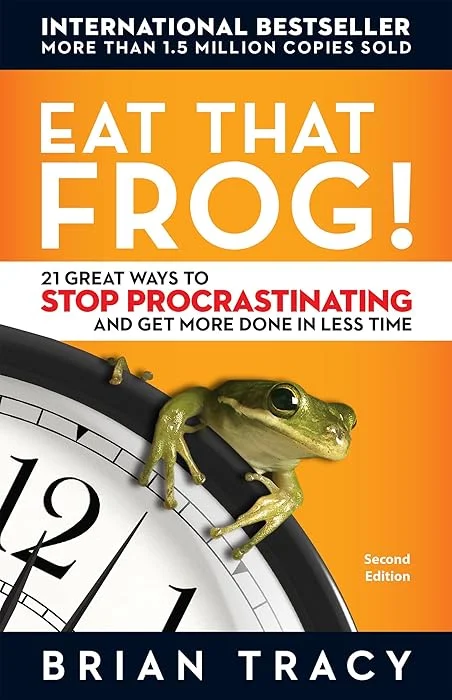
Brian Tracy opens Eat That Frog! with a Mark Twain line. If the first thing you do every morning is eat a live frog, you can go through the rest of the day knowing that the worst is behind you. The frog is a metaphor for the one task on your list that is most important, most consequential, and most likely to be put off. Tracy’s argument across 21 short chapters is that the entire question of productivity reduces to a single habit. Identify your frog. Eat it first. Do not look at it for very long before you start. The chapters are tools that help you find the frog and chew it before lunch.
The book is useful for three kinds of reader. The ESSLCE student who keeps revising the easy subjects in the morning and saving math or physics for an exhausted evening that never comes. The small business owner in Addis or Mekele who postpones the inventory count, the tax filing, or the difficult phone call for weeks while staying busy with smaller things. And the office worker, anywhere, who feels productive at the end of the day but cannot point to one important thing that actually moved forward. Tracy wrote the book for working professionals, but the habits transfer.
What separates Tracy from most productivity writers is that he does not promise a system. The book is a collection of single ideas that each have one job. Plan on paper. Apply the 80/20 rule. Use the ABCDE method. Identify your key constraints. Single-handle the task. Each rule earns its place by being immediately usable. Read the book once to absorb the frog metaphor. Come back to a single chapter on any morning when you have lost the day before noon.
Take-aways
- One task matters more than the rest. On any list of ten tasks, one or two will produce more value than the other eight combined. The frog is whichever one you keep avoiding.
- Clarity is the productivity multiplier. Most people are working on the wrong thing because they never sat down and decided what the right thing was. Write it down before you begin.
- Plan on paper before you move. Ten minutes of planning saves up to two hours of wasted effort. The 10/90 rule says the first ten percent of time spent planning saves ninety percent of the time getting the job done.
- Apply the 80/20 rule ruthlessly. Twenty percent of your activities produce eighty percent of your results. The frog lives inside that twenty percent.
- Creative procrastination is a skill. You cannot do everything, so you must deliberately put off the low-value tasks so the high-value ones get done.
- The ABCDE method ranks every task. A tasks have serious consequences. B tasks have mild consequences. C tasks have none. D tasks should be delegated. E tasks should be eliminated. Never do a B before an A.
- Single-handle the task to completion. Starting and stopping one task five times can take up to five times longer than starting it once and finishing it.
- Eat the frog first thing in the morning. Your willpower is highest, your mind is freshest, and the rest of the day flows from that one decision.
Summary
Tracy’s twenty-one rules are short, repetitive on purpose, and built around one habit. Read together they fan out from four mental moves: clarify what matters, plan before you act, prioritize ruthlessly, and concentrate on one thing at a time. The discipline layer (motivation, urgency, technology, environment) supports the four moves. The book’s strength is that any single chapter, applied for a week, will change a working life.
Clarity comes first, always
Tracy’s first rule, Set the Table, asks for one decision before anything else. What do you want? Most working adults cannot answer the question crisply, and as a result they spend their days on low-value activity that feels urgent. Tracy’s seven-step clarity protocol is short. Decide exactly what you want. Write it down. Set a deadline. Make a list of every task required. Organize the list into a plan. Take action on the plan immediately. Do something every single day that moves you toward the major goal. The protocol works because writing converts a wish into a tangible object the mind can touch.
Clarity also requires Considering the Consequences. The most important tasks are the ones whose results will reach years into your future. Tracy’s rule is that long-term thinking improves short-term decision-making. A student who keeps an Addis Ababa University acceptance letter in mind will study chemistry differently from one who is just trying to pass the next quiz. Tracy then narrows further with two complementary rules. Focus on Key Result Areas says that every job has five to seven measurable outputs, and your weakest output sets the ceiling on your overall performance. Apply the Law of Three says that within those output areas, three tasks usually account for ninety percent of the contribution. Find the three. Work on the three. Let the rest wait.
Plan on paper, prepare thoroughly
The second mental move is to do the planning before you do the work. Plan Every Day in Advance is the rule. Spend ten to twelve minutes the night before, or the first ten minutes of each morning, writing tomorrow’s list. The act of writing forces the mind to think on paper, and a written list (a track to run on, as Tracy puts it) raises productivity by twenty-five percent from the first day. Tracy stacks lists at multiple time horizons. A master list of everything you might one day do. A monthly list at the start of each month. A weekly list each Sunday. A daily list each evening. The daily list pulls from the weekly, which pulls from the monthly, which pulls from the master. Items migrate from one to the next, and items that never migrate get crossed off because they were never important.
Prepare Thoroughly Before You Begin extends the planning move into the moment work starts. Tracy compares the disciplined worker to a pilot running a pre-flight checklist. Assemble every paper, file, number, and tool you will need before sitting down, then sit down and begin. The friction of stopping to look for one missing document is what turns a one-hour task into a three-hour task. Upgrade Your Key Skills takes the same logic to the year-long horizon. Your weakest critical skill determines how fast you can finish your most important tasks. Tracy’s prescription is simple. Read for one hour every morning in your field. Take every course and seminar available. Listen to audio programs in transit. Identify Your Key Constraints is the deepest version of the move. There is always one bottleneck. One factor whose pace sets the pace of everything else. Find it. Fix it. The next bottleneck is hidden behind the current one.
The 80/20 choice: what is your frog?
The third mental move is the one most working adults skip. Apply the 80/20 Rule to Everything says that of any ten things on your list, two will produce more value than the other eight combined. The rule is named for Vilfredo Pareto, who noticed in 1895 that twenty percent of the people in Italy controlled eighty percent of the wealth, and the same skew has since been documented in customers, products, salespeople, sales, and almost every other distribution Tracy has measured across forty years of consulting. The rule is uncomfortable because it means that most of what feels busy is genuinely worth less than what feels difficult. Tracy’s instruction is to resist the temptation to clear up small things first. Small things multiply. Big things, deferred, become catastrophes.
Practice Creative Procrastination is the rule’s necessary companion. Since you cannot do everything, you must consciously decide what not to do. Warren Buffett, asked for his secret, replied: “Simple. I just say No to everything that is not absolutely vital to me at the moment.” Tracy adds the technique of zero-based thinking. Ask of each activity, “If I were not doing this already, knowing what I now know, would I start doing it again today?” If the answer is no, the activity is a candidate for abandonment. Use the ABCDE Method Continually turns prioritization into a daily ritual. Before starting work, go down your list and write a letter next to each task. A is a must-do with serious consequences. B is a should-do with mild consequences. C is a nice-to-do with no consequences. D is a delegate. E is an eliminate. The rule is that you never do a B before an A is finished, and never a C before a B. Most working days collapse because someone wandered into a C task at nine in the morning and looked up at noon.
Eat it first, one bite at a time
The fourth mental move is the actual eating. Tracy stacks three rules here. Take It One Oil Barrel at a Time is borrowed from an Arab proverb. By the yard it’s hard, but inch by inch anything’s a cinch. The largest goal collapses if you can name the next single step. Cross a desert by driving from one oil barrel to the next. Write a book by writing the next paragraph. Slice and Dice the Task applies the salami-slice and Swiss-cheese methods. Carve the work into pieces small enough that starting feels trivial. Punch holes in the work by completing five-minute chunks until the whole thing is gone. Single Handle Every Task is the closing instruction of the entire book. Pick the most important task. Start it. Stay with it until it is done. Tracy’s research finding is striking: starting and stopping one task five times can take up to five times longer than starting it once and seeing it through.
The deeper claim under these three rules is that focus has compounding value. The first ten minutes on a task are slow because the mind needs to load context. Stop after fifteen minutes and you lose the context. Stop after ninety and you have done the work of a full afternoon. Tracy connects this to the concept of flow state, which arrives only after about thirty minutes of unbroken concentration. Most people never enter flow because they check their phone every twenty.
Discipline of time, mind, and tools
The final layer is what Tracy calls the supporting discipline. Put the Pressure on Yourself says that the top ten percent of people in every field have learned to be their own boss. They set personal deadlines tighter than the official ones. They imagine themselves observed and judged. Motivate Yourself into Action is about self-talk. Become your own cheerleader. Tracy’s rule is that ninety-five percent of what you feel is determined by how you talk to yourself in the silence of your own head. Replace “I have to” with “I get to.” Replace “This is hard” with “This is a good problem.”
Technology Is a Terrible Master and its companion Technology Is a Wonderful Servant address the phone in your pocket. The phone is a tool. Set it down for two hours at a time. Do not let it sit on the table during the work block. Focus Your Attention extends the principle. The constant interruption from messages and notifications fragments the day into useless ten-minute slices. Create Large Chunks of Time is the antidote. Block ninety-minute work windows in your calendar. Defend them like meetings with the most important client you have. Develop a Sense of Urgency is the closing accelerator. Get into the habit of moving fast on important tasks. Develop a reputation, with yourself first and others second, as the person who acts.
The book closes by returning to its opening image. Whatever your frog is, resolve to gulp it down first thing. Tomorrow morning, before checking your phone, before opening your email, identify the one task that, if completed in excellent fashion, would have the greatest positive consequence on your day. Start it. Stay with it. Finish it. Then move to the next one.
About the Author
Brian Tracy was born in 1944 in Charlottetown, Canada, to a working-class family and dropped out of high school. After several years of manual labor and door-to-door sales, he discovered that the people who outperformed him were not smarter, they were doing things differently. He set out to learn what they were doing. Over the following decades Tracy built and ran several companies, earned a business degree, and became one of the most-booked corporate speakers in North America. He has delivered more than five thousand talks to more than five million people across eighty-five countries. He is the author of over seventy books on personal effectiveness, sales, leadership, and time management, several of which (including Eat That Frog!) have been translated into more than forty languages. He lives with his family in Solana Beach, California.