Recommendation
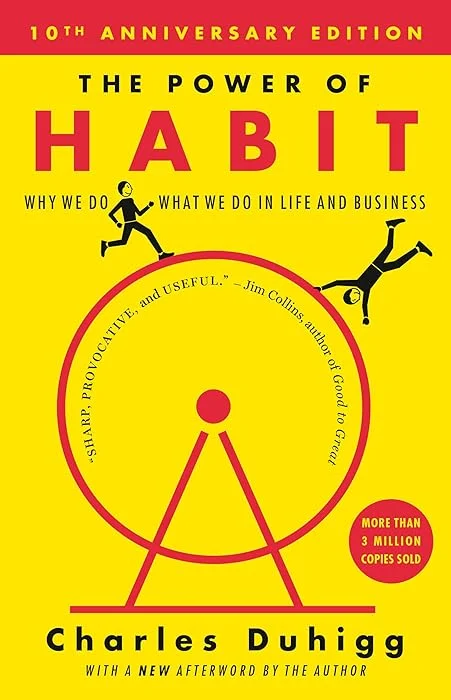
Charles Duhigg wrote The Power of Habit after years as a New York Times investigative reporter, and the book carries the curiosity of a journalist who has decided to find out why we do what we do. His central question is direct. Why does a smoker who has tried to quit twenty times finally quit on the twenty-first? Why does one company transform itself in a decade while a competitor with the same advantages collapses? Why do entire societies sometimes shift their behavior almost overnight after decades of inertia? Duhigg’s answer is that all three sit on the same machinery. A habit is a three-step neurological loop: a cue, a routine, and a reward. Understand the loop and you can rebuild it. Misunderstand it and willpower alone will not save you.
The book is useful for three kinds of reader. Anyone who keeps setting personal goals and slipping back to the old pattern after three weeks. Any manager or entrepreneur trying to change how a team or company operates, especially in an Ethiopian context where institutional routines often inherit decades of accumulated practice. And anyone curious about how social movements actually take hold, which is to say anyone watching the country’s politics and wondering why some calls to action mobilize and others die. Teachers will find the chapter on willpower as a learnable skill useful for ESSLCE prep. Parents will find the keystone-habit chapter useful for raising disciplined children.
What separates Duhigg’s book from most popular psychology is that he stays close to the science and uses real cases. The MIT rat experiments, the NIH brain scans of recovered addicts, the Alcoa safety transformation, the Target pregnancy-prediction scandal, the Montgomery bus boycott. Each chapter is built around one or two long-form reporting pieces and resolved by a clear neurological or sociological mechanism. Read it once for the model. Come back when you have stopped doing whatever you said you would do.
Take-aways
- Habits are a three-part loop. Cue, routine, reward. The brain converts repeated behavior into the loop and then stops paying attention to the routine. Understanding the loop is the prerequisite for changing it.
- Forty percent of daily actions are habits, not decisions. A Duke University study put a number on what William James suggested in 1892. Most of what feels like choice is automatic.
- You cannot eliminate a habit, only replace its routine. The cue and the reward stay. Swap the routine for one that delivers the same reward. This is the Golden Rule of habit change.
- Cravings make habits stick. A habit is only powerful once the brain starts to anticipate the reward before the routine begins. New habits stall until the craving forms.
- Keystone habits unlock others. One small habit, chosen carefully, can cascade across a whole life or organization. Exercise, family dinners, making the bed, workplace safety. Pick the right one and the others follow.
- Willpower is a learnable habit, not a fixed trait. Roy Baumeister’s research shows willpower behaves like a muscle that fatigues with use, but it also strengthens with training and can be made automatic.
- Organizations run on habits the same way people do. Most companies are not operating on strategy at any given moment. They are running thousands of institutional routines learned over years.
- Movements happen when weak ties, strong ties, and a new identity align. Rosa Parks succeeded where others had failed because she sat at the intersection of all three.
Summary
Duhigg builds the book in three concentric circles. Individuals, then organizations, then societies. Each layer uses the same machinery, just at a different scale.
The habit loop: how habits work in the brain
The neurological core of the book is a chapter on Eugene Pauly, an elderly man who lost his short-term memory to viral encephalitis. Eugene could not remember a researcher who had visited him five minutes earlier, but he could walk to the kitchen, make breakfast, and return without getting lost. He could not draw a map of his own house, yet his feet always found the right rooms. Researchers at MIT studying his case discovered that habits live in the basal ganglia, an ancient knot of brain tissue deep beneath the cortex, and that this region can run a learned routine even after the conscious mind has lost the ability to remember it.
The mechanism is the same in every brain. A cue triggers a routine, and the routine delivers a reward. The brain notices, the loop tightens, and over enough repetitions the conscious mind stops paying attention. The cue and the reward stay vivid. The routine in the middle becomes automatic. This is why you can drive a familiar route home while thinking about something else, why a smoker can finish a cigarette without remembering having lit it, and why a runner reaches the end of a workout without remembering the middle.
The mechanism is also why habits feel hard to break. The cue and the reward are still there. The brain is still running the loop. Removing the habit by trying to suppress the routine is fighting against the loop’s structure. Duhigg argues that the only durable change is to honor the loop and rebuild it.
The craving brain: how to create new habits
Duhigg’s most counter-intuitive idea is that habits do not begin with the routine. They begin with a craving. A craving is the brain’s anticipation of the reward, and it is what makes a habit feel inevitable.
He illustrates this with two American business histories. Pepsodent toothpaste did not take off until its inventor added a tingling sensation from citric acid and mint oil. The tingle was not what cleaned the teeth. It was the cue that told the brain a reward had arrived, and within a decade the entire United States had developed a daily brushing habit it had never had before. Febreze, the spray that removes household odors, sat on shelves unsold for years because Procter and Gamble had marketed it as a problem-solver for stinks customers had already grown nose-blind to. Sales only took off when the company reformulated the marketing and added a clean perfume scent at the end of cleaning, so the spray became the reward for finishing a room rather than the solution to a problem the user had stopped noticing.
The lesson for personal habit change is direct. New habits stall, sometimes for weeks, because the craving has not formed. The routine still feels forced. Once the brain starts anticipating the reward before the routine begins, the habit shifts from effort to automatic. The trick is to design the loop so the reward is reliable and visible enough that the craving has something to fix on.
The golden rule: how to change a habit
If habits cannot be eliminated, only replaced, what does replacement look like? Duhigg calls his answer the Golden Rule of habit change. Keep the cue. Keep the reward. Swap the routine in between.
The chapter’s central case is Alcoholics Anonymous, which Duhigg argues has worked for millions of people not because of the spiritual program but because the program is a habit-replacement protocol disguised as a fellowship. The cue for a drinker is the loneliness of a Tuesday night, the social pressure of a bar, the boredom after work. The reward is escape and connection. AA does not try to remove the cue or the reward. It substitutes the routine. Instead of drinking, the alcoholic calls a sponsor or attends a meeting. The cue and the reward stay. The routine in the middle becomes social rather than chemical.
The same chapter examines coach Tony Dungy, who turned the worst team in the National Football League (the Tampa Bay Buccaneers) into a championship organization (the Indianapolis Colts) by drilling his players’ automatic on-field reactions to subtle cues. Dungy refused to give them complex playbooks. He gave them habit loops. See the wide receiver shift his hips. Run the route. Reward, completed play. Over thousands of repetitions, what looked like genius reaction time was simply a habit loop running faster than the conscious mind.
Keystone habits: why some habits change everything
The most quoted chapter of the book is the story of Paul O’Neill, who became CEO of Alcoa in 1987 and announced to an audience of skeptical Wall Street investors that he intended to make Alcoa the safest company in America. Not the most profitable. Not the most innovative. The safest. Several investors walked out of the room in disgust. Within a year Alcoa’s profits hit a record high.
O’Neill had identified what Duhigg calls a keystone habit. Workplace safety was not just one issue among many. It was the issue that, when prioritized, would force every other operation to improve. To reduce injuries, plant managers had to redesign production lines. To redesign production lines, they had to invite worker feedback. To invite worker feedback, they had to build communication channels with the executive suite. To build those channels, they had to break a culture of executive distance that had hidden inefficiencies for decades. Safety became the lever that moved everything else.
Keystone habits at the individual level work the same way. People who start exercising regularly often, without meaning to, also start eating better, drinking less, paying credit-card bills on time, and arguing less with their spouses. The exercise is not causing these other changes. The exercise is rebuilding the underlying sense that I am someone who keeps my commitments to myself, and the other improvements follow that identity shift.
Willpower is a learnable habit
The chapter on Starbucks reframes a concept that most self-help books treat as a fixed trait. Willpower, in Roy Baumeister’s research and Duhigg’s reporting, behaves like a muscle. It tires with use. A judge who has ruled on twenty cases by lunchtime makes worse decisions in the afternoon than a judge who has ruled on five. A dieter who resists a doughnut in the morning is more likely to skip the gym after work. The supply of conscious self-control is finite over a day.
But willpower is also trainable. Starbucks built its training program around this insight. Every barista learns the LATTE method (Listen, Acknowledge, Take action, Thank, Explain) for handling an upset customer. The method is rehearsed until it becomes automatic, so that in the moment of confrontation, when a frustrated customer is yelling about a wrong order, the barista does not have to spend willpower deciding how to respond. The habit handles it. Willpower is preserved for the things that actually require conscious thought.
The implication is that the people who appear most disciplined are usually not exerting more willpower. They are using less of it, because they have automated the choices that drain everyone else.
Organizational and societal habits
Parts two and three of the book scale the same mechanism upward. Most companies, Duhigg argues, do not actually run on strategy. They run on thousands of inherited institutional routines that govern how decisions are made, how information moves between departments, who gets credit for success, who gets blamed for failure. A crisis can be useful precisely because it briefly suspends those routines and creates an opening to install new ones. The case of Rhode Island Hospital, which transformed its surgical safety record after a near-fatal medical error became a public scandal, shows how leaders who recognize the opening during a crisis can rewrite an institution’s habits in months instead of decades.
The book then moves to the habits of societies. Duhigg’s account of the Montgomery bus boycott, which sparked the modern American civil rights movement, focuses on the social network that made Rosa Parks’s act of defiance into a city-wide movement. Parks was not the first Black woman to refuse a bus seat. But she sat at a unique intersection of strong ties (close friends in the NAACP), weak ties (broad casual acquaintances across the city), and the new identity offered by an emerging movement. When she was arrested, her strong ties mobilized immediately, her weak ties carried the news outward fast, and the identity provided a frame that made participation feel like who I am rather than what I am risking. The same three-layer pattern, Duhigg shows, drove the explosive growth of Saddleback Church under Rick Warren in California, and has driven most social movements that worked.
The neurology of free will
The book closes with its hardest chapter. If habits are this powerful, in what sense are we responsible for them? Duhigg sets two real cases side by side. Brian Thomas, a British man with no history of violence, killed his wife while sleepwalking during a nightmare. The jury acquitted him because his action was not, in any legal or moral sense, a choice. Angie Bachmann, an American compulsive gambler, lost her family’s life savings to casinos that had used loyalty-program data to identify her as a high-value addict and to deepen her habit deliberately. The court ruled her responsible for her debts. Duhigg argues that the difference is awareness. Once you know a habit exists and you understand its loop, you become responsible for choosing whether to keep running it.
The book’s last line is the same as its first argument. Habits cannot be eliminated. They can only be understood and replaced. Once you understand the loop, the work is no longer mysterious. The work is choosing which votes to cast, one cue and one reward at a time, until the person you used to be is overwritten by the person you decided to become.
About the Author
Charles Duhigg is an American journalist and author who spent most of his career at The New York Times, where he was part of the reporting team that won the 2013 Pulitzer Prize for Explanatory Reporting for the iEconomy series on Apple and the global economy. Born in 1974 and educated at Yale and Harvard Business School, he writes long-form investigative pieces that connect business behavior, technology, and the underlying psychology of decision-making. The Power of Habit was published in 2012, spent more than three years on the Times bestseller list, and has been translated into more than forty languages. His follow-up book Smarter Faster Better (2016) extends the same investigative method to productivity. He lives in Brooklyn with his family and continues to write for The New Yorker.