Recommendation
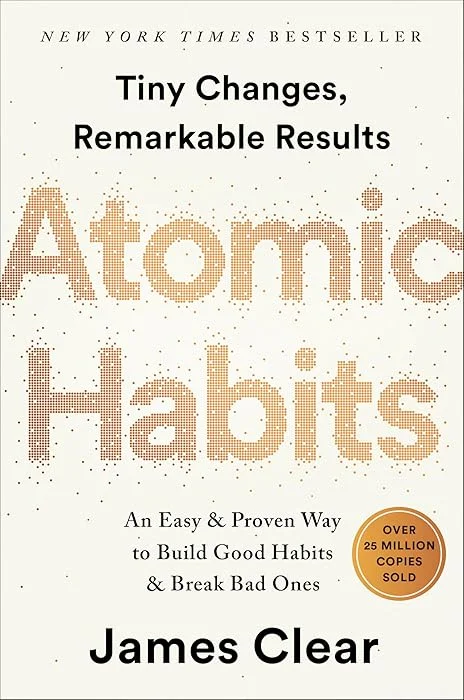
James Clear has one main argument in Atomic Habits, and he repeats it without much elaboration. The shape of a person’s life is set by what they do most days, not by what they do on rare ones. The book rests on a piece of arithmetic. Get one percent better every day for a year and you end up 37 times better than you started. Get one percent worse and you end up at nothing. Most readers nod at this and move on. Clear’s whole project is to keep you from moving on, because almost everyone who fails to change their life fails by underestimating that math.
The book is useful for three kinds of readers. Anyone who keeps setting goals they do not reach. Anyone raising children and trying to shape what those children do every day. Anyone trying to build a craft like writing, programming, music, or business, where progress is invisible for months at a time. Teachers will find it useful. So will students preparing for the ESSLCE.
What makes Atomic Habits better than most books in its genre is that Clear refuses to pretend change is dramatic. There is no secret to discover, no breakthrough day, no five-day reset. There is a method. Read it once for the method. Come back to it later when you have stopped doing whatever you said you would do.
Take-aways
- Habits compound. One percent better every day yields a person 37 times better in a year. One percent worse yields almost nothing.
- Goals are weaker than systems. Everyone has the same goals. People with daily systems are the ones who reach them.
- Identity matters more than tasks. It is easier to keep a habit you tie to who you are than one you tie to what you want.
- Habits run through four stages. Cue, craving, response, reward. To build a habit, work with each. To break one, work against each.
- Environment beats willpower. People who seem disciplined usually live in spaces that make the right thing easy.
- Start with two minutes. A new habit that takes ten seconds gets done. A new habit that takes an hour gets skipped.
- Progress feels invisible for a long time. This is where most people quit. The math has not failed them. They have run out of patience.
- Every action is a vote. You do not have to do the habit perfectly. You have to do it more often than you do not.
Summary
Why small changes compound, and why we miss it
Clear opens with the story of British cycling. In 2003 they had not won an Olympic gold medal in nearly a century. A new director, Dave Brailsford, was hired and told the team they would chase one percent improvements anywhere they could find them. Better pillows on the road so riders slept properly. Better handwashing so they got sick less. Better paint on the truck floors so dust showed up and got cleaned. Within five years they were dominating the Olympics. Within ten they had won seven Tours de France.
The story is striking but the lesson is plain. Habits compound the way money in an iqub compounds, which is to say slowly, in a way that is hard to notice from week to week, and then much faster than seems fair. A behavior done once does not matter. The same behavior done ten thousand times decides who you are.
The hard part, Clear says, is that the early stages of the compounding curve do not feel like a curve. They feel like a flat line. You exercise for two months and the mirror has not changed. You study for two months and the test grade has not moved. You write for two months and no one is reading you. He calls this the Plateau of Latent Potential. The work is being done. The results are just not visible yet. Almost everyone who fails to build a habit gives up here. They were not lacking talent. They had run out of patience for arithmetic.
Goals are not the answer; systems are
Clear’s strangest argument is the one about goals. He thinks they are mostly useless and sometimes worse than useless. His reasoning is direct. Look at any field. The Olympic athlete who lost in the heats and the Olympic athlete who won the gold both wanted the gold. They had the same goal. The student who failed the exam and the student who topped it both wanted to top it. The goal is not what made the difference.
What made the difference is the system. The runner who won the marathon was already running before she signed up for one. The student who topped the national exam already had a study rhythm in place by Grade 9. Goals point you in a direction. Systems are what move you in that direction.
A line from the book worth keeping: you do not rise to the level of your goals, you fall to the level of your systems. On a tired day, ambition does not save anyone. The habit you already built is what does.
Identity is the deepest lever
If systems are how change happens, identity is why it lasts. Clear says behavior change can be attempted at three layers, and most people try the wrong one.
- Outcomes: what you get. Lose ten kilos. Earn a degree. Build a company.
- Processes: what you do. The daily training, the studying, the meetings.
- Identity: who you believe you are. An athlete. A scholar. A businessperson.
Most people work from the outside in. Set the goal first, build the habits second, hope the identity comes later. Clear thinks this is inverted. Decide the identity, and the habits that fit follow naturally. Someone who wants to write a book sets a word count and then misses it. Someone who has decided they are a writer simply writes. The book is what eventually shows up.
The example Clear uses is small but useful. When offered a cigarette, the smoker who refuses by saying “no thanks, I am trying to quit” is still a smoker. The smoker who refuses by saying “no thanks, I am not a smoker” has already shifted. Every action you take, Clear writes, is a vote for the person you want to become.
The Four Laws of Behavior Change
The practical core of the book is a four-part framework. Every habit, Clear says, runs through four stages: cue, craving, response, reward. To build a habit, make each stage work for you. To break one, make each work against you.
1. Make it obvious (cue). The brain pays attention to what is visible. A book left on a pillow gets read. The same book on a shelf gets forgotten. The single most useful tool here is the implementation intention, which means deciding in advance when and where you will do the thing. The form is simple. “I will [behavior] at [time] in [place].” The other tool is habit stacking, attaching a new habit to one you already do. “After my morning coffee, I will read one page.”
2. Make it attractive (craving). People are not motivated by what is good for them. They are motivated by what they want. Clear’s tool here is temptation bundling: pair a habit you should do with one you want to do. Listen to your favorite podcast only while exercising. Eat your favorite snack only after the study session. Surrounding yourself with people for whom the habit is normal works even better. There is no faster way to make a behavior attractive than to belong to a group where it is expected.
3. Make it easy (response). Most people overestimate motivation and underestimate friction. A habit that takes ten seconds to start gets done. A habit that needs you to drive across town gets skipped. Clear’s two-minute rule is more powerful than it sounds. Take any new habit and scale it down to a version that takes under two minutes. Read one page. Write one sentence. Do one push-up. The point is not the work. The point is the ritual. Once the ritual exists, it can grow on its own.
4. Make it satisfying (reward). The brain prioritizes immediate rewards over delayed ones. Most good habits, like exercise or saving money, have their payoff months away while their cost is felt right now. Clear’s answer is to engineer small immediate satisfactions. A tick mark on a calendar. Money moved into a savings jar after each healthy meal. A tracker you can see filling up. The reward itself is not the point. The point is the small flicker of pride that says I did the thing I said I would.
To break a habit, run each law backwards. Make the cue invisible. Make the craving unattractive. Make the response difficult. Make the reward unsatisfying. Take the bowl of sweets off the counter. Read what cigarettes actually do to your body until the idea of smoking becomes unappealing. Move the phone to another room. Tell a friend what you said you would do, so failing is public.
Environment is the invisible hand
One of the quieter ideas in the book is Clear’s claim that self-control is a short-term strategy, not a long-term one. The people we think of as disciplined are not, on the whole, exerting more willpower than the rest of us. They are living in environments where the wrong behavior is hard and the right behavior is easy. A writer at a desk in a quiet room writes more than the same writer at a desk in a loud kitchen. A student who keeps their phone in another room studies more than one with the phone next to them. The environment does the work of discipline silently.
This is a useful reframing because it changes the moral conversation. When someone says they “lack willpower,” they may simply be living in a poorly designed space. Redesign the space and the behavior often follows on its own.
The Goldilocks rule, plateaus, and the long game
A final idea Clear keeps returning to is what he calls the Goldilocks rule. People stay engaged when working on tasks just at the edge of their current ability. Too easy and they get bored. Too hard and they give up. Habits that flatten into routine begin to die from boredom. The remedy is small, deliberate increases in difficulty. Add a kilometer to the run once a month. Add ten minutes to the writing session once a week.
The larger remedy, though, is patience. People overestimate what they can do in a week. They drastically underestimate what they can do in five years. The plateau Clear described in the opening will show up in every domain worth pursuing. The work on those days is the same as on any other day. Keep voting.
The shape of a life built on habits
The closing chapters zoom out. What does a life look like, Clear asks, when its rhythms have been quietly engineered for years? Ordinary. The person reads every day. Walks every morning. Writes every evening. Nothing in any single hour looks like much. But ordinary actions repeated for thousands of days produce results that look extraordinary to anyone who only sees the final state.
The book ends without making any grand promise. There is no place at which the habits become unnecessary. There is only the next small action, then the one after that, then the slow accumulation of a person you decided to become.
About the Author
James Clear is an American writer who works on habits and decision-making. A serious baseball injury in high school almost ended his athletic career, and the question of how ordinary people make extraordinary improvements over time became his preoccupation. He spent years writing essays at jamesclear.com before publishing Atomic Habits in 2018. The book has since sold over 20 million copies and been translated into more than 50 languages. It is widely used in education, sports, business, and public health. Clear lives in Columbus, Ohio, and writes a weekly newsletter read by millions of people.