Recommendation
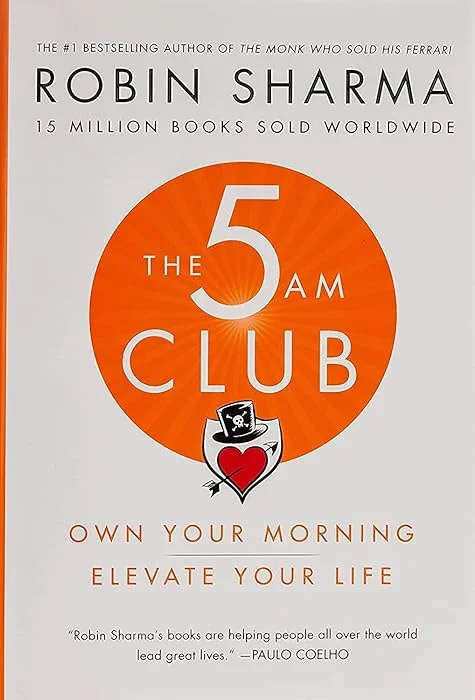
Robin Sharma’s The 5 AM Club is structured as a parable, not as a typical self-help book. An entrepreneur in crisis, an unrecognized artist, and a flamboyant billionaire meet at a personal development seminar and travel together to Mauritius, Rome, India, and Brazil, where the billionaire teaches them how rising at 5 AM and running a specific morning routine transformed his career and his inner life. Around this story Sharma layers a series of frameworks for personal performance, each given a memorable name and a diagram. Strip the parable away, and the book reduces to a clear instruction. Wake up at five. Spend twenty minutes moving, twenty reflecting, twenty growing. Do this every day for at least sixty-six days, until it becomes automatic.
The book is for three kinds of reader. Anyone who suspects their best work would emerge if their mornings looked different. Anyone responsible for a family or a business who needs focused hours and cannot find them after lunch. And anyone in Ethiopia preparing for the ESSLCE, running a small business, or building a craft, who would benefit from one undisturbed hour to study, plan, and pray before the day’s noise begins.
What separates Sharma’s book from the larger field of morning-routine literature is what he asks the first hour to do. He uses it for the cultivation of four interior empires: Mindset, Heartset, Healthset, and Soulset. The outer empires of money, influence, and impact, in his framing, sit on the foundation of the inner ones. Read it once for the framework. The parable gets thick in places; skim it when it does. Come back to the diagrams when you are ready to install the routine.
Take-aways
- Win the morning, win the day. The first hour you control sets the tone for the next sixteen. Most people surrender it to phones, email, and other people’s priorities.
- The Victory Hour, 5 to 6 AM, is non-negotiable for legendary performance. Rise early for the quiet, not for the extra hours.
- The 20/20/20 Formula. Twenty minutes Move. Twenty minutes Reflect. Twenty minutes Grow. That sequence builds energy, calm, and capability before the world starts asking for them.
- Four interior empires, not one. Mindset, Heartset, Healthset, Soulset. Most personal development chases only the first. Real performance asks for all four.
- The 4 Focuses of History-Makers. Capitalization IQ, Freedom from Distraction, Personal Mastery Practice, Day Stacking. The four things that separate the legendary from the merely talented.
- Habits take 66 days, not 21. The 21-day myth is wrong. Research-backed habit installation moves through Destruction, Installation, and Integration, each lasting about three weeks.
- Sleep is part of the system, not a break from it. Five cycles of 90 minutes each, with no screens after sundown, is what makes 5 AM survivable across years.
- Voluntary discomfort builds the willpower for everything else. Sharma’s Strengthening Scenarios: cold showers, fasting, sleeping on the floor, deliberate hardship.
Summary
The book opens with the suicidal thoughts of an entrepreneur whose company is being stolen out from under her by hostile investors. Considering her options, she finds a ticket on her dresser to a personal optimization seminar. The seminar is hosted by The Spellbinder, an aging keynote speaker who has built a global reputation teaching people how to “become legendary.” During his talk, The Spellbinder collapses, apparently from a fatal cardiac event. In the aftermath, the entrepreneur meets a confused, brilliant, neurotic painter and a homeless-looking man with a billion-dollar watch who turns out to be Stone Riley, an industrialist and The Spellbinder’s longtime student. Stone offers to mentor them. The rest of the book follows their travels across four continents as Stone reveals the framework that saved his life.
Why 5 AM, and the Victory Hour
Sharma’s core claim is that the time between 5 and 6 AM is the most valuable hour of any productive life. There are no more minutes in it than in any other hour. The difference is that no one else is awake. The phone is silent. The world has not begun to make demands. A protected hour at the start of the day allows what Sharma calls “transient hypofrontality,” a state where the prefrontal cortex quiets and creative output rises. Stone tells the artist and the entrepreneur that for him, this single hour is responsible for the businesses he built, the books he absorbed, and the inner peace he reclaimed after the death of his wife.
The Victory Hour is also a willpower argument. Roy Baumeister’s research on ego depletion suggests that self-control is a finite resource that drains as the day goes on. Wake up, and your willpower battery is full. Spend that battery on email, social feeds, or other people’s emergencies, and by 8 AM the most valuable hours of cognitive bandwidth are already gone. Spend them instead on a deliberate routine, and the rest of the day runs downhill.
The 20/20/20 Formula
The structure of the Victory Hour breaks into three twenty-minute pockets, each addressing a different dimension of the self.
Move (5:00 to 5:20 AM). Twenty minutes of intense exercise, hard enough to break a sweat. The science Sharma cites: hard exercise releases BDNF (brain-derived neurotrophic factor), elongates telomeres, and produces a sustained dopamine release that fuels the rest of the morning. The exercise itself does not need to be elaborate. Burpees, push-ups, jumping jacks, a run, a stationary bike. What stays constant is the intensity.
Reflect (5:20 to 5:40 AM). Twenty minutes of quiet practice. Stone splits this pocket between journaling, which Sharma calls Daily Diaries, and meditation. The journaling is concrete, not abstract. Download the day’s commitments. Record gratitude. Process frustrations and resentments so they do not contaminate the day. The meditation is a stillness practice, twenty minutes of attention training, which lowers cortisol and builds the calm Sharma argues separates elite performers from anxious ones.
Grow (5:40 to 6:00 AM). Twenty minutes of education. Reading, audiobooks, podcasts on personal mastery or business skill, video lectures on a craft. Sharma’s principle here is the “2x3x Mindset”: to double your income and impact, triple your investment in two areas, personal mastery and professional capability. The Grow pocket is where that investment compounds.
The three pockets together take one hour. The exact times matter less than the sequence. Move first to wake the body. Reflect to settle the heart. Grow to feed the mind. Doing the pockets in reverse order produces a fraction of the result.
The Four Interior Empires
Sharma argues that most self-improvement literature focuses on one dimension of the self at the expense of the others. His framework adds three more.
Mindset is the psychological layer. Beliefs about what is possible, what you deserve, what is true about the world. Sharma’s claim is that beliefs precede behavior, and behavior precedes results. You cannot outperform the story you tell yourself about who you are.
Heartset is the emotional layer. Past hurts, resentments, fears, and unprocessed grief. Stone’s instruction is that these accumulate like sediment if not deliberately released, and that the release happens through writing, conversation, and the kind of reflection the morning Reflect pocket provides. Calm performers, in Stone’s framing, are the highest performers. Anger is a tax on productivity.
Healthset is the physical layer. Sleep, exercise, hydration, nutrition. Without it, the other three collapse.
Soulset is the spiritual layer. Meaning, connection to something larger, the sense that one’s work matters. Sharma is non-denominational about this. He cites Christian, Buddhist, Stoic, and Hindu sources interchangeably. He cares whether a reader has a faith. He does not care which one.
The argument is that all four empires must be tended daily, not seasonally. The morning routine is the only time most people can guarantee an opportunity to do so.
The 4 Focuses of History-Makers
The frameworks keep stacking. Stone walks the entrepreneur and the artist through a second model, this one about what distinguishes people who alter history from people who merely participate in it.
Capitalization IQ. The psychologist James Flynn’s research suggests that what separates legendary performers from average ones is not innate talent but the percentage of that talent actually used. Most people use a fraction of what they were given. The legendary use most of it.
Freedom from Distraction. “An addiction to distraction is the death of your creative production,” is Stone’s brain tattoo for this focus. Smartphones, social media, constant notifications, and the meeting-saturated workday are presented as the principal enemies of the modern mind. Stone’s prescription is extreme: long stretches with no devices, deliberate boredom, deep work in 90-minute blocks.
Personal Mastery Practice. Continuous self-improvement, daily, not as a project but as a way of being. The morning routine is the engine of this focus.
Day Stacking. Small daily wins compound. An amazing day produces an amazing week. An amazing week produces an amazing month. The arithmetic is the same as compound interest. Sharma quotes the principle so often it becomes its own brain tattoo: “Small, daily, seemingly insignificant improvements, when done consistently over time, yield staggering results.”
The Habit Installation Protocol
The most actionable framework in the book is Sharma’s correction of the popular “21 days to a habit” myth. Research from University College London suggests that real habit formation takes about 66 days, and moves through three predictable stages.
Stage 1: Destruction (Days 1-22). The hardest phase. The brain resists. The old pattern of staying in bed is deeply wired, and the new pattern of rising at five must overcome it. Sharma compares this stage to the Space Shuttle: more fuel is burned in the first sixty seconds of liftoff than in the entire orbit around Earth, because escape velocity requires overcoming gravity. Stage 1 works the same way. Almost everyone who fails to install the habit fails here, in the first three weeks, when the discomfort is highest and the visible reward is lowest.
Stage 2: Installation (Days 23-44). The messy middle. The old pattern is breaking down. The new pattern is forming. The brain is rewiring, which is exhausting and emotionally turbulent. Sharma uses the ancient phrase “the dark night of the soul” to describe this phase. The work continues, but it feels worse before it feels better.
Stage 3: Integration (Days 45-66). The new pattern becomes automatic. The willpower that was required to wake at five is freed up for the next habit. Around day 66, what Sharma calls the Automaticity Point, the routine no longer requires conscious effort.
The framework also includes the Lifetime Habit Arc: Trigger (an alarm clock at 5 AM), Ritual (the 20/20/20 routine), Reward (something small and pleasurable that follows), Repetition (the 66 days). The four-part loop encodes the behavior.
Sleep, the Pre-Sleep Ritual, and the Twin Cycles of Elite Performance
The 5 AM Club is not workable without serious attention to sleep. Sharma is firm that staying up until midnight and rising at five just produces sleep deprivation.
His prescription is five full 90-minute sleep cycles, roughly seven and a half hours per night. To get them, bedtime needs to be between 9 and 10 PM, which requires a pre-sleep ritual:
- 7-8 PM. Last meal, all devices turned off, isolation from overstimulation.
- 8-9 PM. Real conversation with loved ones, optional second meditation, reading, an Epsom salt bath.
- 9-10 PM. Cool dark technology-free bedroom, gratitude practice, sleep.
Sharma’s broader framework, the Twin Cycles of Elite Performance, alternates between intense focused output and equally intense restoration. Athletes train and recover. He argues knowledge workers should do the same. Continuous output without restoration burns out the very system that produces the output.
Voluntary discomfort
A recurring theme: real willpower is built by voluntarily entering situations the soft world tells you to avoid. Stone Riley sleeps on the floor once a week, fasts twice a week, takes cold showers daily, and runs in the snow in a t-shirt. He calls these Strengthening Scenarios. Sharma’s argument is that self-control trained against small voluntary hardships becomes available when the larger involuntary ones arrive. The hardships themselves are means, not ends.
This is the section of the book where Sharma is at his most quotable. “World-class begins where your comfort zone ends.” “Continue at all costs. Persistency sits at the threshold of mastery.” “Legendary performers practice being spectacular for so long that they no longer remember how to behave in non-spectacular ways.”
The narrative arc
The story ends in Brazil. The entrepreneur and the artist marry. Stone Riley collapses at the wedding, having been ill throughout the book. The Spellbinder appears at the funeral to deliver one final teaching. Five years later the entrepreneur has reclaimed her company, the artist has become internationally collected, and both still rise at 5 AM. The framework, Sharma argues through plot, scales.
Readers will form their own opinions about the storytelling. The dialogue is theatrical, the descriptions are ornate, and the side characters are exaggerated. None of this affects the value of the frameworks, which can be extracted and used independently of the parable that frames them.
About the Author
Robin Sharma is a Canadian writer, leadership coach, and former litigation lawyer. Born in 1964 in Uganda to Indian parents, he grew up in Canada and trained at Dalhousie Law School before leaving the legal profession to write full time. His breakthrough was The Monk Who Sold His Ferrari (1997), self-published after rejection from major houses, which has since sold many millions of copies. Across more than fifteen books, Sharma has developed a global following in personal development and corporate leadership, with translated editions in over ninety languages. He delivers keynote talks for executive audiences worldwide and runs the Titan Academy, an online training program based on the methodology in this book. He lives in Toronto.