Recommendation
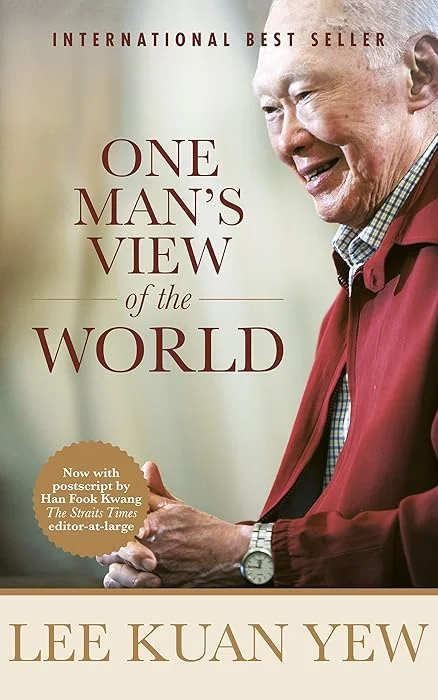
One Man’s View of the World is Lee Kuan Yew’s late-life assessment of where the planet is going. Lee, who served as Singapore’s first Prime Minister from 1959 to 1990 and remained in the Cabinet until 2011, wrote the book in his late eighties from a position few statesmen ever reach: half a century of direct conversation with every major Chinese leader from Mao to Xi, every American president from Lyndon Johnson to Barack Obama, and most of the European and Asian heads of state in between. Henry Kissinger called him the most consequential elder statesman of the late twentieth century. Margaret Thatcher said she read every speech he ever gave and that he was never wrong. The book is Lee using that hard-earned authority to walk a reader through each major power, name what he thinks is happening inside it, and predict where it lands in fifteen or twenty years.
The book is useful for three kinds of reader. Ethiopian policymakers and party officials thinking about how a small country preserves room to manoeuvre among bigger powers. Diaspora professionals trying to understand the global forces shaping where they live and where they came from. Anyone who has watched a Western newspaper describe China’s rise or America’s decline and wished for an account written by someone who had actually been in the room with those countries’ leaders for fifty years.
What separates Lee’s book from most geopolitical writing is its candour. He does not hedge. He does not pretend to be neutral. He believes a strong central state is what China will always want. He believes Japan is sliding into mediocrity. He believes the Arab Spring will not produce democracy. He believes climate change will not be stopped and that the world should prepare for it rather than try to prevent it. The reader will disagree with some of this. Lee wrote to be useful, not to be agreed with. Read the book once for the framework, the second time for the specific country chapters that matter most to you.
Take-aways
- A strong central state is China’s permanent preference. For five thousand years the Chinese have believed that a weak centre produces chaos. The Communist Party will adapt and evolve. It will not be replaced by Western-style democracy.
- America’s strengths are durable. Lee argues that the United States will not lose its top position because of three things: a culture that welcomes immigrants, an innovation system that no rival has copied, and an economy still large enough to absorb mistakes.
- Europe is in decline by its own choice. Aging populations, welfare-state commitments that cannot be paid for, and political union without fiscal union mean Europe will matter less in 2030 than it did in 2000.
- Japan will keep declining unless it changes its immigration policy. Without bringing in foreigners, Japan cannot reverse its demographic shrinkage. Lee thinks it will not change, and so it will keep shrinking.
- The Arab Spring will not produce one-man-one-vote democracy. Tribal structures and the absence of independent civic institutions in most Arab states mean the post-revolutionary settlements will look different from Western expectations.
- Singapore’s three success factors are universal. Safety, equal treatment of every citizen, and the institutional habit of preparing each generation for the next. Lee argues any small country can replicate them with sufficient discipline.
- Small countries cannot change the world. They can move within it. This is Lee’s most often-repeated principle. The job of a small-country leader is to maximise the space available, not to redraw the map.
- Personal endings matter. Lee closes the book with an unusually direct chapter on his own choices about old age, his wife’s death, and how he plans to die. The chapter is short. It is part of his argument that leadership ends with how one leaves, not only how one arrives.
Summary
The book is built around a tour. Each chapter is one country or region, written in Lee’s plain analytical voice, followed by a Q&A section drawn from interviews conducted by editors at The Straits Times. The structure is not academic. Lee is not citing footnotes. He is recalling conversations, naming people he met, and stating his conclusions. What the reader gets is the assessment of someone who spent a lifetime studying the political character of nations from the inside.
China: a strong centre
Lee opens with China because he believes it is the most important country for the next twenty years. His central claim is that to understand China, the reader must understand a 5,000-year cultural preference for a strong centre. Every Chinese, Lee writes, believes that a weak centre produces confusion and chaos. A strong centre produces a peaceful and prosperous China. The mindset predates communism. It will outlast it.
This means Western expectations of Chinese democratisation are wrong, in Lee’s view. The Communist Party will evolve. Leaders will be replaced. Policies will be liberalised. But the system will not become one-man-one-vote. He gives the example of the 2011 Wukan protests, where villagers expelled corrupt local officials and held free elections for their village chief. The party absorbed the protest, sent a deputy provincial secretary, settled the dispute, restored order. The lesson Lee draws: the centre is flexible. The centre is responsive. The centre does not surrender.
China will become the greatest economic power in the world, Lee predicts, and will demand to sit as an equal at the top table with America. He sees the rebalancing as inevitable. He also sees it as manageable. The Chinese, he argues, are not interested in exporting their political system. They are interested in being respected.
America: troubled but still on top
The second chapter is about American resilience. Lee thinks America is troubled. He sees the political polarisation, the dysfunction of Congress, the inability to pass a budget. He sees the income inequality, the public debt, the wars that did not need to be fought. He also sees three things that make America durable.
First, immigration. America still attracts the most ambitious people from every continent. As long as that pipeline runs, the country renews itself. No other major power has built this engine.
Second, innovation. American universities, venture capital, and the broader culture of risk-taking continue to produce the businesses that change the world. China can copy products. China cannot, yet, copy the system that creates them.
Third, what Lee calls “never-say-die dynamism.” Americans believe they can solve their problems. The belief itself is generative. A country that thinks it can recover usually does.
Lee does not predict American decline. He predicts American sharing. America will have to share the top table with China. It will not be displaced from it.
Europe: decline and discord
Lee is harshest on Europe. He sees a continent that has built a welfare state it cannot afford, taken on a common currency without a common fiscal authority, refused to integrate immigrants while needing more of them, and aged into demographic irrelevance.
The euro, Lee argues, was politics solving an economics problem in the wrong direction. Without a unified fiscal policy, the currency union forces the strong economies to subsidise the weak ones indefinitely, or forces the weak ones into austerity they cannot sustain. Neither outcome is stable.
The deeper issue, in Lee’s view, is values. Europeans no longer believe in working as hard as Americans or East Asians do. Productivity reflects this. Birth rates reflect this. The political will to make difficult choices reflects this. A continent that wants to keep its current standard of living must either accept many more immigrants or accept becoming poorer. Lee thinks Europe will choose neither and so the decline will continue.
Japan, Korea, and India
The chapter on Japan, Korea, and India is unusually direct. Lee titles the Japan section “Strolling into mediocrity.” His argument is simple. Japan’s population is shrinking. Its workforce is shrinking. It refuses to admit immigrants in meaningful numbers. Without immigration, no demographic trajectory can be reversed. Japan will become a smaller, older, less dynamic country every decade for the foreseeable future.
Korea, by contrast, Lee admires. Discipline, education, willingness to work, and a successful transformation from poverty to wealth in two generations.
India, Lee describes as still in the grip of caste. He believes caste structures continue to slow the country’s economic mobility despite legal reforms. He sees India as growing but underperforming its potential. He is fond of Indian leaders he has met. He is not optimistic about Indian institutions catching up to Chinese ones.
The North Korea section is short and dismissive. Lee calls the regime “a grand hoax” and predicts its eventual collapse without specifying when.
Southeast Asia
Lee writes about Malaysia, Indonesia, Thailand, Vietnam, and Myanmar in turn. Each gets a few pages of plain assessment.
Malaysia, he argues, has chosen a different path from Singapore by entrenching ethnic preferences for the Malay majority. This has produced political stability and slow growth.
Indonesia, the world’s largest Muslim country, he sees as decentralising in ways that may eventually weaken the centre dangerously.
Thailand has an underclass that is finally stirring politically, a development the established Bangkok elite has not yet accommodated.
Vietnam, Lee writes, is locked in a socialist mindset that the leaders cannot yet break out of. He hopes they will.
Myanmar is the most hopeful chapter. The generals are changing course. Whether the change holds will depend on whether the country builds institutions faster than its ethnic conflicts pull it apart.
Singapore: a nation at a crossroads
The longest chapter is about Singapore. Lee is direct about what he thinks worked and what he worries about.
What worked: the three qualities he lists in the preface. Making Singapore the safest place to live and work in. Treating every citizen equally regardless of race, language, or religion. Ensuring continuing success for every generation of Singaporeans through education, housing, and savings policy that compounds across decades.
What he worries about: complacency. The third generation of Singaporeans, born into wealth, does not understand how fragile the prosperity is. Population growth has slowed below replacement. Without immigration, the country will not have enough workers in twenty years. Without strict meritocracy, the talent pool will narrow. Without continued vigilance about race relations, the multi-ethnic society could fracture.
Lee’s underlying argument across this chapter is that small countries are always one mistake away from irrelevance. Singapore’s success was not inevitable. It was earned. It can be lost.
Middle East: a Spring without a Summer
Lee’s chapter on the Middle East was written shortly after the 2011 Arab uprisings, and his prediction at the time was that the optimism would not produce democratic outcomes. He believed the absence of independent civic institutions, the strength of tribal identities, the role of political Islam, and the economic stress on young populations would combine to produce either authoritarian restoration or sectarian conflict, not one-man-one-vote democracies.
The chapter has aged largely in Lee’s favour. Egypt returned to military rule. Libya collapsed. Syria entered civil war. Tunisia is the exception that Lee himself flagged as the most institutionally prepared.
Lee’s deeper argument is methodological. Democracy is not just elections. It is the slow accumulation of independent institutions: courts, press, professional civil service, business sector, civic associations. Countries that try to install elections without first building those institutions usually produce instability rather than democracy.
Global economy, energy, and climate
The last analytical chapters are economic. Lee predicts continued globalisation will widen inequality within rich countries while reducing inequality between countries. He is broadly pro-globalisation. He thinks the political backlash will be severe but the trend will continue.
On energy and climate, Lee is unsentimental. He believes climate change is real, human-caused, and not stoppable at this point. He believes preparation is more useful than prevention. Singapore, he notes, has already begun building flood defences and rethinking land use for a hotter future. He recommends every country do the same.
Personal life: choosing when to go
The final substantive chapter is unexpected. Lee writes plainly about his wife’s long illness and death, about his own old age, about how he hopes to die. He has discussed end-of-life arrangements with his family. He has written advance directives. He has not feared the conversation. He has tried to make it a matter of practical preparation, like everything else in his life.
The chapter is short. It is part of his argument that leadership ends with how one leaves the stage, not only how one arrives on it. The reader is meant to take this personally.
About the Author
Lee Kuan Yew (1923-2015) was Singapore’s first Prime Minister, serving from 1959 to 1990, and continued in cabinet as Senior Minister and then Minister Mentor until 2011. Born in Singapore under British colonial rule, he came of age during the Japanese occupation of the island, studied law at Cambridge after the Second World War where he earned a double-starred First, and returned to lead Singapore from a small trading port into one of the world’s wealthiest and most efficient states. He met every major Chinese leader from Mao Zedong to Xi Jinping and every American president from Lyndon Johnson to Barack Obama. One Man’s View of the World was published in 2013 by Straits Times Press, with a second edition in 2017 carrying a postscript on his death in March 2015. The book was assembled with editorial support from journalists at The Straits Times, who conducted the interview material that appears in each chapter’s Q&A section.