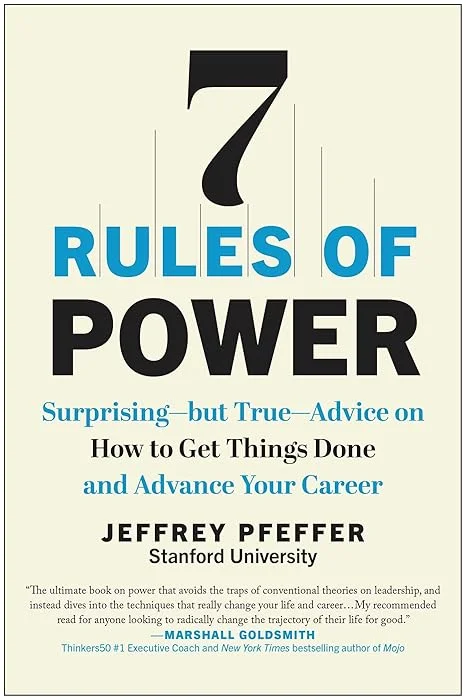
7 Rules of Power: Surprising but True Advice on How to Get Things Done and Advance Your Career
by Jeffrey Pfeffer
Recommendation
Jeffrey Pfeffer has taught a course on power at the Stanford Graduate School of Business for decades, and this book is its distillation. His central claim is blunt: power is not a dark art to be avoided but a skill to be learned, and the refusal to seek it is itself a choice with consequences. If capable, decent people hold back, the field is left to those who feel no such hesitation. As one line he is fond of puts it, if you want power used for good, more good people need to have power. The book gathers what social science actually shows about how influence is won and held, and packs it into seven rules.
The book is written for three readers in particular. Students stepping out of university into their first jobs, including those finishing the national leaving examination and heading to work or to college, will get a frank map of how organizations really reward people. Professionals who feel stuck despite strong performance, especially women, first-generation graduates, and anyone who was raised to be modest and deferential, will find Pfeffer’s argument that performance alone is rarely enough. And small business owners and managers who must get things done through other people will recognize the everyday political reality he describes.
Pfeffer writes without apology. He states the rules plainly, including the uncomfortable ones, and backs each with research and with stories of people who used them to change their careers. Readers looking for comfort or for a gentler account of how the world should work will be frustrated. Readers who want to understand how it does work will find few books this direct.
Take-aways
- Power is a tool, not a vice. Pfeffer argues that treating power as inherently dirty leaves it to the ruthless, and that capable, well-meaning people have a responsibility to build and use it.
- Get out of your own way first. The biggest obstacle is often a self-description that diminishes you. How you think of yourself shapes what you project, so choose the adjectives that convey strength, not the ones that shrink you.
- Performance alone will not save you. Doing excellent work and waiting to be noticed is the most common and most costly career mistake. You must also ask for what you want and make your contribution visible.
- Breaking small rules signals power. People who depart from expected norms, who are willing to be disagreeable and to ask for things others would not, are often read as more powerful and get more of what they request.
- Look and sound powerful. Posture, voice, taking up space, and refusing to open every sentence with an apology all shape how much authority others grant you, often before you have said anything of substance.
- Network relentlessly and just ask. Relationships are the infrastructure of power, and the worst outcome of asking is usually a simple no, which leaves you no worse off than staying silent.
- Use power, because it grows with use. Power is not a fixed quantity that drains as you spend it. Acting decisively, especially early in a role, signals strength, attracts allies, and creates more power.
- Success excuses almost everything. Pfeffer calls this the most important rule: once a person reaches a position of success, people tend to forgive, forget, or rewrite how they got there, which is why one should act rather than agonize over consequences.
Summary
Pfeffer settled on seven rules partly because of the psychologist George Miller, who argued in 1956 that the mind handles about seven items at once, plus or minus two. The rules build on one another, and Pfeffer insists they are not ancient history but a description of how contemporary leaders, from heads of companies to heads of state, actually behave. He also insists, against a fashionable view that power is fading in a networked age, that the fundamentals have not changed.
Power is not a dark art
Many of Pfeffer’s own students arrive uneasy. They call his findings depressing, or, borrowing a word from his colleague Bob Sutton, dark. Pfeffer’s reply is that this discomfort is expensive. People who recoil from power give up the chance to make things happen, and they pay for it in stalled careers and in projects that never get the backing they deserve. He points out that power is linked to better health, because control over one’s work and a higher position in the hierarchy reduce stress, and to greater happiness. Trying to succeed in an organization while refusing to engage with power, he writes, is like trying to build a rocket while ignoring the laws of physics.
He is equally impatient with the popular claim that power is fading in a connected, social-media age. He points to Moses Naim’s book The End of Power, which argued that the powerful now face ever greater limits, and to the irony that Mark Zuckerberg chose it as the first selection of his book club. As Pfeffer notes, Zuckerberg sits atop a share structure that means he cannot be removed no matter what he does. Some people may feel their power slipping, but the fundamentals of how power works, he argues, are old and durable, not obsolete.
Rule 1: Get out of your own way
The first obstacle is internal. Pfeffer tells of Christine, a former student of Asian background who had run a project worth four million dollars yet described herself first as the youngest, the most junior, and the only woman among her peers. He offered her three other true adjectives: the only one with an MBA from a top school, the most analytically skilled, and the one who had run the highest-impact project. She got to choose which set of descriptions to carry in her head. This is the heart of the rule. Imposter syndrome, first named in 1978 and affecting as many as two out of three people in some settings, leads talented people to tell their own stories in ways that shrink them. The work begins with refusing to do that. Pfeffer notes that this is not confined to the timid: even accomplished, successful people routinely downplay their own gifts, a habit he calls simply unhelpful. Among his former students he points to Laura Esserman, a breast cancer surgeon who was later named to Time magazine’s list of the hundred most influential people in the world, as someone who learned to claim her standing rather than wait for it to be granted.
Rule 2: Break the rules
People who break small social rules tend to be seen as powerful. Pfeffer draws on research showing that disagreeableness, the willingness to push back and to be difficult, does not by itself cost a person power, and that those who violate mild norms are often read as confident and in control. The practical edge of this rule is the willingness to ask. Asking for something unusual breaks an unspoken rule, but the downside is small, usually nothing more than being told no, and the upside is everything you would not have received by staying quiet. Pfeffer also notes that rule-breaking can be a source of advantage in its own right, because the unexpected move catches others off guard and the person who is willing to act differently is rarely the one others have prepared to counter.
Rule 3: Appear powerful
Others judge power partly from signals, and those signals can be managed. Pfeffer covers the research on body language and voice: occupying space rather than shrinking, speaking with conviction, and not draining your authority by opening every sentence with an apology for intruding or interrupting. Appearing powerful is not the same as being a fraud. It is presenting yourself in a way that lets your actual competence be taken seriously.
Rule 4: Build a powerful brand
A brand is the story others carry about who you are and what you stand for. Pfeffer argues that you can shape that story deliberately rather than leaving it to chance. This means deciding what you want to be known for, then making sure the people who matter come to associate you with it. He treats self-promotion not as vanity but as the necessary work of ensuring that good work is attributed to the person who did it. In his course he has students craft a short statement of who they are and what they want to be known for, on the principle that if you do not define your own story, others will define it for you, and rarely in your favor. Standing out, even through the simple act of speaking up and being visible, is itself part of building the brand.
Rule 5: Network relentlessly
Relationships are the infrastructure through which power flows. Pfeffer tells the story of Keith Ferrazzi, who on joining the consulting firm Deloitte after business school made one condition: an annual dinner with the firm’s head, guaranteeing himself access to the top. He also describes Reginald Lewis, who talked his way into a Harvard summer program he was technically ineligible for and went on to run a billion-dollar company. The lesson that ties the rule together is simple. If you need help, just ask, and ask widely, because the cost of asking is low and the returns compound.
Rule 6: Use your power
Power grows with use rather than draining away. Pfeffer opens with Lyndon Johnson, who on the flight back to Washington after John Kennedy’s assassination in November 1963 began planning the Great Society, telling an aide, now that I have the power, I aim to use it. Within a short window he drove through the Civil Rights Act, the programs that became Medicare, and much more. Pfeffer draws three lessons. A person new in a role has a honeymoon window to act before opponents organize. Enemies hold grudges longer than friends remember favors, so delay is costly. And using power signals strength, which attracts allies and generates still more power. The pressure of time is real: Pfeffer cites figures showing that the average tenure of a chief executive fell from about eight years in 2000 to roughly five over the following decade, with similar numbers for hospital heads and big-city school superintendents. He offers Amir Dan Rubin, who took over Stanford’s hospital in 2011 as an outsider, as a study in moving fast to establish control and results before the window closed.
Rule 7: Success excuses almost everything
Pfeffer calls this the most important rule, because it answers the fear that holds people back: the worry that the path to power will cost them their reputation. He argues that success tends to wipe the slate. He points to Senator Lindsey Graham, who called Donald Trump unfit during the 2016 campaign and became one of his most loyal allies, explaining simply that he wanted to be relevant. He notes that lists of most-admired chief executives routinely include people who did things that, in a less successful person, would have ended a career, from backdated stock options to clashes with regulators. The reporter Jesse Eisinger, whom Pfeffer quotes, put the dark version of the point bluntly: the greatest privilege of the rich and powerful is the ability to act with near impunity. Or, in the novelist’s phrase Pfeffer also borrows, victors do not just write history, they rewrite it. The conclusion is not that anything goes, but that people worry too much about consequences that success will erase, and that this excessive worry keeps them from acting at all.
Power for good
Pfeffer describes his course as a forcing function, an experience that pushes students, sometimes outside their comfort, to actually try the rules: to build a brand, to expand a network, to speak with more authority, to drop the self-descriptions that hold them back. The deeper aim is not cynicism. It is to give capable people the knowledge and the confidence to act, so that power ends up in better hands. The book asks the reader to set aside the wish that the world ran on merit alone, to see clearly how it does run, and then to decide to play.
About the Author
Jeffrey Pfeffer is the Thomas D. Dee II Professor of Organizational Behavior at the Stanford Graduate School of Business, where he has taught since 1979 and where his course on power is among the most popular. He is the author of more than a dozen books, including Power: Why Some People Have It and Others Don’t, Managing with Power, Leadership BS, and Dying for a Paycheck, along with influential work co-written with Robert I. Sutton such as The Knowing-Doing Gap. His writing draws consistently on social science evidence rather than inspirational aphorism, and he is widely regarded as one of the most important scholars of organizational power and behavior. 7 Rules of Power was published in 2022.