Recommendation
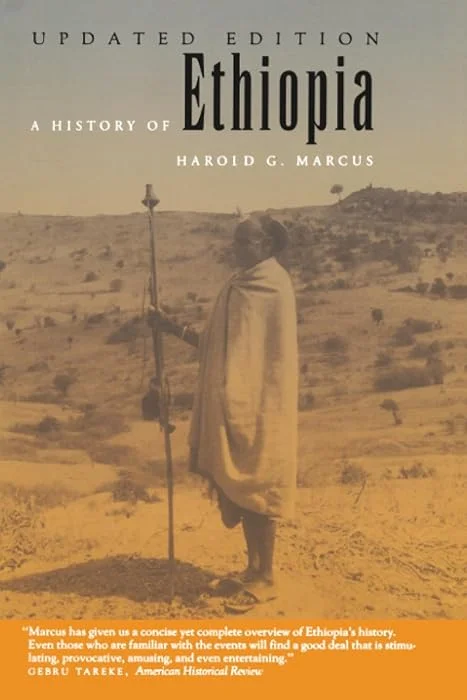
Harold Marcus’s A History of Ethiopia is the canonical English-language scholarly history of the country. First published in 1994 by the University of California Press and updated in 2002, the book covers the full sweep of Ethiopian history from the Axumite Empire through the Ethio-Eritrean war of 2000. Marcus spent forty years as an Ethiopianist at Michigan State University, taught at Addis Ababa University, and wrote large portions of the updated edition while living in Gonder. The book is what historians refer to when they need one authoritative source on Ethiopia.
The book is for three kinds of reader. Ethiopian students and adults who learned a fragmented version of the national story in school and want it in one piece, ordered and argued. Diaspora Ethiopians whose children are asking questions about the country they came from. Foreign readers who keep encountering Ethiopia in headlines and need a framework to understand what they are reading. The book is also a reference for any Atenu reader who plans to study, write, or teach about the country.
What makes Marcus’s book useful is its sweep and its argument. He argues that Ethiopia has a long continuity as an idea even when it has been politically fragmented. The Axumite Empire faded after the seventh century. The Zagwe dynasty followed in the eleventh. The Solomonic dynasty arrived in 1270 and shaped the modern state. The empire shrank under Muslim invasions in the sixteenth century and Oromo expansion in the seventeenth. It re-centralized under Tewodros in the 1850s, defeated European imperialism at Adwa in 1896, modernized under Haile Sellassie, collapsed in the 1974 revolution, and was reconfigured under ethnic federalism after 1991. Through every break, the idea of Ethiopia survived. The book reads that survival as the central plot.
Take-aways
- Ethiopia is one of the oldest continuous civilizations on earth. The Axumite Empire was a major power by the third century. Christianity arrived in the fourth. Amharic-language scripts and Ethiopian Orthodox literature have been produced continuously for more than 1,500 years.
- The Solomonic claim has shaped political legitimacy for 700 years. The 1270 restoration of the Solomonic line, descended in legend from King Solomon and the Queen of Sheba, became the framework every later ruler had to either claim or replace.
- Ethiopia is the only African country never colonized. The Battle of Adwa in 1896, when Menilek II’s army defeated Italian forces, preserved Ethiopian sovereignty during the European Scramble for Africa. The victory shaped African political consciousness for the next century.
- The country has alternated between strong centres and fragmentation. Marcus’s organizing pattern: empire, decline, restoration, empire again. Every Ethiopian generation has lived through one phase of this cycle.
- Three modern states, three theories of nation. Haile Sellassie centralized through Amharic-language modernization. The Derg centralized through Marxist-Leninist ideology. The EPRDF decentralized through ethnic federalism. Marcus describes all three plainly.
- Religion has been a continuous political force. Ethiopian Orthodox Christianity, Islam, and traditional religions have coexisted for centuries with varying degrees of accommodation and conflict. The state has often defined itself through one tradition while ruling the others.
- The countryside is Ethiopia. Marcus, who lived in Gonder during the writing, insists that any Ethiopian history written only from Addis Ababa misses the country. Eighty percent of Ethiopian life happens outside the capital.
Summary
The book is built chronologically. Sixteen chapters move from prehistoric Ethiopia to the year 2000. Marcus writes in plain academic prose, names his sources, and avoids the dramatic flourishes common in popular history. The summary that follows tracks his chapter structure.
Beginnings: to 1270
Ethiopian history begins archaeologically in the highlands of what are now Tigray and Eritrea. By the third century the Kingdom of Axum was a regional power trading with Rome, India, and Arabia. Axumite rulers minted their own coins, built monumental stelae, and converted to Christianity in the fourth century under King Ezana. The Christianity that arrived was Coptic in origin, becoming the Ethiopian Orthodox Tewahedo Church and remaining so for the next sixteen centuries.
Axum declined after the seventh century as Islamic expansion cut Ethiopia’s Red Sea trade routes. The empire’s centre shifted south into the highlands. The Zagwe dynasty rose around the eleventh century with its capital at what is now Lalibela, where King Lalibela ordered the carving of the rock-hewn churches that remain Ethiopian pilgrimage sites today. The Zagwe legitimised themselves with Christian piety. They did not claim Solomonic descent.
That changed in 1270, when Yekuno Amlak overthrew the Zagwe and established what would be called the Solomonic dynasty. The claim was that the new line descended from Menelik I, the son of King Solomon and the Queen of Sheba. The story was canonised in the Kebra Nagast, the foundational Ethiopian text on royal legitimacy. The Solomonic dynasty would rule, with interruptions, until 1974.
The Golden Age and decline of the Solomonic dynasty: 1270 to 1796
The first two centuries of Solomonic rule were the empire’s classical age. Kings moved the court across the highlands, ruling through a mobile imperial camp rather than a fixed capital. Christian monasteries proliferated. Geez literature flourished. The Ethiopian Orthodox Church became the country’s most durable institution.
The sixteenth century brought the empire’s most serious crisis. In the 1520s the Muslim leader Ahmad ibn Ibrahim al-Ghazi, known in Ethiopian history as Ahmad Gragn, invaded from the east with Ottoman support. His armies devastated the highland Christian heartland, destroyed monasteries and manuscripts, and came close to ending the Solomonic state altogether. The empire survived only with Portuguese military assistance arriving in 1541. The damage was permanent. The Christian highlands lost much of their cultural patrimony in two decades of war.
In the wake of the Gragn invasion, the Oromo began the long expansion from southern grasslands into the central highlands. By the seventeenth century they had reshaped the demographic map of Ethiopia and absorbed much of what the wars had emptied. Marcus treats this as one of the most consequential population movements in African history.
The seventeenth century also brought the move of the imperial capital to Gonder, where the empire built castles and churches that still stand. By the eighteenth century the dynasty had weakened to the point that regional warlords held real power. The period the chronicles call Zemene Mesafint, the Era of the Princes, ran from roughly 1769 to 1855. The emperor became symbolic. The country became, in effect, a confederation of fighting nobles.
Imperial restoration: Tewodros, Yohannes, and Menilek
Marcus treats the 1855 coronation of Tewodros II as the beginning of modern Ethiopian history. Tewodros, born Kassa Hailu, rose from minor nobility to defeat the regional warlords and have himself crowned emperor at the age of thirty-seven. He attempted to centralise power, modernise the army, and reform the church. He died in 1868 at Magdala when British forces, sent to recover diplomatic hostages he had taken, defeated his depleted army. He shot himself rather than surrender.
Yohannes IV followed and consolidated the empire further before dying in battle against the Mahdists in 1889. Menilek II then took the throne and ruled until 1913. Menilek’s reign was the most consequential of any Ethiopian monarch in the modern era. He expanded the empire south into Oromo, Sidama, and Somali regions, doubling the territorial size of Ethiopia. He founded Addis Ababa in 1886. He oversaw the introduction of the telephone, the railway from Djibouti, electricity, and Ethiopia’s first hospitals and modern schools.
The defining moment of Menilek’s reign, and of modern Ethiopian history, was the Battle of Adwa on 1 March 1896. The Italian government, having tricked Ethiopia into signing a treaty in 1889 that the Italian text claimed made Ethiopia a protectorate, prepared for full conquest. Menilek mobilised a hundred thousand soldiers from across the empire. At Adwa his army destroyed the Italian force. Italy recognised Ethiopian sovereignty and withdrew. Ethiopia became the only African country to defeat a European colonial army in the Scramble for Africa. For the next century the victory shaped African political consciousness from Pan-Africanism to anti-colonial movements continent-wide.
Haile Sellassie: 1916 to 1974
Marcus devotes four chapters to Haile Sellassie’s long reign. The future emperor, Ras Tafari Makonnen, became regent in 1916 under Empress Zewditu and assumed full power as emperor in 1930. His project across nearly six decades was to centralise Ethiopia into a modern state while preserving the Solomonic monarchy.
The Italian invasion of 1935 interrupted that project. Mussolini’s forces, using poison gas and overwhelming firepower, took Addis Ababa in 1936. Haile Sellassie went into exile in England. The Italian occupation lasted five years and was marked by atrocities including the massacre of an estimated 19,000 to 30,000 Addis Ababa residents in February 1937 in retaliation for an assassination attempt on the Italian viceroy. British and Ethiopian forces liberated the country in 1941 and Haile Sellassie returned.
The post-war reign saw Ethiopia centralise further. Haile Sellassie founded Addis Ababa University in 1950, oversaw the federation and then annexation of Eritrea in 1962, and made Ethiopia a founding member of the United Nations and the Organisation of African Unity, which sited its headquarters in Addis Ababa in 1963. Marcus describes the emperor as a brilliant statesman abroad and an increasingly out-of-touch monarch at home. The 1973 Wollo famine killed an estimated 200,000 to 300,000 people while the imperial court continued in opulence. Television footage of starving peasants intercut with imperial banquets ended the regime’s legitimacy.
The Revolution and the Derg: 1974 to 1991
In February 1974 a series of strikes and military mutinies escalated into a full revolution. By September a committee of junior officers known as the Derg had deposed the emperor. Haile Sellassie was placed under house arrest and died in 1975 under disputed circumstances. The Derg consolidated power under Major Mengistu Haile Mariam, who emerged as supreme leader after the killing of his rivals on 3 February 1977 in a meeting at the Grand Palace.
The Derg years (1974 to 1991) were the most violent period in twentieth-century Ethiopian history. The Red Terror of 1977 and 1978 killed tens of thousands of political opponents, mostly young urban Marxists from rival factions. Mass land reform in 1975 ended feudal tenure and reorganised rural life. Resettlement campaigns in the 1980s moved hundreds of thousands of peasants under conditions that caused widespread deaths. The 1984-1985 famine, which killed an estimated one million people, became the global image of African suffering. The famine was both a natural disaster (drought) and a political one (the regime’s policies, military conflict, and use of food as a weapon).
By the late 1980s the Derg was fighting losing wars against the Eritrean People’s Liberation Front (EPLF) in the north and the Tigrayan People’s Liberation Front (TPLF) in Tigray. The collapse of Soviet support after 1989 ended the regime. In May 1991 Mengistu fled to Zimbabwe. The TPLF entered Addis Ababa and Eritrean forces entered Asmara within days of each other.
The EPRDF era and the Eritrean war: 1991 to 2000
Marcus’s two final chapters cover the new rulers. The TPLF, transformed into a broader coalition called the Ethiopian People’s Revolutionary Democratic Front (EPRDF), took power under Meles Zenawi. Eritrea, after a 1993 referendum, became independent.
The EPRDF rebuilt the country on an explicit principle of ethnic federalism. The 1995 constitution divided Ethiopia into nine ethnic-based regional states (later expanded), each with the constitutional right of self-determination including secession. Marcus is clear that this was a radical departure from every previous Ethiopian state, which had built unity around either dynastic legitimacy (the Solomonic line) or revolutionary ideology (the Derg). The EPRDF built unity, in theory, around acknowledged ethnic difference.
The model was tested almost immediately. In May 1998 a border dispute escalated into a full war with Eritrea. The Ethio-Eritrean war of 1998 to 2000 killed an estimated 100,000 soldiers and ended with Ethiopian forces decisively defeating the Eritrean military. The border remained disputed for two decades after. Marcus, writing from Addis Ababa during the war, treats the conflict as evidence of the limits of the ethnic federalism experiment when applied to a regional rival rather than internal management.
What the book argues, when you step back
Across sixteen chapters and 1,700 years, Marcus’s underlying argument is that Ethiopia is durable as an idea even when fragile as a state. Empires rise and fall. Capitals shift from Axum to Lalibela to Gonder to Addis Ababa. Religions compete and accommodate. Ethnic populations migrate and assimilate. The Christian-highland-Amharic-Solomonic core has expanded, contracted, and been challenged from every direction. Through all of it, something Marcus calls “the idea of Ethiopia” has survived.
The book does not claim that idea is permanent. The closing chapters are explicit that the EPRDF experiment with ethnic federalism poses the most serious test of unity since the sixteenth-century Muslim wars. Marcus does not predict the outcome. He leaves the reader to follow events past the book’s 2000 endpoint with their own eyes.
About the Author
Harold G. Marcus (1936 to 2003) was an American historian of Ethiopia and one of the founders of the field of Ethiopian studies in North America. He taught at Michigan State University from 1965 until his death and held the position of Professor of History and African Studies. He produced more than a dozen books on Ethiopian history, including The Life and Times of Menelik II (1975) and the two-volume political biography Haile Sellassie I: The Formative Years and A Man Out of His Time. He served as president of the African Studies Association and edited the journal Northeast African Studies. He spent his 1999-2000 sabbatical living in Gonder, Ethiopia, the period during which he wrote the updated edition of this book. A History of Ethiopia was first published by the University of California Press in 1994 and revised in 2002.