Recommendation
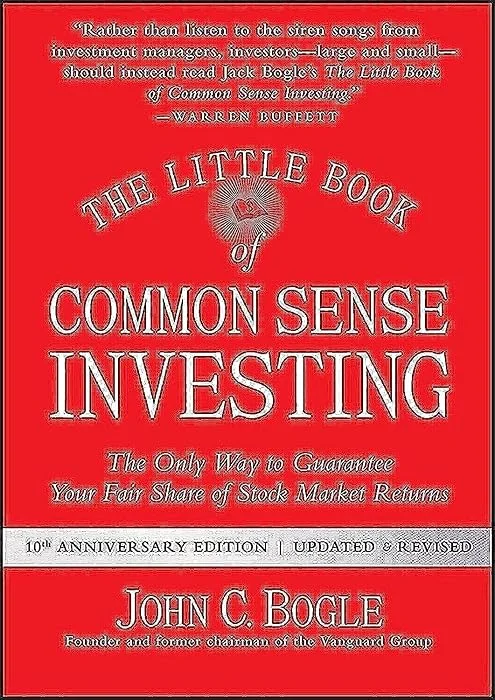
John Bogle founded Vanguard in 1974 and created the first index mutual fund in 1975, an act that Paul Samuelson once compared to “the invention of the wheel, the alphabet, and wine and cheese.” The Little Book of Common Sense Investing is the most distilled statement of the argument Bogle spent five decades making: the simplest reliable way for an ordinary investor to build wealth in the stock market is to buy a low-cost fund that holds every publicly traded company, and to hold it forever. The 10th Anniversary Edition was published in 2017 and is the version summarized here.
The book is useful for three kinds of reader. The Ethiopian diaspora professional in Toronto, Minneapolis, Dubai, or Washington who is choosing between an advisor’s mutual fund portfolio and a Vanguard or iShares S&P 500 index ETF inside their TFSA, 401(k), or Roth IRA. The Addis salary earner with a dollar-denominated NIB or CBE forex account who wants to know what to do with savings they have decided to keep outside the birr. And the older reader approaching retirement who is trying to translate a working life of saving into a steady monthly income stream, and who needs to understand how much should sit in stocks, how much in bonds, and what role the dividend yield actually plays.
What makes the book worth reading is its arithmetic honesty. Bogle is not a salesman of complexity. He is a man who watched the active-management industry charge a small fortune to deliver returns that on average lagged the market by exactly the amount of the fees, and who built an institution to do the opposite. The argument is simple, but as he warns repeatedly, it is not easy to follow. The reader who takes it seriously will be asked to ignore most of what they hear about investing and to do almost nothing for forty years.
Take-aways
- Owners as a group earn what their businesses earn. Over the very long run the stock market’s return equals the dividend yield plus the rate of earnings growth, and nothing else.
- Before costs, beating the market is a zero-sum game. After costs, it is a loser’s game. For every investor who outperforms by one point, another underperforms by one point, and both pay fees on the way to the result.
- Costs compound as cruelly as returns compound generously. At a 7% market return and a 2% all-in fee, a fifty-year investment of $10,000 grows to about $115,000 instead of $295,000. The intermediaries, putting up no capital and taking no risk, keep about 60% of the potential return.
- Time is the friend of returns and the enemy of costs. A 1.5% annual cost difference compounds into a 35% or larger gap in terminal wealth across a working lifetime.
- The traditional index fund eliminates three risks and leaves only one. It removes the risk of picking the wrong stock, the wrong sector, and the wrong manager. Only market risk remains, and that is the risk a stock investor wants to be paid for.
- Performance reverts to the mean. Costs do not. A fund’s hot streak almost always cools, but its expense ratio almost never does.
- The exchange-traded fund is a useful tool turned against its purpose. A broad-market ETF held forever behaves like an index fund; the same instrument traded daily becomes a vehicle for the speculation Bogle warns against.
- A simple stock and bond allocation, rebalanced rarely, beats most professional strategies. Benjamin Graham’s 50/50 floor, with a range from 75/25 to 25/75, still serves the typical investor better than the average advisor’s portfolio.
Summary
Bogle organizes the book around three connected ideas: a parable about who really collects the returns of business; the arithmetic of costs as they compound across a lifetime; and the specific mechanism, the broadly diversified low-cost index fund, that lets an ordinary investor capture their fair share of those returns. The chapters elaborate, but the spine is short.
The Gotrocks family and the helpers
Bogle opens with a parable he credits to Warren Buffett’s 2005 Berkshire Hathaway shareholder letter and develops for his own purposes. The Gotrocks family, grown across generations into thousands of cousins, owns all of the stock of every public company in America. Each year the family receives every dividend and benefits from every dollar of retained earnings. Their wealth compounds together at the same rate, and the family stays harmonious.
Then a few fast-talking Helpers arrive. They tell the smart cousins that they can earn a larger share than the rest of the family by selling some shares to relatives and buying others in return. The Helpers charge a brokerage commission on each trade. Soon the family wealth is growing more slowly, because some of the dividends and earnings are now flowing out to the Helpers rather than staying inside the family. The smart cousins, watching their share shrink, conclude that they were not good enough stock pickers and hire money managers. The managers charge fees and trade at a higher pace, raising both commissions and taxes. The cousins then hire consultants to choose better managers. The consultants also charge fees.
Eventually a sage uncle gathers the family and tells them what has happened. Their original 100% share of all the dividends and earnings of corporate America has dwindled to roughly 60%. The rest now flows to the Helpers. He recommends firing the brokers, the managers, and the consultants, and going back to the original strategy of owning everything and holding it. Bogle then writes, in italics, that this is exactly what an index fund does.
The relentless rules of humble arithmetic
Bogle credits the phrase to Louis Brandeis, who used it in his 1914 book Other People’s Money to predict the collapse of speculative finance. The arithmetic, Bogle argues, is unbreakable. Investors as a group must earn precisely the market return before costs. After costs are deducted, investors as a group must earn less than the market return by exactly the amount of those costs.
This is not a controversial claim. It is a tautology. But its consequences are usually ignored. Bogle quotes Upton Sinclair: “It is difficult to get a man to understand something when his salary depends on his not understanding it.” The financial intermediation industry exists because investors have not done the arithmetic.
The costs Bogle catalogues for an actively managed equity fund are the published expense ratio (averaging about 1.3% across active funds), the sales load if any (often 5% spread over a holding period), and the hidden cost of portfolio turnover (about 1% per year for a fund turning over its holdings at the typical 80% annual rate). The all-in figure for active fund ownership comes to between 2% and 3% per year. The all-in figure for a traditional broad-market index fund can be as low as 0.04%.
Compounding returns versus compounding costs
The book’s most repeated image is a chart of $10,000 invested for fifty years. At a 7% gross return the money grows to $294,600. At a 5% net return, which is what the same investor receives after paying a 2% annual fee, the money grows to $114,700. The shortfall, $179,900, is the cost of intermediation across a working lifetime.
Bogle frames the gap as a confiscation. The investor put up 100% of the capital and assumed 100% of the risk, then received less than 40% of the return that the market itself delivered. The system of financial intermediation, having put up no capital and assumed no risk, kept 61%.
He returns to this calculation throughout the book in different forms. Over the past 25 years, the S&P 500 Index returned 9.1% annually. The average actively managed equity mutual fund returned 7.8%. The average mutual fund investor (calculating by dollar-weighted returns, which account for buying high and selling low) earned just 6.3%. The cumulative dollar gap across that quarter-century, on a $10,000 initial investment, came to about $77,000 for the index investor versus $36,100 for the average fund investor. The difference is not a debate about which manager to pick. It is a structural feature of the system.
Why active funds fail, and why they keep failing
The intuition that some fund managers must be skilled enough to beat the market over long periods is mathematically true but practically useless. In any given year a few managers will beat the index. Across five years, fewer. Across fifteen years, a vanishingly small number. The Credit Suisse strategist Michael Mauboussin, whom Bogle cites, calculates the odds of beating the market for fifteen consecutive years at one in 223,000.
The reason is not that managers are unintelligent. The reason is that they compete with one another using the same tools, and the gross outperformance they generate as a group is necessarily zero (every winning trade has a losing counterparty). What separates the winners from the losers, year by year, is the cost burden each manager carries. Across long periods this cost burden does almost all the work of explaining which managers underperform.
The data Bogle assembles supports this conclusion across markets and asset classes. Standard and Poor’s tracks the share of active funds that beat their benchmarks: 85% of US active funds underperform over fifteen years; 89% of international active funds underperform; 90% of emerging-market funds underperform; 96% of high-yield bond funds underperform. The pattern holds in every market segment Bogle examines, efficient or inefficient, equity or bond. Indexing works wherever it has been implemented.
Dividends and the slow-and-steady half of the return
A section of the book Bogle added in the 10th Anniversary Edition concerns dividends. Since 1926 dividends have contributed an average annual return of 4.2% to the S&P 500, accounting for 42% of the index’s 10% total return. Compounded across nine decades, that dividend stream is responsible for most of the wealth ever generated by the American stock market. A $10,000 investment in the S&P 500 made on January 1, 1926, would have grown to $1.7 million through price appreciation alone. With dividends reinvested, the same investment grew to $59.1 million.
The cost problem reasserts itself in the dividend chapter. The average actively managed growth mutual fund has an expense ratio of 1.3%, which is identical to the average gross dividend yield those funds earn from the stocks they own. The result, on a 2016 snapshot Bogle reproduces from Morningstar, is that expenses confiscate 100% of dividend income for the average growth fund and 58% for the average value fund. The equivalent index funds pass 96% to 98% of dividends through to the shareholder.
The exchange-traded fund as a trader to the cause
Bogle was the inventor of the traditional index fund and a public skeptic of its descendant, the exchange-traded fund (ETF). His skepticism is precise: there is nothing wrong with a broad-market ETF held for life. The Vanguard S&P 500 ETF or the Spider 500 ETF, bought once and held for forty years, behaves indistinguishably from the corresponding traditional index fund.
The problem is the trading. The Spider 500 alone traded at an annual portfolio turnover rate of 2,900% in 2016, indicating that its average holder owned shares for less than two weeks. The proliferation of narrowly defined sector and factor ETFs, of which Bogle counts more than 2,000 in 2017, turns the index-fund concept inside out. Investors choose which sectors to bet on, time their entries and exits, and pay brokerage commissions and short-term tax on every move. The 20 best-performing ETFs of 2003 to 2006, Bogle notes, produced an average investor return that lagged the funds’ own reported returns by five percentage points per year. ETF holders, like active-fund holders, buy after good performance and sell after bad performance, and the timing penalty erodes the benefit of the structure.
The closing chapter on smart-beta and factor ETFs is a similar critique aimed at fund sponsors. Bogle treats most factor strategies as data-mined active management dressed in index-fund clothing, designed to charge a higher expense ratio in exchange for outperformance that historically has not materialized after costs.
Asset allocation: stocks, bonds, and the role of Social Security
The asset-allocation chapters are the most actionable part of the book. Bogle accepts Benjamin Graham’s 1949 framework as a starting point: never less than 25% in stocks, never more than 75%, with a default of 50/50 for the typical investor. He layers his own refinements. Younger investors who are accumulating savings can hold 80% in stocks and 20% in bonds. Older investors transitioning into retirement can move toward 50/50 or, late in life, 25/75. These ranges are guides, not prescriptions, and Bogle is honest that the right answer depends on a reader’s particular ability to take risk and willingness to take risk.
The chapter on costs and allocation contains a counter-intuitive table. A 75% stocks / 25% bonds portfolio held in actively managed funds, with all-in costs of 2% on stocks and 1% on bonds, produces a net annual return of 3.5%. A 25% stocks / 75% bonds portfolio held in low-cost index funds, with all-in costs of 0.05% on stocks and 0.10% on bonds, produces a net annual return of 3.66%. The lower-cost, lower-risk portfolio beats the higher-cost, higher-risk portfolio. Cost reduction is, in this sense, equivalent to risk reduction.
The retirement chapter introduces a useful framing for American readers and, by extension, for the diaspora professional who has built a US-based or Canadian-based career. Social Security (or its Canadian equivalent CPP/OAS, or a Gulf end-of-service indemnity) should be counted in the bond-like portion of the portfolio. A retiree with a $1 million mutual fund portfolio and a Social Security benefit with a capitalized value of $200,000 effectively holds $1.2 million, of which the $200,000 functions as bond exposure. Adjusting the mutual fund allocation accordingly lets the retiree carry more equity exposure than they would assume.
Stay the course: the closing rules
The final chapter, “Investment Advice That Meets the Test of Time,” pairs Bogle’s maxims with the sayings of Benjamin Franklin from Poor Richard’s Almanack. The pairing is genuine: both men wrote for ordinary savers who would otherwise be persuaded by the financial fashion of their century. Bogle’s rules in the closing chapter compress to eight short claims. Start investing as early as possible. Investing carries risk, but not investing dooms financial life. The sources of return are dividends and earnings growth. Total diversification eliminates everything but market risk. Costs matter overwhelmingly. Taxes matter and must be minimized. Neither beating the market nor timing the market can be generalized into a strategy. Acknowledge what cannot be known, and prepare for it through allocation rather than prediction.
The book closes with Paul Samuelson’s 2005 line, delivered at the Boston Society of Security Analysts, comparing the invention of the index fund to the invention of the wheel, the alphabet, and wine and cheese. The line is grand, and Bogle reproduces it with mild embarrassment, but it captures the book’s ambition. The principles are old. The discipline is hard. The result, applied across a working lifetime, is the wealth that most savers assume is unavailable to them.
About the Author
John Clifton Bogle was the founder of The Vanguard Group, the firm he organized in 1974 under an unusual structure: it is owned by the shareholders of the funds it administers, so the firm’s profits flow back to investors as lower fees rather than out to private owners. He created the first index mutual fund tracking the Standard and Poor’s 500 Index in 1975 and spent the next four decades defending its case, often against the active-management industry from which he came. By the writing of the 2017 edition of this book, the equity index funds his work pioneered had grown from $28 billion to $4.6 trillion in assets, a 168-fold increase over his career. His 1951 Princeton senior thesis, “The Economic Role of the Investment Company,” already contained the principles the Little Book would lay out fifty-six years later: investors deserve to be served economically, efficiently, and honestly. He wrote eleven books, the first in 1994 and this one (originally 2007, revised in 2017) the most widely read of them.
Notes for the Editor
Ethiopian framing opportunities (6 marked above)
| # | Section | Leverage | Suggested angle |
|---|---|---|---|
| 1 | Gotrocks Helpers | high | Map the Helpers onto Toronto/DC bank advisors and Addis offshore wealth managers |
| 2 | Humble arithmetic | high | ESSLCE Grade 11 geometric-progression math as the foundation for fee-evaluation |
| 3 | Why active fails | high | Honest scope note: book speaks to dollar-denominated savers, not birr-only savers |
| 4 | Asset allocation | high | Diaspora retiree returning to Ethiopia: currency exposure, TIPS, EA exposure |
| 5 | Stay the course | high | Iqub patience, multi-generational stone-house tradition as native disciplines |
| 6 | Closing sign-off | closing | Orthodox-Muslim religious compatibility; sharia-screened index funds exist |
Pipeline timing
- PDF read + English draft (model): _____ min
- Humanizer pass (model): _____ min
- Ethiopian framing pass (editor): _____ min
- Amharic translation (model): _____ min
- Audio narration (Epherata H.): _____ min
- Audio editing/upload: _____ min
- Total end-to-end: _____ min (target: 90)
Terminology lock for Amharic translation
| Term | Amharic | Notes |
|---|---|---|
| Index fund | ኢንዴክስ ፈንድ | Established loan term; in financial press this is rendered as ኢንዴክስ |
| Expense ratio | የወጪ ምጥጥን | New lock for this book |
| Compound return | የመደመር ትርፍ | Established; same root as “compound interest” |
| Dividend | የትርፍ ድርሻ | Established term in NBE materials |
| Asset allocation | የንብረት ድልድል | New lock |
| Market capitalization | የገበያ ካፒታል | Loan term; ካፒታል is already established |
| Reversion to the mean | ወደ መካከለኛ ተመላሽነት | New lock; this is a technical concept |
| Stay the course | መንገድህን ጠብቅ | New lock; this is Bogle’s mantra |