Recommendation
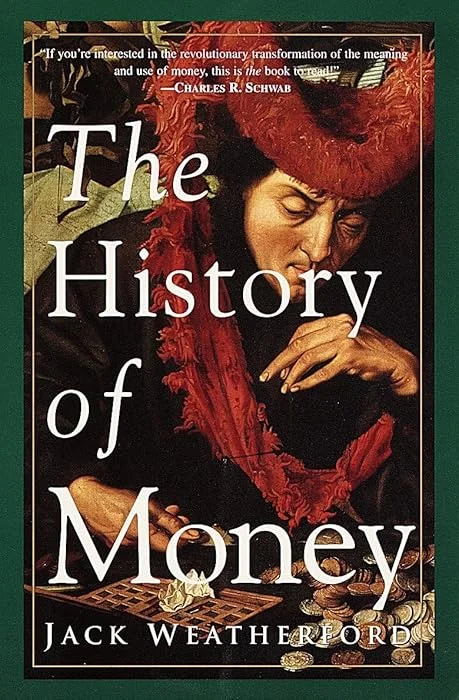
Jack Weatherford’s The History of Money tells the story of money the way an anthropologist would: not as economics, but as one of the most powerful cultural inventions humans have ever made. His argument is that money has gone through three great revolutions. The first began with the invention of coins in the kingdom of Lydia almost three thousand years ago, and it created the open market. The second began in the banks of Renaissance Italy, and it created paper money, national banks, and modern capitalism. The third is happening now, as money turns electronic and slips free of any single government. Each revolution, Weatherford says, built a new kind of society around it.
The book is for three kinds of reader. The reader who studied economics as formulas and graphs and wants to see where the thing itself came from. The small trader in Merkato or Mekele who handles cash all day and has never stopped to ask what cash actually is. The diaspora reader who moves money across borders by app and senses that something basic is changing under their feet.
What makes the book worth reading is its range and its eye for the strange true detail. Weatherford moves from Aztec markets that used chocolate for money to the silver mountain of Potosi, from the bankers of Florence to the trillion-mark notes of Weimar Germany. He treats money as a human story full of kings, crooks, and accidents, and he writes it for the general reader rather than the specialist. By the end the dollar in your pocket looks less permanent and a good deal stranger than it did.
Take-aways
-
Money is a cultural technology, not a fact of nature. It is something humans invented and keep reinventing, and each form of it reorganizes the society that uses it.
-
There have been three revolutions in money. Coins in ancient Lydia, paper money and banking in Renaissance Italy, and the electronic money emerging now.
-
The first coins were made in Lydia around 640 BC. They were small lumps of electrum, a natural gold and silver alloy, stamped with a lion’s head so even an illiterate trader could trust their weight.
-
Coins created the open market. Once value could be counted instead of weighed, anyone could trade with anyone, and the retail market of shops was born in the Lydian capital of Sardis.
-
Renaissance bankers invented money you cannot touch. Italian families turned debts and bills of exchange into a system of credit, which freed commerce from the weight of metal and seeded modern banking.
-
The dollar is a German silver coin, and so is the Ethiopian talari. Both names descend from the thaler, first minted in a Bohemian valley, and the same coin became the trusted currency of Ethiopia.
-
Inflation is a hidden tax. When a government prints money faster than the economy grows, it quietly takes value from everyone holding the old currency, as Weimar Germany showed at 4.2 trillion marks to the dollar.
-
Electronic money is loosening the link between money and the state. Weatherford predicts a new world where money flows instantly across borders and creates fresh winners and losers.
Summary
Weatherford organizes the book in three parts that match his three revolutions: Classic Cash, Paper Money, and Electronic Money. He is a cultural anthropologist, not an economist, and he says so plainly, borrowing Georg Simmel’s remark that not a single line of his study is meant as a statement about economics. The book is a sequence of vivid episodes rather than a theory, and the episodes carry the argument.
A shattering, simplifying idea
Weatherford opens with a claim that sounds like overstatement until he makes the case: money is one of the few human ideas powerful enough to remake an entire civilization. It does this by simplifying. A single number can stand in for a cow, a day of work, a sack of grain, or a human life, and once everything can be priced against everything else, the old bonds of kinship, religion, and rank start to loosen. Money dissolves the world into prices and then rebuilds it on new terms. That is why he treats each change in the form of money as a change in the shape of society, and why he can write a history of the world through what people have used to pay each other.
For an Ethiopian reader this is not abstract. The birr in your hand, the remittance that arrives from a relative in the Gulf, the iqub that turns a group of neighbors into a rotating bank, the idir that pools small payments against the cost of a funeral: each is money doing what Weatherford describes, organizing trust and turning relationships into something that can be counted and carried.
Before coins: shells, salt, and chocolate
The first kind of money was not minted at all. Across the world people used commodities that everyone wanted and that were hard to fake: cowrie shells, cattle, beads, tobacco, and salt. Weatherford lingers on the Aztecs, who used cacao beans as small change and who built an empire on tribute rather than trade. He calls this protomoney, money that is also a useful thing in itself. Its weakness is obvious. A cow cannot be split to buy a loaf of bread, salt dissolves in the rain, and cacao can be eaten. Commodity money worked, but it set a low ceiling on how complex an economy could grow.
Ethiopia holds one of the most famous examples of commodity money in the world. For centuries the amole, a standardized bar of rock salt cut in the Afar lowlands, traveled the highland trade routes as money, accepted from Tigray to the south. It carried the same strengths and weaknesses Weatherford describes: it was real and useful and trusted, and it was also heavy, breakable, and slowly eaten by the damp. The amole is Ethiopia’s own chapter in the story this book tells.
Lydia’s lion: the first coins
The turning point came in the small kingdom of Lydia, in what is now Turkey, around 640 BC. Lydian kings began stamping small standardized lumps of electrum, a natural alloy of gold and silver, each marked with a lion’s head. The mark was the key. It told even an illiterate trader that the king vouched for the weight and the metal, so value could be counted rather than weighed on a scale. The most famous Lydian king, Croesus, who reigned from 560 to 546 BC, struck the first coins of pure gold and silver and grew so wealthy that “rich as Croesus” survives as a saying in many languages today.
Coins did something larger than make payment easier. They created the open market. Once anyone could carry trusted value in a pouch, a stranger could trade with a stranger, and the kings of Sardis set up rows of specialized shops where buyers came to sellers. Weatherford traces a straight line from that Lydian market to the Greek agora and on to the modern shopping street.
Coins usually reach us as a one-line definition. This is where they began. It is worth adding that Ethiopia joined this story early: the kingdom of Aksum minted its own gold, silver, and bronze coins from around the third century AD, one of the very few ancient African powers to issue its own coinage, a sign of how deeply the country was woven into the trade of the ancient world.
The bankers of Florence
The second revolution began not with a new coin but with a new idea about debt. In the city-states of Renaissance Italy, banking families learned to move money without moving metal. A merchant could deposit florins in Florence and draw the value in Bruges through a bill of exchange, a piece of paper that stood for the coins. Banks could lend more than they physically held, and credit became a force of its own. Weatherford shows how this abstract, paper-based money broke the old order: power shifted from those who owned land to those who owned bills, bonds, and shares, and feudalism gave way to capitalism.
The leap the Italian banks made, turning trust into spendable value, is one Ethiopians make every week in a humbler form. The iqub gathers a group who each pay in a fixed amount and take turns receiving the pot, so a member can buy a sewing machine or restock a shop long before they could have saved the full sum alone. It is credit without a bank, the same magic the Florentines built into an industry: money made to do more than its weight in metal would allow.
The same flood of money could also destroy. When Spanish silver from the mines of Potosi in the Andes poured into Europe in the sixteenth century, there was suddenly far more money than there were goods to buy, and prices in Spain rose by about four hundred percent over the century. Historians call it the price revolution, and Adam Smith later judged that the American mines had cut the value of Europe’s gold and silver to roughly a third of what it had been. It was an early and painful lesson that more money is not the same thing as more wealth, the lesson inflation would teach the world again and again.
The dollar’s secret Ethiopian life
One of the book’s best threads explains where the word dollar comes from, and it runs straight through Ethiopia. In the sixteenth century a silver mine in the Bohemian valley of Joachimsthal produced so many coins that people named them after the valley: Joachimsthaler, shortened to thaler. The name spread across languages, becoming daalder in Dutch, tallero in Italian, dollar in English, and, as Weatherford notes directly, talari in Ethiopian. The most famous thaler of all, struck in honor of the Austrian empress Maria Theresa and frozen forever with the date 1780, became the trusted silver coin of the Middle East and the Horn of Africa.
It became, in fact, the money of Ethiopia. Weatherford records that when Mussolini conquered Abyssinia, he found the economy so dependent on the Maria Theresa thaler, and Ethiopians so unwilling to accept any substitute, that Rome was forced to mint its own thalers between 1935 and 1937. Around 800 million of the coins were struck between 1780 and 1975, every one bearing the same 1780 date.
For the Ethiopian reader this is the heart of the book. The Maria Theresa thaler is the ancestor of the modern birr, and talari is simply its Amharic name. The detail that Mussolini’s officials had to strike their own thalers, because Ethiopians would not trust an Italian substitute, is a small act of resistance hidden inside the larger one. It belongs to the same conquest that Prevail describes, money refusing to surrender even as the army was forced back.
Paper, gold, and Nixon’s break
The paper money we know took centuries to win trust. Weatherford tells it through gamblers and visionaries, above all John Law, the Scottish adventurer whose paper-money scheme inflated and burst in France in a spectacular bubble. Governments slowly learned to anchor paper to gold, promising that each note could be exchanged for a fixed weight of metal, and the gold standard ruled the nineteenth century from the Bank of England, the institution London nicknamed the Old Lady of Threadneedle Street.
The fight over that anchor could grip a whole nation. In the United States the question of whether the dollar should rest on gold alone or on silver as well became the central political battle of the 1890s, and it produced one of the strangest monetary documents in history. When the Populist orator William Jennings Bryan warned the 1896 Democratic convention that the powerful must not crucify mankind upon a cross of gold, he was pleading for silver against the gold standard. Weatherford reads L. Frank Baum’s 1900 children’s book The Wonderful Wizard of Oz as a coded retelling of that fight: Dorothy as the ordinary citizen walking a yellow brick road of gold, the Cowardly Lion as Bryan, the Emerald City where everyone must look through green-tinted glasses the color of paper money, and the Wizard of Oz himself, Oz being the standard abbreviation for an ounce of gold.
The anchor held until it became inconvenient. In 1971 President Richard Nixon severed the last link between the dollar and gold, and from that day the world’s money has been backed by nothing but confidence in the governments that issue it.
After 1971 every major currency floats on trust alone, which is exactly what makes inflation possible. A reader who has watched the birr buy less each year is watching this directly. When money is anchored only to confidence, a government that prints too much erodes the savings of everyone holding it, which is why Ethiopians so often move savings into grain, livestock, land, gold, or a steadier foreign currency.
Electronic money and the third revolution
The book closes on the change Weatherford believes is the biggest of all. The bridge to it was plastic. The credit card, he argues, was a quiet revolution of its own, turning debt into a mass-market convenience and letting ordinary people spend money they did not yet have while the banks earned steadily on the gap. From there money goes fully electronic, becoming numbers that move between computers and live nowhere in particular. He sees this loosening the ancient bond between money and the state. He also warns of its costs, including inflation as a hidden tax and a widening gap between those inside the electronic economy and those left in what he calls the cash ghetto, a cash-only underclass cut off from credit and from the cheaper, faster money of the connected world. Writing in 1997, before mobile money or cryptocurrency, he could not name the forms the third revolution would take, but he was confident it would remake society as deeply as coins and banks once did.
Weatherford was describing a future the Ethiopian reader now lives in. The spread of telebirr and mobile payments, the slow fade of cash in the cities, the ability to send value across the country by phone: this is the third revolution arriving on Ethiopian ground. The book gives that change its long history, so that the coin, the salt bar, the thaler, and the phone all turn out to be chapters of one story.
About the Author
Jack Weatherford is an American cultural anthropologist who taught for many years at Macalester College in St. Paul, Minnesota. The History of Money was published by Crown in 1997. His earlier books, all concerned with how cultures shape and are shaped by material forces, include Indian Givers (1988), on the contributions of Native American peoples to the world, Native Roots (1990), and Savages and Civilization (1993). His method here is anthropological: he cares less about monetary theory than about money as a lived, cultural object, which is why the book reaches for the Aztec market and the Bohemian mine rather than the equation. He later became widely known for his books on Genghis Khan and the Mongol Empire.