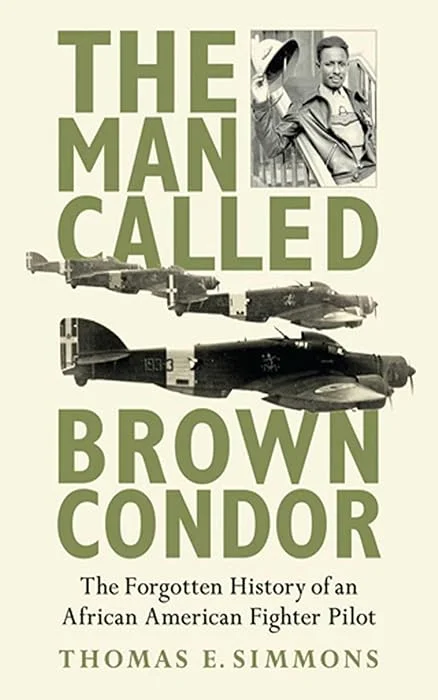
The Man Called Brown Condor: The Forgotten History of an African American Fighter Pilot
by Thomas E. Simmons
Recommendation
In 1935, when Fascist Italy massed its armies on Ethiopia’s borders, a thirty-two-year-old Black mechanic and pilot from Gulfport, Mississippi sailed alone across the Atlantic to offer Ethiopia his services. His name was John Charles Robinson. Within a year he was a colonel commanding the Imperial Ethiopian Air Corps, flying unarmed biplanes through a sky owned by the Regia Aeronautica, carrying Emperor Haile Selassie to and from the front, and surviving three wounds, two gassings, and the Italian fighters that hunted his couriers. Thomas E. Simmons spent some thirty years reconstructing this life from interviews and archives, because almost no history book recorded it.
The book speaks first to Ethiopian readers, who will find in it a foreigner who served the country in its darkest hour and chose to be buried in its soil. It speaks to students preparing for the national school leaving examination, who study the Italian invasion of 1935 to 1941 but rarely meet the American who flew for Ethiopia. And it speaks to any reader, in Addis Ababa or in the diaspora, who wants to understand how the modern Ethiopian Air Force and Ethiopian Airlines trace a line back to a boy who saw his first airplane on a segregated Mississippi beach.
Simmons writes as a pilot, with a storyteller’s eye for cockpit detail and a researcher’s patience for the record. He recreates scenes and dialogue from recorded interviews with the people who knew Robinson, so the book reads like a novel while resting on decades of documentation. What emerges is a double portrait: of a man who refused every door closed in his face, and of two countries, the one that would not let him fly and the one that made him a colonel.
Take-aways
- A seven-year-old on a Gulfport beach found his life’s dream in 1910. John Robinson watched a floatplane land on the Mississippi shore and decided he would fly, though his mother warned that a Black man had no business fooling around with airplanes.
- American aviation was closed to Black students, so Robinson swept floors to enter it. Rejected repeatedly by Chicago’s Curtiss-Wright school, he took a Saturday night janitor’s job, listened from the back of the classroom, and copied the blackboard notes after each class.
- He collected a string of firsts. Robinson became the first Black American to earn commercial, multi-engine, and air transport ratings, helped establish Robbins Airport, the first airfield in America owned and operated by Black people, and founded the Challenger Air Pilots Association in 1932.
- Ethiopia offered the proving ground America refused him. Through the Associated Negro Press and the emperor’s nephew Dr. Malaku Bayen, Haile Selassie invited Robinson to Addis Ababa in 1935 and made him a colonel commanding the Imperial Ethiopian Air Corps.
- His air corps had fewer than two dozen aircraft, and none carried a gun. Against Italy’s two hundred modern warplanes, Robinson ordered his pilots to fly as couriers, not warriors, hiding planes under brush and running from every speck in the sky.
- He was the first American to witness the opening of the road to World War II. From an unarmed Potez biplane above the Mareb River on 3 October 1935, Robinson watched a hundred thousand Italian troops invade Ethiopia, and he later carried the news of the mustard gas that followed.
- Without Robinson, Simmons argues, there would have been no Tuskegee Airmen. He persuaded Tuskegee to pursue aviation in 1934, gave its first chief instructor advanced training in his Chicago school, and trained the Black mechanics who kept the fighters flying.
- He gave his last decade, and his life, to Ethiopian aviation. Robinson returned in 1944 to rebuild the air corps, trained more than three hundred pilots and mechanics, helped set up the airline that became Ethiopian Airlines, and died in 1954 from injuries suffered after a mercy flight.
Summary
Simmons assembled the book from roughly thirty years of original research, including recorded interviews with Robinson’s sister, his business partner Cornelius Coffey, fellow pilots, students, and the men who flew with him in Ethiopia. Because so little was written down at the time, the author reconstructs scenes, conversations, and cockpit moments from those testimonies and from newspaper archives, and he tells the story in narrative form, moving between Mississippi, Chicago, and Addis Ababa.
A child on a Mississippi beach
John Charles Robinson was born in Carrabelle, Florida, in 1903, the year the Wright brothers first flew. After his father’s death, his mother Celeste moved with her two children to Gulfport, Mississippi, where she married Charles Cobb, a gentle railroad mechanic who raised John as his own. In 1910, the pilot John Moisant landed a float-equipped biplane on the Gulfport waterfront, and a seven-year-old Black boy broke from his mother’s grip and ran down the beach with his hands stretched toward the machine. From that day the dream never left him, though his mother told him plainly that no Black man had any business fooling around with airplanes. The Gulfport of his childhood was rigidly segregated: hand-me-down schoolbooks from the white schools, separate waiting rooms at Union Station, a colored balcony at the cinema. Yet his parents saved relentlessly for education, and in 1921 John boarded a segregated train coach for Tuskegee Institute in Alabama, the school founded by Booker T. Washington, where George Washington Carver still taught. He graduated in 1924 in automotive mechanical science. Simmons writes that few men of any color knew more about internal combustion engines than the new graduate, yet every garage on the Mississippi coast offered him only sweeping, tire changing, and washing jobs.
Sweeping his way into the sky
Diploma in hand, Robinson could not find mechanic’s work in Mississippi, so he went north, first to Detroit, where he rose from helper to sought-after engine man, then to Chicago, where he opened his own garage. The Curtiss-Wright School of Aviation rejected his application again and again, never mentioning race, always finding an excuse. So Robinson applied for a Saturday night janitor’s job at the school, swept the classroom during the evening ground school, listened to every word from the back of the room, and copied the notes left on the blackboards after class. He shared what he learned with an Aero Study Group of Black friends, who together built a working airplane from five-dollar mail-order plans and a rebuilt motorcycle engine. When the instructor Bill Henderson inspected the homebuilt plane and flew it, he pushed the school to admit Robinson. An instructor named Snyder tried to wash him out with spins and stalls until Robinson vomited over the side, then showed up anyway for every lesson and soloed in his eighth hour. He earned his license in 1927, the year Lindbergh crossed the Atlantic, and went on to become the first Black American to hold commercial, multi-engine, and air transport ratings. Curtiss-Wright hired him to teach its first all-Black aviation mechanics class, which included women. With his friend Cornelius Coffey he traded a rebuilt Hudson sedan and two hundred dollars for their first airplane, helped establish Robbins Airport, the first airfield in America owned and operated by Black people, and founded the Challenger Air Pilots Association in 1932. In 1934 he flew to his Tuskegee class reunion and persuaded the college’s leadership to commit, when funds allowed, to a school of aviation.
The call from Addis Ababa
At an Associated Negro Press event, Robinson said publicly that Black pilots needed one thing above all: a chance to prove professional ability beyond doubt. The press service’s founder, Claude Barnett, carried those words to Dr. Malaku Bayen, Haile Selassie’s nephew, then in the United States. Ethiopia, facing invasion, needed pilots. The emperor, badly burned by the showman Hubert Julian, who had crashed his prized de Havilland Gypsy Moth into a eucalyptus tree before his coronation, checked Robinson’s records and found them impeccable, then cabled an invitation. Family and friends begged him not to go. In May 1935 Robinson sailed first class out of New York, crossed to Marseilles, took a smaller ship through the Suez Canal to Djibouti, and rode the narrow-gauge railway 488 miles up to Addis Ababa, a capital of eucalyptus-scented air at 7,600 feet where camel caravans shared the streets with consular flags. An American newspaper wag had already nicknamed him the Brown Condor, and the name reached Ethiopia before he did. On the train, the royal escort Ras Mebratu laid out the arithmetic of the coming war: an army of perhaps three hundred thousand, only a quarter with modern training, facing an industrial power; fewer than two dozen aircraft, none armed, against Italy’s two hundred; an arms embargo that hurt only the country that could not manufacture weapons.
Colonel of an unarmed air corps
Received at the palace, Robinson was offered the rank of colonel, command of the Imperial Ethiopian Air Corps, and Ethiopian citizenship, arranged so as to shield his American passport. The fleet he inherited was a museum: a handful of French Potez 25 biplanes, a Fokker tri-motor, a Farman, two Junkers transports, flown by about eighteen pilots, several of them French nationals who would be ordered home the moment war broke out. Robinson set a doctrine that offended every romantic idea of war and saved his men’s lives: they were couriers, not warriors. Planes were to be refueled on landing and hidden under brush, pilots were to fly low along the terrain or high in the clouds, and anyone who saw a dot in the sky was to run. Arming the planes, he argued, would be like putting spiked collars on rabbits to fend off dogs. In a country with few roads, fewer radios, and terrain that could swallow a runner for weeks, his slow biplanes were the empire’s nervous system, carrying orders, reports, ammunition, and medical supplies between the capital and the fronts. He learned the mountains the way the early American mail pilots had, with a compass, a watch, and a notebook of sketched landmarks, because the clouds of Ethiopia, as he discovered, had rocks in them.
War without mercy
Before dawn on 3 October 1935, Robinson was aloft in a Potez above the Mareb River and watched three columns, a hundred thousand Italian troops, wade into Ethiopia along a forty-mile front. Simmons calls him the first American to witness the first Fascist step on the road to World War II. Two days later, at Adowa, the town where Ethiopia had humiliated Italy in 1896, eighteen Italian tri-motor bombers attacked while Robinson was collecting scouts’ reports; he was cut by debris, stumbled through streets full of mutilated civilians, and flew the dispatches to the capital with blood drying on his face. Italian pilots hunted his unarmed courier planes for sport, and rumor put a price on the Brown Condor’s head. Chased by two faster Imam fighters, he escaped with a snap roll learned from his Chicago instructor and a bullet through his forearm, the second of three wounds; a hometown newspaper later recorded that he was wounded three times and gassed twice. When Ethiopian armies fought the invasion to a standstill, Marshal Badoglio asked Rome for special weapons, and from January 1936 the Regia Aeronautica sprayed mustard gas, the terrible yellow rain, over warriors, villages, rivers, and Red Cross hospitals, in violation of the Geneva Protocol Italy had signed. The International Red Cross committee in Geneva even declined Ethiopia’s appeal for gas masks. Robinson’s closest Ethiopian friend, the RAF-trained pilot Mulu Asha, was burned by gas at Ganale Doria and died with thousands of others under machine-gun fire at a river they were too thirst-crazed not to reach. As the emperor’s personal pilot, flying a fast Beechcraft Staggerwing assembled in Addis Ababa, Robinson carried Haile Selassie to the front for the final battle at Mai Ceu. The emperor’s farewell gave Robinson his last mission: go home and tell your nation what you have seen, because if the world refuses to act, what happened here is only the beginning. On 4 May 1936, with the capital in chaos, Robinson flew out to Djibouti just as the emperor sailed into exile, and the war ended with Ethiopia occupied but never surrendered.
Hero at home, instructor for a coming war
Robinson came home broke; Coffey sold a lovingly restored trainer for five hundred dollars to pay his passage. He landed in New York in late May 1936 to a hero’s welcome he never learned to enjoy: reporters boarding the ship in the harbor, five thousand people at a Rockland Palace banquet, and in Chicago a crowd of thousands at the airport, a parade of five hundred automobiles, and twenty thousand people lining the route. Lowell Thomas had carried his exploits on national radio. Yet within weeks the Spanish Civil War swept Ethiopia from the front pages. Robinson rebuilt his life as an educator: his John Robinson National Air College, hosted at Annie Malone’s Poro College, enrolled fifty students, forty of them white. When the Civilian Pilot Training Program opened in 1939, and Tuskegee finally won its grant, the college asked Robinson to lead the aviation school he had first proposed. Obligated by his own school’s government contracts and by a standing promise to Ethiopia’s exiled emperor, he declined, and the job went to C. Alfred “Chief” Anderson, whom Tuskegee first sent to Chicago to take advanced training, including aerobatics, from Robinson himself. When war came, the Army told the thirty-eight-year-old he was too old to fly combat, so he trained the Black aviation mechanics who would keep the Tuskegee Airmen flying, at Chanute, at Keesler, and in his own Gulfport, until a segregationist Mississippi senator learned that Black men were teaching white students and had the instructors transferred. Noel Parrish, the white commander who made the Tuskegee program work, said simply that Robinson set the bar and erased his doubts. By war’s end more than six hundred pilots had graduated, and eighty-three of them earned the Distinguished Flying Cross. Simmons’s verdict is blunt: without John Robinson there would have been no Tuskegee Airmen.
Once more to Africa
In 1944, at Haile Selassie’s request, Robinson recruited five Black American pilot-mechanics, crossed the U-boat Atlantic in a convoy, flew by stages from England to Khartoum, and bounced 450 miles by truck into Addis Ababa to rebuild the air corps of a liberated Ethiopia. The Italians had executed thirty thousand Ethiopians, including most of the educated class, a loss Simmons says would take a generation or more to replace. His team’s first class of eighteen cadets learned to fly, against all training logic, on a twin-engine Cessna UC-78, the only aircraft available, and lost nobody. By the end of the contract the group had trained more than three hundred pilots and mechanics, several of whom became generals of the new Ethiopian Air Force. In 1946 Robinson helped broker the agreement with TWA that created the national carrier, and Simmons notes that the Ethiopian Airlines he helped establish grew into one of the world’s safer airlines. His Ethiopian career ended on a bitter note: in 1948 the Swedish count Gustaf von Rosen refused to fly as copilot to a Black man, Robinson flew the C-47 alone, and when the count stormed into his office the fight ended with a broken Swedish jaw. Ethiopia could not afford to lose Swedish aid, and Robinson resigned his command rather than make the emperor choose. He stayed anyway, kept his villa and his salary, advised the Ministry of War, went into business with his close friend Prince Makonnen, Duke of Harar, and ran the duke’s new aviation school. On 14 March 1954 he volunteered to fly whole blood and medicine to an injured young Ethiopian in the countryside; the little Stinson’s engine failed on the return, and the crash killed his Italian copilot and burned Robinson badly. The American consulate staff donated blood, and the emperor came to his bedside, but he died on 28 March 1954, aged fifty-one. His funeral cortege stretched for more than a mile through Addis Ababa, and he was buried with ceremony at Holy Trinity Church.
About the Author
Thomas E. Simmons is an American author and pilot from Mississippi who spent some thirty years researching John C. Robinson’s life. Because Robinson’s story had largely vanished from the written record, Simmons built the book from original research: recorded interviews with Robinson’s sister Bertha Stokes, his partner Cornelius Coffey, fellow aviators Janet Waterford Bragg, Harold Hurd, and Al Key, Tuskegee chief instructor C. Alfred Anderson, General Noel Parrish, and Jim Cheeks, who flew with Robinson in Ethiopia. He supplemented the interviews with archives including the Smithsonian Air and Space Museum, the National Archives, the Library of Congress, the Chicago Defender, and the Gulfport Daily Herald. The Man Called Brown Condor was published by Skyhorse Publishing in 2013 as a Herman Graf Book.