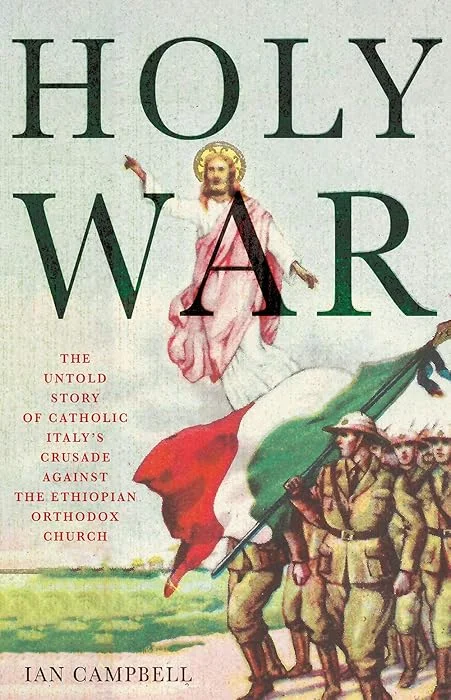
Holy War: The Untold Story of Catholic Italy’s Crusade Against the Ethiopian Orthodox Church
by Ian Campbell
Recommendation
When Italy invaded Ethiopia in 1935, the world recorded a war of conquest. Ian Campbell argues that it was also something the history books left out: a religious war, sanctified by the Italian Catholic hierarchy as a crusade against the ancient Ethiopian Orthodox Church, and waged through the systematic killing of its clergy and the burning of its churches. Over two decades of fieldwork, archival digging, and interviews with eyewitnesses, Campbell pieced together a campaign that the Italians took care to leave undocumented and that the wider world never noticed. His central case study, the massacre at the monastery of Debre Libanos in May 1937, turned out to be far larger than anyone had recorded, and only the most visible part of a much wider pogrom.
The book speaks first to Ethiopian readers, especially the Orthodox faithful and anyone who passes the Yekatit 12 monument in Addis Ababa and wants to know what it commemorates. It speaks to students of Ethiopian history, including those preparing for the national leaving examination, who learn about the Italian occupation and the Patriots but rarely about its religious dimension. And it speaks to readers anywhere who want to understand how an atrocity can be carried out in remote places, against people who leave no witnesses, and then quietly vanish from the record.
This is a sober, heavily documented work, and Campbell lets the evidence carry the weight. He does not soften the findings, and he does not inflate them. He treats the subject with the seriousness it demands, and he is careful to note that the victims, though mostly Orthodox Christians, were not only Christians, and that not every Italian shared the zeal of the men who gave the orders.
Take-aways
- The invasion was framed as a holy war. Italian cardinals, archbishops, and bishops promoted and blessed the 1935 campaign as a crusade against what they called the heretics and schismatics of the Ethiopian Orthodox Church.
- The Ethiopian Church is one of the oldest in the world. Christianity in Ethiopia traces back to the fourth century, and the Ethiopian Orthodox Tewahedo Church has stood at the center of the nation’s identity ever since.
- Yekatit 12 began with a failed assassination. On 19 February 1937, two young Eritreans threw grenades at the viceroy Rodolfo Graziani during a public alms-giving in Addis Ababa, wounding him but killing no senior officials.
- The reprisal was a massacre. Italian forces killed almost all of the roughly 3,000 Ethiopians at the ceremony, and Blackshirts then spent days hunting and killing across the city, with an estimated 19,000 civilians dead in all.
- Debre Libanos was far deadlier than recorded. Campbell’s reconstruction puts the death toll of the May 1937 monastery massacre between roughly 1,800 and 2,200, against the figure of around 320 in the Italian commander’s own telegrams.
- The killing of clergy was systematic, not incidental. Campbell documents a wider campaign in which hundreds of churches and monasteries were attacked, with around 2,000 churches reported ransacked or ruined and thousands of clergy killed.
- The war did not end when Mussolini said it did. Although Italy declared victory on 9 May 1936, fighting and reprisals continued for years, out of sight of a world that had turned its attention to Europe.
- The record was nearly erased. Because the targeted churches were often remote and the clergy were executed, few witnesses survived, and the religious dimension of the occupation passed almost unrecorded until Campbell reconstructed it.
Summary
Campbell built the book over roughly two decades, joined for much of that time by the Ethiopianist scholar Richard Pankhurst, to whom the work is dedicated. It is the culmination of a trilogy that includes his studies of the assassination plot against Graziani and the massacre of Addis Ababa. What began as an inquiry into a single monastery massacre widened, as the evidence accumulated, into the story of a campaign against an entire national Church. The work demanded site visits, false starts, and the patient cross-checking of fragmentary Italian documents against the testimony of survivors and the records of the Church, and Campbell warns the reader early that the picture that emerged was far darker than he had assumed when he began.
A most ancient Church
Ethiopia received Christianity in the fourth century, and the Ethiopian Orthodox Tewahedo Church became one of the oldest national Churches in the world. Campbell opens by establishing what was at stake. The monastery of Debre Libanos, founded by the thirteenth-century monk Tekle Haymanot, whose name means Plant of Faith, was among the most revered pilgrimage sites in the country, its principal church rebuilt by Emperor Menelik. The Church was not a side institution. It was woven into the monarchy, the calendar, the land, and the sense of nationhood, which is precisely why it became a target. Debre Libanos held a special place: its abbot held the office of Ichege, the head of Ethiopia’s monks and the second-highest figure in the Church after the archbishop, and the monastery had been a spiritual heart of the country for more than six centuries. To strike it was to strike at the institution that bound the nation together.
A war blessed as a crusade
Campbell’s most pointed argument concerns the Italian Catholic hierarchy. He documents how senior clergy promoted the invasion as a sacred undertaking. In October 1935, Cardinal Schuster, the influential Archbishop of Milan, gave the campaign what was widely seen as a divine seal and blessed thousands of the steel rings collected to fund the war. Other cardinals and bishops joined in, casting the Orthodox Ethiopians as heretics and schismatics to be brought into the Roman fold. Campbell traces how the rhetoric of the medieval crusades resurfaced almost word for word in the sermons of 1935 to 1937. For many Italians, this was no longer only a colonial war. It was a holy war.
Mussolini’s own aims were political, to avenge old humiliations and to enlarge the prestige of Italy and of Fascism, but the blessing of the Church gave the enterprise a moral cover that reached deep into Italian society. Emperor Haile Selassie, for his part, took Ethiopia’s case to the League of Nations in Geneva, placing great faith in an international order that ultimately did nothing to stop the invasion. Among the senior churchmen of the period was Cardinal Eugenio Pacelli, the Vatican Secretary of State who would later become Pope Pius XII, a reminder of how close to the center of the Church the sanctioning of the war reached.
Yekatit 12: the massacre of Addis Ababa
On Friday, 19 February 1937, the date remembered as Yekatit 12, the viceroy Rodolfo Graziani held a public alms-giving at the former imperial palace at Sidist Kilo. During the ceremony, two young Eritreans in his entourage threw hand grenades at the dais. Graziani and several officials were wounded, but none of the senior figures were killed. The response was immediate and vast. Italian forces killed almost all of the roughly 3,000 Ethiopians gathered at the ceremony. That evening the Fascist federal secretary Guido Cortese unleashed the Blackshirts of the 6th Tevere Division, joined by Italian civilians, for days of unrestricted killing and looting. More than 4,000 houses were burned, residents were hunted through the streets, and an estimated 19,000 Ethiopian civilians died, including a large share of the most educated. Campbell calls it the largest single crime against humanity the Italians committed in Ethiopia. No family was permitted to bury its dead; bodies were burned in public or thrown into rivers and wells, and thousands more were rounded up into detention camps in and around the city and as far as Somaliland and Eritrea. While the capital burned, the Italians carried out parallel massacres in secondary towns wherever their garrisons stood. Campbell describes it as the deadliest assault by invaders under Catholic command on the capital of an Orthodox Christian country since the sack of Constantinople in the Fourth Crusade of 1204. At the height of it, the Italians tried to burn down St George’s Cathedral, Menelik’s royal church and the place of Haile Selassie’s coronation in 1930, and had already pulled down the emperor’s equestrian statue on the orders of the colonial minister Alessandro Lessona.
Debre Libanos
After Yekatit 12, Graziani turned on the institutions he saw as obstacles, among them the Amhara nobility, the educated class, and above all the Church, which he accused of complicity, or at least of failing to react. In May 1937 he ordered the destruction of Debre Libanos. The task fell to General Pietro Maletti, who had the clergy and pilgrims rounded up and taken in trucks to execution sites at Laga Weldé and at Borale, near Debre Birhan. The Italian commander’s telegrams reported around 320 dead. Campbell’s reconstruction, drawing on eyewitnesses and the monastery’s own records, puts the true toll between roughly 1,800 and 2,200, including monks, deacons, priests, students, and pilgrims from across the country. Among the last to die were children and servants who had been locked in a cellar for safety and starved when the monastery emptied. The killing was staged over several days in May, with separate executions at the monastery, at Laga Weldé, and at Borale, reaching beyond the monks of Debre Libanos to clergy, students, and pilgrims drawn from churches across the country. Maletti’s own written orders covered only the monastery’s monks, which leaves Campbell with a hard question: why did a commander who portrayed himself as merely following instructions go so far beyond them, executing pilgrims and clergy he had never been told to touch? The massacre, ordered in writing by the High Command, was the best documented part of the campaign, and yet even it had been recorded at a fraction of its real scale.
The wider pogrom
Debre Libanos, Campbell argues, was the tip of the iceberg. As he dug deeper, he found that the killing of clergy and the burning of churches had been carried out in town after town and village after village, often in remote areas where no witnesses survived. A postwar Ethiopian submission reported around 2,000 churches ransacked or ruined and 500,000 homes and properties burned. Campbell notes that this represents perhaps a fifth of the estimated ten thousand or more churches standing in Ethiopia at the time of the invasion. Most of the non-combatant victims, Campbell concludes, were Christians, the majority of them Orthodox, though he is careful to record that the dead were not only Christian and that the suffering fell across the whole population. The invasion also introduced a form of total war, waged deliberately against civilians as well as soldiers, a method Europe would come to know well in the years that followed. Because the world believed the war had ended when Mussolini proclaimed his empire on 9 May 1936, almost none of this reached the outside press. In reality the fighting and the reprisals continued for years, and Campbell notes that more Ethiopians died at the hands of the Italian military after that date than before it, while correspondents were forbidden to report that the two armies were still engaged.
Recovering the record
The achievement of the book is recovery. Campbell shows how a deliberate campaign was hidden by its own perpetrators, who executed the witnesses and kept the killing in places the press could not reach, and how it then slipped from history because the rest of the world had moved on. By combining fragmentary Italian documents with Ethiopian oral testimony and the records of the Church itself, he restores both the scale of what happened and its character as a war on a faith. He closes by reflecting on why the story matters, and on the long shadow that the crusading impulse, revived in the twentieth century, cast over one of the world’s oldest Christian nations. The point of the recovery, he suggests, is not only to name the dead but to ensure that a crime carried out in silence is no longer allowed to rest in it.
About the Author
Ian Campbell is a historian known for his investigations into the Italian occupation of Ethiopia, where he lived and worked for many years. Holy War is the third of his books on the subject, following The Plot to Kill Graziani, which examined the attempted assassination of Mussolini’s viceroy, and The Addis Ababa Massacre: Italy’s National Shame, a detailed account of the killings that followed Yekatit 12. He also wrote a study devoted specifically to the massacre of Debre Libanos. His method combines archival research in Italian and Ethiopian sources with extensive fieldwork and eyewitness interviews, and his work has been central to the modern effort to document Fascist Italy’s crimes in Ethiopia. Holy War was published by Hurst and Company of London in 2021, and is dedicated to the Ethiopianist scholar Richard Pankhurst.