Recommendation
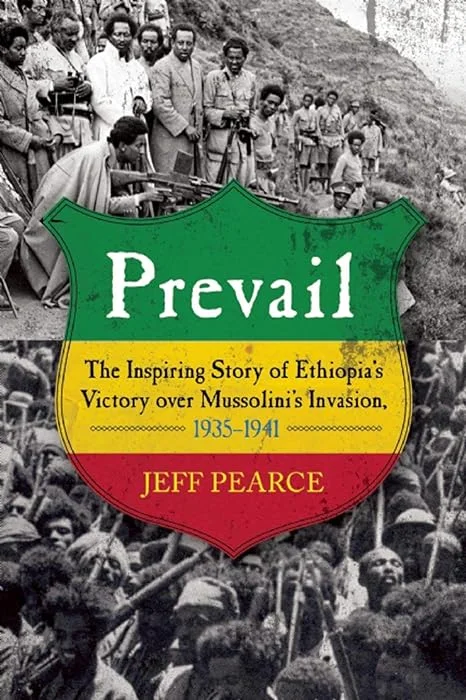
Jeff Pearce’s Prevail is a full narrative history of the war Italy launched against Ethiopia in 1935 and the resistance that ended six years later with the Emperor riding back into his capital. Pearce calls it the war the world forgot, and he sets out to explain both why it once mattered enormously and how it slipped out of memory. He tracks the diplomacy in Geneva, London, Paris, and Washington, the fighting in the mountains of Tigray and the deserts of the Ogaden, the long occupation, and the patriot bands who never accepted defeat. The book carries a foreword by the historian Richard Pankhurst, and it draws on Italian diaries, Swedish and Dutch Red Cross records, British dispatches, and the memories of Ethiopians who lived it.
The book is for three kinds of reader. The reader who knows the Italian occupation as a few lines about poison gas and the patriots and wants the full shape of it. The diaspora Ethiopian in Washington or London who grew up hearing about the Arbegnoch from a grandparent and wants the documented account. The general reader anywhere who knows the Second World War but has never been told that one of its first chapters was written in Addis Ababa.
What makes the book worth the time is its scale and its evidence. Pearce restores the war to its real size: a conflict that pulled in Harlem and Cape Town, the League of Nations and Standard Oil, Winston Churchill and Nelson Mandela. He treats the Ethiopians as actors in their own history rather than as victims in someone else’s, and he lets the documents carry the weight, including the ones that show how the great democracies chose to look away.
Take-aways
-
Ethiopia was the only African member of the League of Nations, and the League failed it. When Italy attacked, the body sworn to defend members imposed sanctions that left out oil and never closed the Suez Canal to Italian troopships.
-
The war began with a manufactured incident at Walwal. A clash over desert wells in the Ogaden in December 1934 gave Mussolini the pretext he wanted, and Pearce argues the provocation was orchestrated from Rome.
-
Italy used poison gas on a scale meant to terrify. Aircraft sprayed mustard gas, called yperite, over soldiers, herders, livestock, and Red Cross hospitals, in open violation of the conventions Italy had signed.
-
Haile Selassie’s 1936 speech to the League is one of the most quoted appeals in modern politics. Speaking in Amharic at Geneva, he warned the assembled powers, “It is us today. It will be you tomorrow.”
-
The occupation produced one of the century’s worst urban massacres. After a grenade attack wounded the viceroy Graziani in February 1937, Italian forces were given three days to kill at will in Addis Ababa, remembered in Ethiopia as Yekatit 12.
-
The resistance never stopped. The Arbegnoch, the patriots, kept fighting through five years of occupation, and their pressure made the country ungovernable long before the British arrived.
-
The Emperor came home exactly five years to the day after he lost the capital. He entered Addis Ababa on 5 May 1941, the same date the Italians had taken it in 1936.
-
No Italian was ever tried for war crimes committed in Ethiopia. Commanders who ordered gas and reprisal killings were shielded after 1945, and the war was quietly reclassified as a separate, forgotten conflict.
Summary
Pearce builds the book in three movements, named for the arc he sees in the story: Resist, Endure, Prevail. The first part covers the slide into war and the failure of diplomacy to stop it. The second covers the invasion, the gas, the defeat of the regular army, and the years of occupation. The third covers the patriot resistance, the British re-entry, the liberation, and the long silence that followed. The structure lets him hold two stories at once: what happened on Ethiopian ground, and what the wider world did, or refused to do, in response.
A pretext in the desert
The road to war ran through a cluster of wells called Walwal, an oasis deep in the Ogaden region of Ethiopia, near the frontier with Italian Somaliland. In December 1934 Ethiopian and Italian-led forces clashed there. Pearce argues the confrontation was engineered from Rome, and that Mussolini was already looking for a fight. Haile Selassie’s response was to take the dispute to the League of Nations rather than answer force with force, a choice that turned a desert skirmish into an international crisis and put Italy’s intentions on the world’s agenda.
Behind Walwal lay an older wound. In 1896 an Italian army had been broken at Adwa, the first time a European power was decisively defeated by an African one. Mussolini wanted that humiliation erased, and the conquest of Ethiopia was meant to be the erasing. The Duce was not improvising a colonial adventure. He was settling a national score and building the new Roman Empire he had been promising Italians since he took power.
For the Ethiopian reader the name Adwa needs no gloss. The 1896 battle, marked every year, is the moment the country proved a European army could be beaten. Mussolini knew it too, and his war was in part a demand for a rematch. Reading Prevail alongside the Adwa story turns 1935 from an isolated catastrophe into the second act of a single contest.
The world watches, and the powers look away
For more than a year the crisis dominated Western headlines. Ethiopia’s membership in the League of Nations meant, on paper, that the other members were bound to defend it. In Britain the League of Nations Union had just published the Peace Ballot, a survey of more than eleven million people, and the public had voted overwhelmingly for collective action against an aggressor. The example everyone understood was Italy against Ethiopia.
The governments did not follow their publics. Britain and France preferred to keep Mussolini away from Hitler, and they were willing to pay for that with Ethiopian territory. In December 1935 the British foreign secretary Samuel Hoare and the French premier Pierre Laval secretly agreed a plan to hand Italy a large slice of the country. When the Hoare-Laval Plan leaked, the scandal forced Hoare out, but the underlying choice held. Sanctions were imposed on Italy, yet they pointedly excluded oil, the one commodity that could have stopped the war machine, and the Suez Canal stayed open to Italian troop and supply ships. The League had the tools and declined to use them.
The episode is worth sitting with. Ethiopia did everything the system asked of it. It joined the League, it brought its grievance to Geneva instead of the battlefield, it trusted the promise of collective security. The promise was empty. For Ethiopian readers who have watched later crises play out with the same vocabulary of concern and the same absence of action, the pattern will feel familiar.
Tanks, gas, and the men who fought anyway
The invasion opened in October 1935. Italy’s first commander, De Bono, advanced cautiously into the north and took the symbolic prize of Adwa; when he proved too slow for Mussolini, he was replaced by Pietro Badoglio, while Rodolfo Graziani pushed up from the south. The Ethiopians were outgunned in every category. Their rifles were often old and mismatched, their shields were buffalo hide, and against tanks and aircraft they had courage and terrain.
For a while that was nearly enough. At Dembeguina Pass in December 1935, fighters under Ras Imru swarmed an Italian column in a narrow gorge and slipped away with fifty captured machine guns. News that “savages” were holding their own astonished the world and infuriated Mussolini. So Italy reached for the weapon that broke the resistance: poison gas. Aircraft sprayed yperite across whole districts. It burned soldiers and herders, fouled the water and pasture, and fell on the Red Cross hospitals that tried to treat the victims. The last set-piece battle came at Mai Chew in the north at the end of March 1936, fought into Easter, where Haile Selassie himself took the field. The army was shattered, and the retreat toward Lake Ashangi turned into a gauntlet of gas and air attack.
The schoolbook reduces this to a phrase: Italy used poison gas. Prevail gives the student the names and the places behind the phrase, Dembeguina and Mai Chew and the shores of Lake Ashangi, and the commanders Imru, Kassa, and Seyum who led men into it. Those fighters were a regular army with leaders and tactics, defeated by chemical weapons their enemy was forbidden to use and used anyway.
A king’s lonely prayer
With the army broken, the Emperor left for exile, and in June 1936 he did something no head of state had done before. He walked to the rostrum of the League of Nations in Geneva and addressed the assembled powers directly. Italian journalists in the gallery tried to shout him down and were removed by the guards. Choosing to speak in Amharic, he laid out the gas, the broken treaties, the abandoned promises. “God and history will remember your judgment,” he told them. As he stepped down, the microphone caught his last warning to a Europe that thought itself safe: “It is us today. It will be you tomorrow.”
The speech changed no votes that week. No delegate offered him an answer. Within three years the same powers that had let Ethiopia fall were at war with the same enemies, and his warning read like prophecy.
The slogan behind the book’s title, “The Lion of Judah has prevailed,” is older than the war. It belongs to the Solomonic claim that runs through Ethiopian kingship and to the scripture that shaped the Emperor’s public voice. His appeal at Geneva was framed as a moral one, addressed to powers that called themselves Christian and civilized, and it exposed how little those words bound them when an African nation was the one in danger.
The occupation and Yekatit 12
Italy declared its empire and settled into occupation. The ancient obelisk of Aksum was hauled down and shipped to Rome in 1937 as a trophy. The Italians built roads and barracks, but they never held the countryside, and the resentment in the capital was constant. It broke open in February 1937. At a public ceremony, two young men, Moges Asgedom and Abriha Deboch, threw grenades at the viceroy Graziani. He survived with hundreds of shrapnel wounds, and the reprisal was immediate and enormous. Guido Cortese, the local Fascist Party secretary, gave Italian civilians and soldiers three days of free rein. They went through Addis Ababa with iron bars, rifles, and cans of petrol, beating and shooting and burning families inside their homes. Thousands of Ethiopians died in what the country remembers as Yekatit 12, the Graziani Massacre.
Pearce, leaning on the work of historian Ian Campbell, shows how the killing was organized rather than spontaneous, and how the truth was buried afterward, kept even from officials in Rome, so that Italy could avoid the humiliation of admitting the attack may have started inside the viceroy’s own staff.
Yekatit 12 is not abstract history in Ethiopia. The date is marked, and a monument in Addis Ababa names the dead. What Prevail adds to the memorial is the documented sequence, drawn from Italian diaries and later scholarship, and the reminder that the victims were the ordinary residents of the city, the old and the poor who had come out for a public occasion.
The Arbegnoch and the road back
The resistance the Italians could never crush had a name of its own. Foreigners called the fighters patriots; Ethiopians called them the Arbegnoch. For five years they harried the occupation, melting into the hills, striking and vanishing, making the country impossible to truly govern. The journalist George Steer, who knew Ethiopia well, wrote that the patriot’s chief weapon was his “invisible ubiquity,” the constant uncertainty about where he would appear next.
When Italy entered the wider war in 1940, Britain finally had a reason to act. The eccentric officer Orde Wingate was sent to build what he called Gideon Force, a small column that would fight alongside the Arbegnoch and escort Haile Selassie back into the country. The campaign of 1941 combined British and Commonwealth troops, Sudanese units, and the patriot bands who had carried the war for half a decade. Town by town, the occupation collapsed.
The word matters. The British came at the end of a fight that was already five years old, and Prevail keeps the Arbegnoch at the center of their own liberation. In many Ethiopian families the word arbegna still names a grandfather, and the book gives that inheritance its documented due.
Day of deliverance, and the war the world forgot
On 5 May 1941 Haile Selassie rode back into Addis Ababa. The date was deliberate. It was exactly five years since Badoglio had driven through the same gates expecting the Italian empire to last forever. Around fifteen thousand patriots of Abebe Aregai marched into the city, Wingate rode a white horse, and the Emperor, saddle-sore, came in a black Ford convertible while crowds threw flowers and prostrated themselves in the road. From the rostrum he reached, as he always did, for scripture: “On this day Ethiopia stretches out her hands to God.”
Then the forgetting began. After 1945 the conflict was filed away as “another war,” separate from the Second World War and not worth revisiting. Badoglio surrendered to the Allies and persuaded them to keep him as prime minister, which conveniently made prosecuting him impossible. Graziani was sentenced in 1948, but for collaboration with the Germans against Italians, not for anything done in Ethiopia, and he was soon released. Not a single Italian was ever tried for the war crimes committed during the invasion and occupation. As Pearce and Pankhurst both note, the silence held so well that in 2012 a town in Italy could put up a monument to Graziani, which is part of what moved Pearce to write.
The obelisk of Aksum was finally returned and raised again in its own field, which Pearce treats as a small act of justice against a long forgetting. That is the book’s purpose. It sets the record down in full, so the war keeps its real size and the Arbegnoch keep their names. Remembering accurately is its own form of respect.
About the Author
Jeff Pearce is a Canadian writer and journalist. Prevail, published by Skyhorse in 2014, is his narrative history of the Italo-Ethiopian war of 1935 to 1941, written to rescue the conflict from the margins of the Second World War’s story. To build it he worked from a wide base of primary material, including Italian eyewitness diaries, the records of the Swedish and Dutch Red Cross missions, British diplomatic and journalistic sources, and the private collection of the Pankhurst family. He traveled in Ethiopia during his research, and several of the book’s photographs are his own, taken at Aksum, Lalibela, and around Addis Ababa. The book carries a foreword by Richard Pankhurst, the historian and a founder of modern Ethiopian studies, and it is dedicated to the journalist George Steer and to the Ethiopian Patriots.