Recommendation
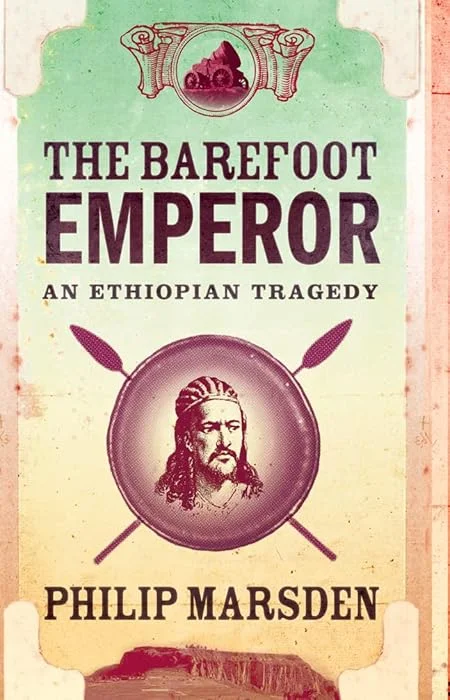
Philip Marsden’s The Barefoot Emperor is the story of Tewodros II, the ruler who pulled a broken Ethiopia back into a single shape and then broke himself against the modern age. Born Kasa Hailu around 1820, far from the royal court, he climbed from outlaw to King of Kings, ended the long century of provincial warlords the chronicles call the Zemene Mesafint, and tried to drag the ancient empire toward the technology of Christian Europe. The dream curdled. Letters to Queen Victoria went unanswered, a British consul and a group of European missionaries ended up in chains, and Britain answered with one of the most elaborate and expensive military expeditions of the Victorian age. It closed in April 1868 on the flat-topped mountain of Meqdela. Marsden builds the account from people who were there: the captives’ memoirs, the missionaries’ diaries, the Amharic chronicles of Zeneb and Welde Maryam, and Tewodros’s own letters.
The book is for three kinds of reader. The ESSLCE history student who meets Tewodros as a single proud line in a textbook and wants the human being behind the spear-carrying mural. The teacher or general reader who knows the emperor mainly through the Sevastopol replica on a roundabout in Addis Ababa. The diaspora Ethiopian whose feeling for Tewodros is strong, inherited, and rarely examined.
What makes the book worth reading is that Marsden refuses the two easy verdicts. He does not deliver the schoolbook hero, the greatest patriot who loved his country to the point of tears. He also rejects the Victorian caricature of the mad despot, the figure Alan Moorehead once called a black reincarnation of Ivan the Terrible. He holds both halves at once: a reformer of real vision and a ruler whose cruelty deepened year by year, and he leaves the judgment to the reader. The result is a portrait of a man and a moment, the bright and quickly shadowed meeting between a long-isolated empire and a pushy, industrial Europe.
Take-aways
- Tewodros ended the Zemene Mesafint. For roughly a century, real power had belonged to regional lords while powerless emperors reigned in name at Gondar. Kasa Hailu broke that order in battle and was crowned in 1855.
- He rose from outside the dynasty. His father was Dejazmach Haylu Welde Giyorgis; his enemies taunted that his mother, Atitegeb, sold koso on the streets of Gondar. Church-schooled, he became a shifta in the western lowlands and won men through a run of victories.
- His name was a prophecy. The sacred text Fekkare Iyesus foretold a king called Tewodros who would restore Ethiopia’s glory. Kasa took the name at his coronation and stepped knowingly into that messianic role.
- He measured himself against King David. He completed his Dawit, the psalms, as a boy and carried a copy everywhere; observers said he shaped his life on his “illustrious progenitor,” the shepherd who became a king.
- His reforms ran ahead of his power. He wanted a paid army that would buy grain instead of plundering it, an end to the slave trade, and a tax on the Church’s vast lands. The clergy resisted, and on the question of Church land he backed down.
- He was gripped by European technology. He set Protestant missionaries to work at a foundry at Gefat, and together they cast the seven-ton mortar he named Sevastopol.
- A diplomatic snub lit the fuse. His overtures to Britain drew no real reply for years; only a single rifle arrived where he had asked for an alliance. Feeling insulted, he chained the British consul and several Europeans on Meqdela.
- He chose death over capture. As Lieutenant-General Sir Robert Napier’s army stormed Meqdela after Easter 1868, Tewodros put his own pistol in his mouth. The act sealed his legend. The British looted the mountain’s treasures and carried his young son, Alemayehu, to England.
Summary
Marsden tells the story chronologically and through witnesses, alternating between the Ethiopian camp and the Europeans who were drawn into it. He frames the whole book with his own journeys on foot through the highlands, tracing the road Tewodros built in his final months, so that the landscape itself becomes a character.
A boy from Qwara
Kasa Hailu was born around 1820 in provincial obscurity, in the lowland region of Qwara. His father, Dejazmach Haylu Welde Giyorgis, died when Kasa was young. The truth about his mother, Atitegeb, troubled him all his life: enemies said she was a camp-follower who sold koso, a common purgative, on the corners of Gondar, while others called her a noblewoman of great beauty. Either way she secured him years of Church schooling, and he could outquote many of the European missionaries who later came to the country. He was studying at a monastery when a warlord attacked it and slaughtered the novices. Kasa fled, and joined the outlaws who haunted the remoter hills. He lived in caves, robbed caravans, and divided the spoils among his growing band. As a boy he had completed his Dawit, the psalms of David, with unusual speed, and those who later met him noticed that he carried a copy everywhere and shaped himself on his “illustrious progenitor,” the shepherd who became Israel’s king. The confirmed facts of his early life kept falling into that ancient pattern: the provincial birth, the outlaw years, the followers who gathered to a leader marked by luck. When drought and famine struck and the rulers in Gondar could do nothing, it was Kasa who rode out of the wilderness with looted grain and gave people money to buy tools, even cutting back the forest himself to plant grain. The pattern of his rise was set: military success so consistent that he came to read it as a plan devised by God.
The crown and the prophecy
Kasa’s wars carried him through the great names of the age. He defeated Empress Menen and her son Ras Ali, his own father-in-law, ending their power at Ayshal on 29 June 1853. The clemency and the cruelty appeared side by side from the start. He spared the captured rebel Biru Goshu, who admitted he would have executed Kasa in his place, yet when a captured minstrel was made to repeat the mocking song he had sung against him, Kasa had the man flogged to death. He captured the senior cleric, Abune Selama, and then broke Dejazmach Wube of the north in the Simien mountains early in 1855, rallying his exhausted troops with a pun: “I will give you my name,” he promised, and simien in Amharic means both “my name” and the province of his rival. Two days later, in the presence of Abune Selama and the ichege, the head monk, Kasa was crowned. He did not at first claim the Solomonic title; he did something he judged greater. The sacred Fekkare Iyesus had long promised that a ruler named Tewodros would rise to banish Ethiopia’s enemies and restore her glory. In the 1830s the whisper had already run through the highlands, “Tewodros is come,” and an earlier man who claimed the title had his severed head hung in the square at Gondar for his presumption. Kasa took that name and made it stick. With his victories he made the territory of Ethiopia larger than it had been for a thousand years, and the Era of the Princes was over.
A vision born too early
Tewodros opened his reign with proclamations that read like a national programme. Soldiers were to be paid and trained, so that they would buy food from farmers rather than plunder it; weapons not in his army’s hands were to be smelted into ploughshares and sickles. He moved against the slave trade, buying slaves and sending them to be baptised. He dreamed of reclaiming the coast and the lands annexed by Egypt. Walter Plowden, the British consul who left the fullest early portrait of him, found a young, tireless ruler of clear ideas and signal faith, courteous to his humblest subjects and free of greed, but warned London of his violent anger and his unyielding sense of divine right. The reforms that met the hardest wall were fiscal. When Tewodros asked the clergy to accept a tax on their enormous landholdings, they produced the Fetha Negest, the Book of the Law of Kings, and read out that what is given to the Holy of Holies cannot be taken back. He raged, then relented: the priesthood conceded his right to tax them, and he agreed never to use it. His authority had reached its limit at the gates of the Church.
The lure of the foreign smith
More than territory, Tewodros wanted what Europe could make. From the first Portuguese mission in 1520, Ethiopian emperors had asked the same blunt question of their Christian visitors: how many guns do you have for us? Tewodros pursued the answer with a builder’s obsession. He gathered the Protestant missionaries who came hoping to convert the country, and turned them into engineers. At a foundry village at Gefat, men like Theophilus Waldmeier and Johann Flad, who had arrived to save souls, instead cast cannon and a great mortar for the emperor. The largest of these he named Sevastopol, a seven-ton bronze monster that would become the strange symbol of his reign. The missionaries’ faith and the emperor’s ambition met in the heat of the foundry, an arrangement that bound the Europeans to him and, in time, helped to trap them.
The unanswered letter
The tragedy turns on a failure of communication. Encouraged by Plowden, Tewodros wrote to Queen Victoria, “the child of Christ” addressing “the child of Christ,” asking for friendship and, beneath the courtesy, for arms and an alliance against the Muslim powers on his borders. The letter and Plowden’s supporting plea moved at the speed of empire’s paperwork. Two years passed; the War Office, judging it “inappropriate” to arm him, sent a single rifle and no ammunition. Plowden was later killed, and the Englishman John Bell, who had served the emperor closely, was killed soon after. Isolated, grieving, and convinced he had been snubbed by the most powerful Christian monarch on earth, Tewodros turned on the foreigners within reach. He imprisoned the new consul, Charles Duncan Cameron, and the missionary Henry Stern, then others, holding them in chains high on Meqdela. The break with Stern was bitterly personal: the missionary had published a passage repeating the old taunt that the emperor’s mother had sold koso on the street, the very wound Tewodros had carried since boyhood. Britain sent an envoy, Hormuzd Rassam, with a conciliatory letter; the emperor received him with warmth and then added him to the captives. Diplomacy had run its course.
Napier’s road, Tewodros’s road
Britain’s reply was an army. Lieutenant-General Sir Robert Napier landed at Annesley Bay on the Red Sea coast and built, from nothing, a port, a railway, water condensers, and supply depots, then marched some four hundred miles inland. Forty-four elephants brought from Bombay hauled the heavy guns. The campaign would run far past its budget, reaching about nine million pounds, and Napier admitted afterward that he had never thought of the cost. The bill was so large that Parliament added a penny to income tax to pay for it, and people came to call it the twopenny war. As the British advanced, Tewodros made his own extraordinary march. In October 1867 he burned his capital at Debre Tabor and set out for Meqdela with fifty thousand people, building a road as he went so that his cannon could follow. Week after week his half-starved followers hacked the route from the rock by hand and hauled Sevastopol up the slopes on leather straps while rebels picked off the stragglers. A journey a messenger could do in days took the emperor six months. British officers who reached the finished road called it a monument of unconquerable resolution, a march unequalled in the annals of history. The armies met below Meqdela on Good Friday, on the plain of Aroge. From the heights Tewodros opened with his guns, then sent thousands of warriors surging down the slope, many on horseback, against a thin British line still climbing up from the valley. They charged into breech-loading Snider rifles and the screaming arc of rockets from the Naval Brigade. The fighting lasted only a few hours, and the slaughter was terrible and one-sided: hundreds of Ethiopians fell for a handful of British dead. The will was not in question. The machines were on the other side.
Meqdela, and the long echo
After the defeat at Aroge, Tewodros wavered between surrender and defiance, released some prisoners, and refused Napier’s terms because, he said, the general had been sent by a woman. When the British stormed the gates of Meqdela after Easter, the emperor freed his last followers from their allegiance, declared he would never fall into an enemy’s hands, and shot himself with his own pistol as the first soldier reached the summit. Rassam, the captive he had called his friend, oversaw his burial. The British then looted the mountain, where Tewodros had gathered the treasures of thousand-year-old monasteries: silver crosses, filigree crowns, holy tabots, and vellum manuscripts. It took fifteen elephants and nearly two hundred mules to carry the plunder away, and a British Museum agent bought hundreds of manuscripts at the auction that followed. The army burned Meqdela and marched to the coast, taking with them the emperor’s seven-year-old son, Alemayehu, who was raised in England and died there at eighteen, buried near St George’s Chapel at Windsor. The legend grew faster than the grief. King Menelik of Shoa, who had escaped Meqdela years before, mourned the man who had once been a father to him, and went on to unite the country and defeat the Italians at Adwa in 1896, completing much of what Tewodros had begun. In the century that followed, Ethiopians remembered not the victims or the defeat but the death: the choice to die rather than surrender, echoed by leaders down to the wars of the twentieth century. In Addis Ababa there is no statue of the man, only the Volkswagen-sized replica of Sevastopol, a gun that never fired, its open mouth still speaking of what might have been.
About the Author
Philip Marsden is a British travel writer and author of narrative non-fiction. He first travelled to Ethiopia in the early 1980s, during the rule of the Derg, and returned over the following decades, walking long stretches of the country on foot. For The Barefoot Emperor he drew on Ethiopian and European archives and on guides and scholars in the country, including the historian Richard Pankhurst, a long-time resident of Addis Ababa, and Shiferaw Bekele of Addis Ababa University. He worked from the first-hand accounts of the European captives and missionaries, surviving Amharic chronicles, and Tewodros’s own correspondence, supported by the document collections of the scholar Sven Rubenson. His method shows throughout: he walks the ground he writes about, and reads the landscape as evidence alongside the documents.