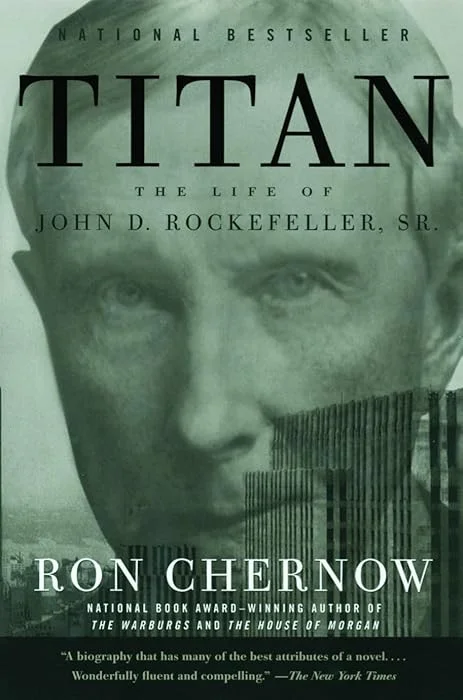
Titan: The Life of John D. Rockefeller, Sr.
by Ron Chernow
Recommendation
John D. Rockefeller built Standard Oil into the most powerful company of its age, became the richest man in the world, and then gave away more money than anyone before him. Ron Chernow set out to explain how one person could be all of these at once. The answer he found is that the devout Baptist who tithed from his first wages and the cold monopolist who crushed his rivals were not two men wearing one face. They were a single, consistent person whose faith and his hunger for order ran from the same source. Chernow calls that faith the passkey to the whole life, and he uses it to open a story that earlier biographers had left half shut.
The book rewards three kinds of reader. Anyone studying business or economics, including ESSLCE students working through market structures and the idea of monopoly, will find one of the clearest accounts ever written of how a single firm comes to control an entire industry, and what governments eventually do about it. Small business owners and traders will recognize Rockefeller’s obsessions: the daily ledger, the war on waste, the patience to wait out a competitor. And readers drawn to the older question of money and conscience, the same ground covered in The Money Code, will watch a man wrestle his whole life with what wealth is for.
Chernow does not ask you to admire Rockefeller or to condemn him. He lays out the rebates and the secret deals beside the universities and the medical research, and he trusts you to hold both in your mind at once. That refusal to flatten the man is what makes the book endure.
Take-aways
- Rockefeller’s faith and his fortune came from the same root. Chernow treats the evangelical Baptist and the ruthless industrialist as one integrated person, not a saint with a hidden devil or a pirate with a pious disguise.
- He gave to charity from his very first paycheck. As a clerk earning about a dollar a day, the teenage Rockefeller recorded donations in a small red book he called Ledger A, and by age twenty his giving had passed a tenth of his income.
- Standard Oil grew through order, not just force. Rockefeller’s edge was relentless bookkeeping, low costs, and control of refining, barrels, pipelines, and railroad shipping, long before he reached for monopoly.
- The Cleveland Massacre of 1872 showed his method. Using secret railroad rebates, he absorbed most of his Cleveland rivals in a matter of weeks, then repeated the pattern until Standard Oil refined roughly nine barrels in ten across America.
- The 1882 trust invented a new kind of company. A board of nine trustees quietly bound dozens of firms into one $70 million enterprise, a structure so novel that the law had no name for it yet.
- Breaking up Standard Oil made him richer. The Supreme Court split the trust into more than thirty companies in 1911, their shares soared, and Rockefeller’s fortune climbed to a peak near $900 million, leaving him just short of the first billionaire.
- He tried to give money away as carefully as he made it. Guided by Frederick T. Gates, Rockefeller funded the University of Chicago, a great medical institute, and a worldwide campaign against hookworm, treating philanthropy as a science.
- The contradictions never resolved, and Chernow lets them stand. The same man fixed prices and funded cures, dodged subpoenas and tithed to his church, and the book asks the reader, not the author, to judge.
Summary
Chernow builds the life around a paradox he states plainly in his foreword: Rockefeller was “such an implausible blend of sin and sanctity” that previous writers either canonized him or demonized him, and both missed the point. The biography moves from a frontier childhood to the oil fields of Pennsylvania, through the building of Standard Oil, into the long public reckoning that broke the company apart, and finally across four decades of retirement and giving. Throughout, Chernow keeps returning to the Baptist faith that he says explains the rest.
The flimflam man’s son
John Davison Rockefeller was born on July 8, 1839, in Richford, New York, then little more than a crossroads in hill country. His father, William Avery Rockefeller, known as Big Bill, was a traveling salesman of patent medicines, a bigamist, and a con man who came and went without warning. His mother, Eliza Davison, was a steady and deeply religious woman who held the household together through the father’s long absences. The boy grew up watching one parent improvise and deceive and the other keep faith and keep accounts, and he chose his mother’s path with a vengeance.
At sixteen, after a short course in double-entry bookkeeping, he found work as an assistant bookkeeper at the Cleveland firm of Hewitt and Tuttle. He took the job so seriously that for the rest of his life he honored September 26 as “Job Day” and celebrated it more warmly than his own birthday. Ledgers became, in Chernow’s phrase, sacred books to him. He loved the way figures rooted decisions in fact and saved a person from fallible emotion, and he pounced on errors of a few cents. The habits of that high stool, the patience, the precision, the suspicion of waste, would later be turned on an entire industry.
A tithe before a fortune
The most surprising fact in the early chapters is moral, not financial. From his first wages, when he was earning roughly a dollar a day, Rockefeller gave money away and wrote each gift into Ledger A. He gave to his Baptist mission, to a mission in a New York slum, to a Black church, and once toward helping a man buy his wife out of slavery. By the time he was twenty, his charitable giving had crossed the tenth that his faith taught him to set aside. Chernow stresses that this was not a late performance to launder a tainted name. The giving and the getting grew up together, two expressions of one disciplined conscience.
In 1864, after a careful courtship, he married Laura Celestia Spelman, always called Cettie, a thoughtful and devout woman from a Cleveland family active in the abolitionist cause. She became his moral anchor and his closest counsel. He worked the morning of his wedding and recorded the cost of the ring, fifteen dollars and seventy-five cents, in his ledger.
Building the octopus
Rockefeller entered oil in Cleveland during the Civil War. With the chemist Samuel Andrews and the merchant Maurice Clark he set up a refinery, christened the Excelsior Works, in 1863. He soon bought out the Clarks and bet everything on refining rather than on the wild gamble of drilling. On January 10, 1870, he and his partners, including Henry M. Flagler, folded their holdings into a joint-stock company called the Standard Oil Company of Ohio, capitalized at one million dollars. At its founding it controlled about a tenth of American refining. Rockefeller already saw further. Standard Oil, he told one businessman, would someday refine all the oil and make all the barrels.
His advantage was scale and cost. He owned his own barrel-making, his own warehouses, his own fleet of tank cars, and he drove waste out of every step. Because he shipped more oil than anyone, he could demand secret discounts, called rebates, from the railroads, and even drawbacks paid to him on his rivals’ shipments. In 1872 the South Improvement Company scheme gave him a devastating edge, and in a few weeks he absorbed most of the refiners in Cleveland. Critics later called it the Cleveland Massacre. He repeated the pattern across the country until, by the early 1880s, Standard Oil refined close to ninety percent of America’s oil.
The trust and the mask
To hold this sprawling empire together across many states whose laws forbade a company from owning property elsewhere, Rockefeller’s lawyer Samuel C. T. Dodd designed something new. The Standard Oil Trust agreement, dated early in 1882, placed the stock of dozens of companies in the hands of nine trustees who met for lunch at 26 Broadway in New York. The public knew nothing of this seventy-million-dollar combination until it surfaced by accident in a hearing years later. Today it would be called a holding company. At the time it seemed almost an invisible thing, controlling most of the refineries and pipelines in the country while appearing to own nothing.
Rockefeller guarded his secrets with a famous composure. He wrote letters as if a prosecutor might one day read them, avoided the words trust and monopoly in favor of the gentle word cooperation, and revealed as little as possible even to friends. Over the 1880s and 1890s he steadily lost his hair to a condition called alopecia, until by the early 1900s not a hair remained on his head or face and he took to wearing wigs, which only deepened the air of a man hidden behind a mask. He saw himself not as a predator but as the builder of a lifeboat, gathering a chaotic and self-destructive industry into one orderly ship.
Nemesis: the muckrakers and the breakup
The secrecy bred suspicion, and the suspicion found a voice. Ida Minerva Tarbell, who had grown up in the Pennsylvania oil regions, watched her own father’s small business broken by Standard Oil’s tactics. Years later, as a journalist, she produced The History of the Standard Oil Company, a patient and damning account that turned Rockefeller’s name into a byword for corporate greed. Henry Demarest Lloyd had attacked him earlier in Wealth Against Commonwealth. Their reporting helped make Rockefeller the most hated businessman in America and fed a national argument about the power of trusts.
The reckoning came in 1911, when the Supreme Court ordered Standard Oil dissolved into more than thirty separate companies. It looked like defeat. It became, in Chernow’s words, the luckiest stroke of his career. Rockefeller still owned about a quarter of the whole. As investors discovered how much hidden value the pieces held, and as the automobile created endless new demand for gasoline, the shares of the new companies soared. His net worth climbed to a lifetime peak near nine hundred million dollars in 1913, a sum larger than the entire yearly spending of the United States federal government. The breakup meant to humble him left him just short of being the world’s first billionaire.
The science of giving
Long before the breakup, the sheer scale of his fortune had become a burden. Money poured in faster than he could responsibly place it, and reckless giving, he feared, did more harm than good. His answer was a Baptist minister named Frederick T. Gates, who became the architect of a new kind of philanthropy. Gates urged Rockefeller to give at wholesale rather than retail, to fund institutions and root causes instead of handing out relief case by case.
The results reshaped American life. Rockefeller founded the University of Chicago and built it, with the scholar William Rainey Harper, into a major university. He created a great institute for medical research, later Rockefeller University, that helped turn medicine into a science. Through the General Education Board and the Rockefeller Foundation he funded schools across the American South and a sweeping campaign to eradicate hookworm, a parasite that had quietly drained the health of millions. Across these institutions he placed close to half a billion dollars. In his last decades, coached by the publicist Ivy Lee, he also softened his public image with a simple ritual, handing out shiny dimes to the people he met.
The long retirement and the verdict
Rockefeller stepped back from running Standard Oil long before the breakup and lived more than forty years in retirement, much of it on the golf course and at his estates, including Kykuit in the hills north of New York City and a winter home at Ormond Beach in Florida. He kept his fortune in one compact mass and transferred most of it to his son, John D. Rockefeller, Jr., the dutiful heir who would carry the family’s philanthropy forward and slowly remake the family name. Rockefeller died in his sleep on May 23, 1937, six weeks short of his ninety-eighth birthday, and was buried in Cleveland beside his mother Eliza and his wife Cettie.
Chernow ends where he began, with a man of permanent contradictions. He neither demonizes nor canonizes. He sets the rebates beside the research institutes, the broken rivals beside the cured patients, and the granite secrecy beside the lifelong tithe, and he leaves the verdict to the reader.
About the Author
Ron Chernow is an American writer known for large, deeply researched biographies and financial histories. His first book, The House of Morgan, won the National Book Award and was later named one of the hundred best nonfiction books of the century by the Modern Library. The Warburgs won the Eccles Prize as the best business book of its year, and his essay collection The Death of the Banker was widely praised. Titan, first published in 1998, was a New York Times Book Review Editors’ Choice and won wide acclaim as the definitive life of Rockefeller. Chernow went on to write celebrated biographies of Alexander Hamilton, which inspired the stage musical, and of George Washington, which received the Pulitzer Prize. He is recognized as one of the leading biographers writing in English.