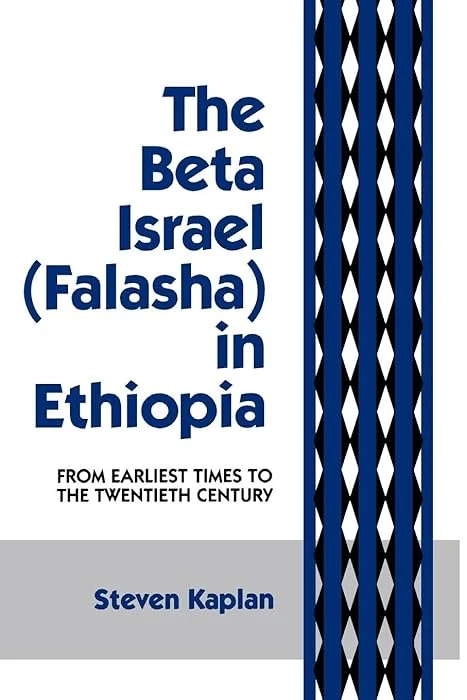
The Beta Israel (Falasha) in Ethiopia: From Earliest Times to the Twentieth Century
by Steven Kaplan
Recommendation
For more than a century, the Jews of Ethiopia have been described as a lost tribe: an ancient fragment of Israel that wandered south, preserved a frozen biblical religion, and waited in the highlands to be found. Steven Kaplan, a historian at the Hebrew University of Jerusalem, set out to write their history from the sources rather than from the legend, and the account he produced is at odds with almost everything the reading public had been told. His central claim is that the Beta Israel are an Ethiopian people. Their Judaism did not arrive from outside as a relic of antiquity. It took shape inside Ethiopia, in the regions around Lake Tana, between the fourteenth and sixteenth centuries, and it drew much of its form from the same Old Testament world that shaped Ethiopian Orthodox Christianity.
The book is for three kinds of reader. Ethiopian readers who grew up with the names Gondar, Semien, and the Solomonic dynasty and want to understand the people who lived alongside that history. Readers of any background who have encountered the dramatic modern story of Ethiopian Jewry in Israel and want the deep background that precedes it. And anyone interested in how a community comes to be defined, named, and set apart from its neighbors over centuries of contact.
What makes the book valuable is its discipline. Kaplan refuses to read the present back into the past. He shows that the very name Falasha means a landless person, not an exile from Zion, and that the religious life now treated as ancient was the work of fifteenth-century monks. He treats the Beta Israel as actors in Ethiopian history rather than as visitors to it. The story he tells is quieter and more tangled than the legend, and it rests only on what the sources will actually carry.
Take-aways
- The Beta Israel are best understood as Ethiopians, not as a foreign Jewish transplant. Kaplan argues that their history is the story of their life in Ethiopia, and that imported terms like Exile and Return obscure far more than they reveal.
- The name “Falasha” means a landless person, not an exile from the Holy Land. It comes from a root meaning to wander or migrate, and Kaplan ties it to the loss of land rights under the Solomonic state, not to any memory of ancient Israel.
- Biblical identity is the shared inheritance of both Jews and Christians in Ethiopia. The Ethiopian Orthodox Church kept the Saturday Sabbath, circumcision on the eighth day, and Old Testament dietary laws, so a common Hebraic culture preceded the split between the two groups.
- Their distinctive religion took shape relatively late, under Christian monks. Tradition credits the renegade monk Abba Sabra and his disciple Ṣagga Amlak with bringing monasticism, purity laws, and a sacred literature to the Beta Israel in the fifteenth century.
- Their books reached them through the Ethiopian Church, not through other Jews. Most Beta Israel sacred texts were translated into Ge’ez from Arabic and arrived by way of Christian sources, some as late as the eighteenth century.
- For nearly three centuries they fought the Christian emperors and lost. From the campaigns of Yeshaq in the fifteenth century to the final defeat under Susenyos in the 1620s, war ended with loss of land, enslavement, conversion, and the end of political autonomy.
- Status rose and fell with imperial patronage. In the Gondar golden age they prospered as smiths, masons, and soldiers; in the Era of the Princes they slid into a despised caste linked to the evil eye, the buda.
- The Great Famine of 1888 to 1892 reshaped the community. Known as Kifu-qen, the awful days, it may have killed half to two-thirds of the Beta Israel and broke down the village barriers that had kept them apart from their neighbors.
Summary
Kaplan organizes the book as a narrative history in the humanities tradition. He leans on written sources, especially those in Ge’ez, and reads them alongside the oral traditions collected by earlier scholars. He deliberately ends the story in the year 1904, on the eve of the community’s entry into world Jewish history, because everything after that belongs to a different kind of book. The summary that follows tracks his argument from the question of names to the question of categories.
A people and their names
Kaplan opens with the problem of what to call his subject. Three names compete. “Falasha” is the term under which the Jews of Ethiopia were known to the reading public for most of the modern era, but members of the community came to regard it as derogatory, and Kaplan shows it was not applied to Judaized groups before the sixteenth century. “Ethiopian Jews,” the term now preferred in Israel, is historically awkward, since in medieval Ethiopia the word ayhud (Jews) was a slur thrown at Christian heretics as often as at actual Jews. Kaplan settles on “Beta Israel,” the House of Israel, the community’s own name for itself, because it carries the least polemical weight. The choice is not cosmetic. It signals his whole method: to describe the people in Ethiopian terms rather than to file them under categories borrowed from elsewhere.
Aksum and the Old Testament world
The search for origins begins at Aksum, the cradle of Ethiopian civilization, which grew rich on Red Sea trade in the first centuries of the Common Era. Kaplan accepts that Jewish influences reached Aksum early and directly, before King Ezana converted the kingdom to Christianity in the fourth century. His evidence is linguistic: words like meswat (alms), tabot (ark), and the name ‘arb for Friday, which in Ge’ez means the eve of the Sabbath rather than the sixth day. These point to contact with Jews or Judaism before the Bible was translated into Ge’ez. But Kaplan is careful. The Ethiopian Orthodox Church became the most faithful keeper of the Old Testament of any church in the world, observing the Saturday Sabbath, circumcision on the eighth day, and biblical dietary laws. Biblical practice and an Israelite self-image, he insists, are the common heritage of all Ethiopians, Christian and Jewish alike. They cannot by themselves prove a separate Jewish community.
He then walks through the famous origin theories and finds each one wanting as history. The land of Cush in the Hebrew Bible refers to Nubia, south of Egypt, not to present-day Ethiopia. The tale of Solomon and the Queen of Sheba, told in the Kebra Nagast, is the heart of Ethiopian royal legitimacy but is a sacred and political text, not a record of migration. The tradition that the Beta Israel descend from the lost tribe of Dan runs back through the ninth-century traveller Eldad ha-Dani, whom Kaplan, following Ullendorff, judges more likely a Jew from South Arabia than from Ethiopia, and forward to the sixteenth-century Egyptian authority known as the Radbaz, whose ruling shaped rabbinic opinion to this day. The legend of Queen Yodit, the fierce Falasha queen who supposedly toppled Aksum, he traces to a real tenth-century queen who was most likely a pagan ruler of the south, recast over time as a Jewess by Christian tradition.
From ayhud to Falasha: the invention of a tradition
The core of the book is its argument that the Beta Israel became a distinct people through events inside Ethiopia. As the Solomonic dynasty expanded after 1270, loosely affiliated groups of ayhud around Lake Tana came under growing pressure. The turning point Kaplan identifies is the reign of Yeshaq, which began in 1413. Earlier kings had treated the ayhud as a peripheral nuisance. Yeshaq moved against them in force, and a decree attributed to him sums up the change: he who is baptized in the Christian religion may inherit the land of his father, otherwise let him be a falasi, a landless person. Whether or not Yeshaq spoke those exact words, and Kaplan notes the doubts, the decree marks the moment when many Beta Israel were stripped of the right to own inheritable land, the rist, and pushed toward tenancy and crafts.
The other half of the transformation was religious. Beta Israel tradition credits a charismatic holy man, Abba Sabra, generally believed to have been a Christian who quarrelled with the king and took refuge among them, with bringing monasticism into their world. His disciple Ṣagga Amlak, said to be a son of the emperor Zar’a Ya’eqob, helped carry the change. Monastic clergy became the chief religious authorities and built a sophisticated liturgy, a calendar of holidays, and a body of sacred literature. Almost all of that literature, including the well-known Te’ezaza Sanbat, the Commandments of the Sabbath, reached the Beta Israel through Ethiopian Christian channels, translated into Ge’ez from Arabic. Kaplan’s conclusion is striking: the monks were not guardians of an ancient faith but major innovators, the crucial catalysts in what he calls the invention of the Falasha. It is more than coincidence, he notes, that one meaning of the word falasyan is monk.
Two centuries of war: resistance and defeat
From 1468 to 1632 the Beta Israel mounted their most determined military resistance and suffered their heaviest defeats. Their organized presence shrank to Semien, Dambeya, and Wagara, with the mountain strongholds of Semien holding out longest because of their harsh terrain. Kaplan reads the wars in the context of the wider crisis of the Christian empire: the devastating invasion of Ahmad ibn Ibrahim, known as Gragn, who routed Emperor Lebna Dengel at Shembra Koure in 1529, and the long northward drift of the imperial center toward Lake Tana, which brought the emperors into repeated collision with the Beta Israel.
The campaigns of Sarsa Dengel, who ruled from 1563 to 1597, were the best documented and the most brutal, ending with mass deaths at Warq Amba in 1588, where the defeated leader Gushen and his followers flung themselves from the heights rather than surrender. Worse came under Susenyos, who ruled from 1607 to 1632 and eventually converted to Catholicism. The Beta Israel leader Gedewon backed a series of rebellions, and Susenyos answered with orders to massacre Beta Israel men and sell their wives and children into slavery. Around 1626 Gedewon was decapitated and his head sent to the emperor. With that, close to three hundred years of armed conflict ended. The Beta Israel remained a recognizable people, but never again posed a military threat to imperial rule. Their strategies for survival would have to take other forms.
Glory and decline: Gondar to the Era of the Princes
The defeat did not begin an inevitable downward spiral. When Susenyos abdicated in 1632 his son Fasiladas founded Gondar, the first permanent Ethiopian capital since Lalibela, and the next century and a half is remembered in Beta Israel tradition as a time of peace and welfare. Their skills made them valuable. They worked as smiths, weavers, potters, masons, carpenters, and soldiers, and tradition credits them with a hand in the castles, churches, and bridges of the Gondar period. Some won titles and land. Their fortunes, Kaplan shows, rose and fell with the strength of the central government and the demand for their crafts.
The Era of the Princes, the Zemene Mesafint, which Kaplan dates from 1769, reversed the trend. As warlords fought over a powerless throne, the demand for skilled builders collapsed and the Beta Israel were pushed into the lowest-status crafts, smithing and pottery. Here the book examines the belief in the buda, the possessor of the evil eye, which Christian neighbors attached to smiths and potters and, by extension, to the Beta Israel. The buda was said to turn into a hyena and drain its victim’s blood. The Beta Israel returned the suspicion, viewing Christians as polluted eaters of raw meat. Kaplan reads these mirror-image fears as symbolic boundaries between two groups whose religions and daily lives were otherwise remarkably similar. By the close of the era the Beta Israel were politically powerless, economically impoverished, and socially marginalized, saved from religious collapse only by the energy of monastic leaders like Abba Wedaje of Qwara.
The mission and the famine
The nineteenth century brought two forces that changed the community for good. The first was the Protestant mission. After Tewodros II reunited the country in 1855, the London Society for Promoting Christianity amongst the Jews established a mission to the Falasha in 1860, led by the converted German Jew Henry Aaron Stern and shaped over decades by J. Martin Flad. Because the Ethiopian state required that all converts join the Orthodox Church, the mission’s converts, known as Mr. Flad’s Children, never formed a separate church, and the work was carried out mostly by Ethiopian agents. Kaplan rejects the common charge that conversions were bought or forced. The mission’s deeper effect was to attack the Beta Israel’s claim to biblical authority and, in doing so, to push them toward a sharper sense of their own Jewish identity.
The second force was disaster. The Great Famine of 1888 to 1892, which Ethiopians call Kifu-qen, the awful days, struck after years of Mahdist invasion from the Sudan and a cattle plague that killed an estimated nine-tenths of the country’s herds. Drought and locusts followed. In the worst-hit regions around Lake Tana, where most Beta Israel lived, perhaps three-quarters of the population died. Kaplan estimates that between half and two-thirds of all Beta Israel perished, and that by the early twentieth century travellers counted no more than fifty thousand. The famine scattered villages, broke down the purity rules that had separated the Beta Israel from Christians, and pushed many into conversion. It did as much as any single event to reshape who the community was.
A tyranny of categories
Kaplan closes by naming the habit of mind he has been fighting. The opposition between Jewish and Christian, he argues, has little basis in Ethiopian reality. He proposes instead a continuum, with the Beta Israel toward the Hebraic side, the Ethiopian Church toward the Christian, and the Qemant toward the animistic, but with no hard wall between them. On the whole, he writes, the religious system of the Beta Israel had far more in common with that of Ethiopian Christians than with that of any outside Jewish group. The book stops in 1904, the year Jacques Faitlovitch arrived and began the work that drew the community into world Jewish consciousness and, eventually, toward Israel. Faitlovitch projected the image of a lost tribe out of place in Africa. Kaplan’s whole book is an argument that this image, however moving, is not their history. The history is Ethiopian.
About the Author
Steven Kaplan is a scholar of African history and comparative religion who has spent much of his career at the Hebrew University of Jerusalem, where he directed the research project on Ethiopian Jewry at the Ben Zvi Institute for the Study of Oriental Jewish Communities from 1983 to 1989. He wrote most of this book during a 1989 to 1990 sabbatical supported by the National Endowment for the Humanities, in residence at the Center for the Study of World Religions at Harvard and as a visiting scholar at Boston University. The Beta Israel (Falasha) in Ethiopia was published by New York University Press in 1992 and was the first book-length scholarly history of the community. Kaplan has written widely on Ethiopian Christianity, the holy man in Ethiopian tradition, and the modern immigration of Ethiopian Jews to Israel.