Recommendation
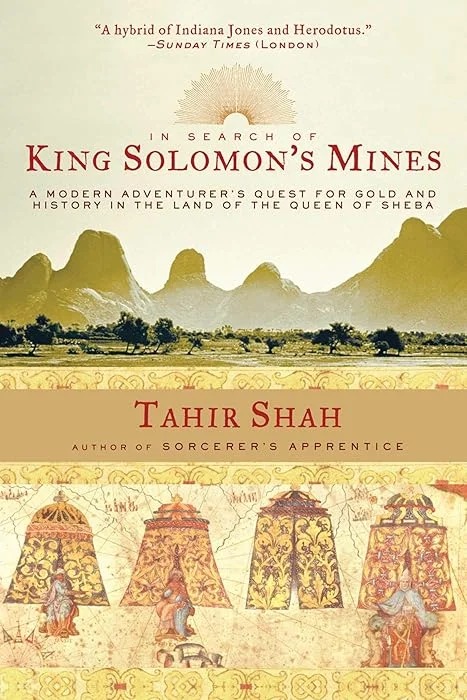
Tahir Shah’s In Search of King Solomon’s Mines is the account of a real journey built on an old question: where did the gold of the Bible actually come from? It begins in the Old City of Jerusalem, where Shah buys a crude treasure map from a reluctant shopkeeper, and it follows a single clue, the biblical land of Ophir, all the way into the Ethiopian highlands. Shah reasons that the Queen of Sheba’s kingdom, the source of the gold she carried to Solomon, was most likely in Ethiopia, and that the mines might still be found. What follows is part detective story, part travelogue, and part portrait of a country that most outsiders know only from famine footage.
The book is for three kinds of reader. The reader who grew up with the Queen of Sheba, Menelik, and the Ark of the Covenant as stories from church and school, and has never seen them treated as a working map to a real treasure. The traveler or the Ethiopian abroad who wants to see the country through the eyes of an affectionate, unsentimental stranger who actually went to the places few visit. And the reader simply curious about where Ethiopia’s gold actually comes from, whether it is the women panning rivers in the south or the locked bullion room of a modern mine.
What makes the book worth the time is its honesty about what a quest really is. Shah never finds Solomon’s treasure. The legend keeps receding ahead of him. But in chasing it he reaches the parts of Ethiopia that the legend was hiding, the hand-dug pits where thousands still mine gold the way Solomon’s miners did, the priests guarding their relics, the muleteers and the curses and the rain. The treasure he comes home with is the country itself.
Take-aways
-
The whole journey starts with one biblical word: Ophir. The Bible says Solomon’s gold came from a place called Ophir but never says where it was, and for centuries treasure hunters placed it everywhere from India to Peru to southern Africa.
-
Ethiopia’s own scripture makes it the most logical answer. The Kebra Negast tells how the Queen of Sheba, called Makeda, bore Solomon a son, Menelik, whose companions are said to have brought the Ark of the Covenant to Axum, where Ethiopians hold that it still rests.
-
The mines that turn out to be real are dug by the poorest people alive. In the south, near Shakiso and Bedakaysa, thousands of men, women, and children dig gold by hand from open craters, exactly as the ancients did, with no machinery and almost no safety.
-
A modern legal mine sits right beside them, in another world. The Lega Dembi plant, owned by the tycoon Mohammed Al-Amoudi, blasts rock with ammonium nitrate and pours bullion bars worth around 80,000 dollars each, behind razor wire and armed guards.
-
Shah’s real guide is the country, in the person of Samson. An Addis taxi driver who secretly reads a forbidden history book by candlelight, Samson becomes prospector, fixer, and protector, and his hunger to know Ethiopia’s past drives the book as much as the gold does.
-
The legend has lured better-equipped men to ruin. The Englishman Frank Hayter, nicknamed Abba Kuta, the Father of Madness, spent the 1920s hunting these mines and claimed to find sealed caves on a mountain called Tullu Wallel before a curse, he said, drove him back.
-
Ethiopia has long been a screen for other people’s fantasies. From the medieval myth of Prester John to Rider Haggard’s 1885 novel, outsiders kept projecting their dreams of a golden Christian kingdom onto a country they had never seen.
-
A quest can succeed by failing. Shah’s two expeditions to Tullu Wallel both end in retreat, the mines unfound, yet he returns having seen the living Ethiopia that the search for a dead king’s gold had kept hidden in plain sight.
Summary
The book is built as a journey with a single thread running through it. Shah follows the gold, and every person he meets, every legend he chases, and every mine he climbs down into is another step along that thread. The structure is the trip itself, told in order, from a shop in Jerusalem to a rain-soaked mountain in western Ethiopia.
A map bought in a war zone
Shah opens in the Old City of Jerusalem during the Intifada, with gunfire in the streets and the tourists gone. In a dusty shop he calls Ali Baba’s Tourist Emporium he notices an inky hand-drawn map in a chipped gold frame, marked only with a river, mountains, a cave, and an oversized X. The shopkeeper tells him it shows the mines of Suleiman, King Solomon’s mines, in Africa. Shah buys it, then later catches the same shopkeeper hanging a second, near-identical map for the next customer.
The map sends Shah back to the Bible. He fixes on Ophir, the land from which Solomon’s navy fetched gold, ivory, apes, and peacocks. Nobody knows where Ophir was, but reading the clues, the short voyage down the Red Sea, the gold close to the surface, the apes and ivory, Shah concludes that the answer points to Ethiopia. The second great clue is the Queen of Sheba, Solomon’s most famous visitor, who arrived with camels bearing gold and spices.
For Ethiopians this is not a foreign riddle. The imperial line traced its descent from Menelik, the son the Ethiopian texts say Makeda bore to Solomon, and the Kebra Negast, the Glory of Kings, tells the whole story. The Ark that Menelik’s companions are said to have carried home is held to rest in Axum to this day. Shah is chasing a treasure map; an Ethiopian reader recognizes it as the country’s own genesis.
Samson, son of Yohannes
In Addis Ababa, mauled by a conference delegate’s guide-dog and warned about rabies, Shah meets the man who will carry the book. Samson, son of Yohannes, is a taxi driver with a ramrod back who stops his cab to pray over a stranger’s funeral because, he says, when an elder dies the whole nation must mourn. Samson supports a houseful of relatives and longs above all to know his country’s history.
That history is dangerous knowledge. Shah arrives in an Ethiopia still raw from the Derg. Haile Selassie, the last emperor, was smothered in his palace in 1975 and buried in secret; Mengistu’s government had collapsed in May 1991 after seventeen years of terror. The new state treats the imperial past as a taboo subject, afraid the people will remember their kings. Samson keeps a single history book hidden, reading it at night behind a bolted window, pretending to snore so the neighbours will not hear him turn the pages.
Samson is more than a driver. By the end he has been prospector, gold miner, guide, missionary in disguise, and protector. His curiosity about Makeda and Menelik, about Tewodros and the British explorers, is the same curiosity that animates the search, and his courage is what keeps Shah alive.
The legends that drew the foreigners
Before the journey south, Shah lays out the long history of the obsession. The Victorians decided that the ruins of Great Zimbabwe were Solomon’s Ophir, a theory now discredited. Rider Haggard’s 1885 novel King Solomon’s Mines, written on a shilling bet, moved the mines to South Africa and made them diamond mines, capitalizing on the diamond fever of the day. And for a thousand years Europeans had been spellbound by Prester John, a mythical Christian king said to be descended from Solomon and Sheba, ruling a kingdom of jewelled palaces and a fountain of youth, which they eventually located in Ethiopia.
Ethiopia, in other words, has spent centuries as a blank screen for other people’s fantasies of gold and grace. Shah knows he is the latest in that line, and saying so is part of why the book stays honest.
Frank Hayter and the Accursed Mountain
The figure who haunts the second half of the book is Frank Hayter, an Englishman born in 1902 on the Welsh borders. Hayter came to Ethiopia in 1924 as a taxidermist sent to collect a hundred baboons for the London Zoo, and according to his own telling, a monk cursed him for stealing sacred animals. He stayed for years, working as a rat-catcher, butterfly hunter, muleteer, and above all a gold prospector. The locals called him Abba Kuta, the Father of Madness. In his 1936 book The Gold of Ethiopia, Hayter claimed to have found stone-faced cave entrances high on a mountain called Tullu Wallel, with a fabulous treasure inside, before a flooding river and the baboons’ curse sealed the caves against him forever.
Shah takes the story to Dr. Richard Pankhurst, the foremost scholar of Ethiopia, who lives outside Addis and speaks faultless Amharic. Pankhurst’s grandmother was the suffragette Emmeline Pankhurst, and his mother moved to Ethiopia in the 1930s to support the resistance against the Italian invasion. Pankhurst confirms that Tullu Wallel, near Beni Shangul, sat in a region long famous for fine gold, and that Hayter wrote anti-Fascist letters to his mother. Then he delivers the warning that hangs over everything: as a source, Hayter is “rather unreliable.”
The mines that are real
Heading south into the Adola greenstone belt, Ethiopia’s richest gold seam, Shah finds the thing he was looking for, though not as legend promised. Past the frontier town of Shakiso lies a raw mining settlement called Bedakaysa: dozens of thatched huts, drinking dens, gambling, and a crater the size of a football pitch and a hundred and fifty feet deep. In it, thousands of men, women, and children dig by hand, barefoot, hauling earth to the surface in a human chain, panning the silt for alluvial gold exactly as Solomon’s miners would have done before blast-mining existed.
Shah calls it a sight out of the Old Testament, and writes that at that moment the idea of Solomon’s mines fell sharply into focus. The treasure was never a single buried hoard. It is this, the living, dangerous, hand-worked gold economy of the Ethiopian south, where a guide named Noah from Gambela carries his bags and a young man tells him that whatever America is like, it must be better than Bedakaysa.
Legal gold and the price of it
A short distance from the hand-dug pits is the opposite extreme. The Lega Dembi mine belongs to Midroc, the company of Mohammed Al-Amoudi, whose face, Shah notes, greets you across the country and who seems to own the tanneries, the car dealerships, the construction firms, and the new Addis Sheraton. Behind razor wire and armed patrols, an Australian manager named Wayne shows Shah how modern gold is won: ammonium nitrate to blast the rock, women driving the giant Caterpillar trucks, a furnace pouring molten metal into bars worth roughly 80,000 dollars each, about three hundred and fifty of them a year.
Standing in the bullion room, Shah wonders whether this gold could revive Ethiopia’s economy if investors came. That evening he celebrates at the Sheraton, another of Al-Amoudi’s projects, where foreign aid workers dine on foie gras flown in from Paris while ordinary Ethiopians are nowhere to be seen in the restaurant.
The treasure he actually found
The book climbs, literally, to Tullu Wallel, Hayter’s Accursed Mountain in the far west near Nejo. The first expedition, through forest and thigh-deep mud, ends when the cave the muleteers find dead-ends at a rock wall twenty feet in. Shah goes home defeated and cannot let it go. Seven months later he returns, ropes in the same driver and the battered Jeep, and pushes back up the mountain in worse rain than before, his feet rotting, his companion Samson sick with worms. On the last morning, with the food gone, the water finished, and the rain turning to hail, he orders the retreat.
He never finds the mines. The book closes with him smiling wryly as he walks away: Frank Hayter’s secret was still safe, and so was the whereabouts of King Solomon’s mines. The honesty of that ending is the point. The gold of legend stays in the realm of legend, but the journey delivered something Shah could not have planned, a close, affectionate, clear-eyed look at Ethiopia and its people in a hard decade.
In the acknowledgements Shah writes that Ethiopia is encircled by mountains and shrouded in misinformation, and that he hoped to lift the veil on a land that has captivated travelers for centuries. He came for gold and left having found Ethiopia, which he dedicates the book to. The search failed and the journey succeeded, and for the reader that distinction is the whole reward.
About the Author
Tahir Shah is a British travel writer of Afghan descent, from a family whose ancestral home is Paghman, in Afghanistan. The search for King Solomon’s mines ran in his blood before he took it up: his grandfather, Sirdar Ikbal Ali Shah, crossed southern Arabia hunting the mines, and his father took up the same quest along the Red Sea coast. Shah began his writing life in his twenties when the photojournalist Mohamed Amin, who had filmed Ethiopia’s famine footage in the mid-1980s and lost an arm in Addis Ababa, hired him to write books. His earlier travel narratives include Sorcerer’s Apprentice and Trail of Feathers: In Search of the Birdmen of Peru. In Search of King Solomon’s Mines was first published in Britain in 2002 by John Murray, and draws on two arduous journeys through Ethiopia in the years after the fall of the Derg.