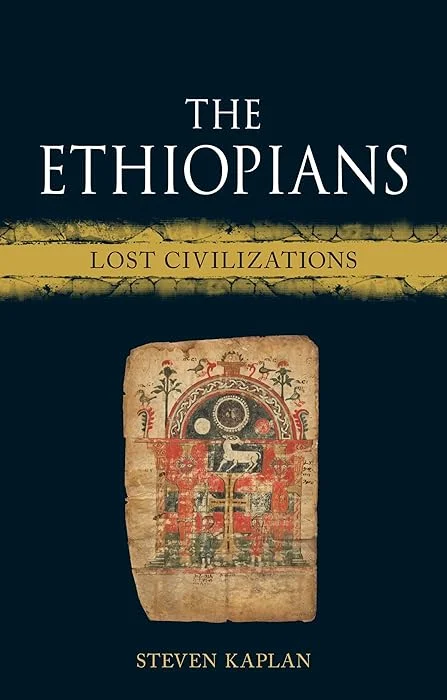
The Ethiopians: Lost Civilizations
by Steven Kaplan
Recommendation
There are millions of Ethiopians alive today, so in what sense can the Ethiopians be a lost civilization? Steven Kaplan, a scholar who spent almost fifty years studying the country, answers that the loss is not of a people but of a past. The early history of Ethiopia and Eritrea, especially the centuries before 1500, has been hidden behind a curtain of later legend. Much of what feels timeless, the sacred geography of Aksum, the conversion stories, the music of the saints, even the spices in the food, can be shown to have taken its familiar shape long after the events it claims to describe. This short volume, part of Reaktion’s Lost Civilizations series, sets out to lift that curtain and show the early Ethiopians as they were, not as later generations needed them to be.
The book is for several kinds of reader. Ethiopian readers who grew up with the names Sheba, Aksum, Lalibela, and the Solomonic dynasty and want to know what scholarship can and cannot confirm about them. Curious readers of any background who know Ethiopia only through famine or the restaurant down the street and want the deep story behind the names. And anyone drawn to the question of how nations build the story of their own origins, then come to believe it without question.
What makes the book valuable is its honesty about evidence. Kaplan writes for the educated non-specialist, but he refuses to smooth over the gaps. Where the sources are silent he says so. Where a beloved tradition turns out to be younger than it looks, he explains how scholars know. He treats the legends with respect while declining to mistake them for chronicles. The result is a humbler and more interesting Ethiopia than the one in the schoolbooks, a meeting place of Africa, the Middle East, and the Indian Ocean that minted its own coins, hewed whole churches from rock, and sheltered the first Muslims while the rest of the world forgot it was there.
Take-aways
- The Ethiopians are “lost” in the sense that their early past was reshaped by later eyes. Kaplan argues that much of what is presented as ancient, from Aksum’s holy sites to the conversion narratives, was given its current form centuries after the fact.
- Aksum was an African civilization, not a colony of South Arabia. Recent research has overturned the old claim that the kingdom was founded by settlers from across the Red Sea, and Kaplan firmly takes the African side.
- The Queen of Sheba is many queens. Known as Makeda in Ethiopia and Bilqis in Islam, she anchors the Kebra Negast, the national epic in which her son Menelik carries the Ark of the Covenant to a new Zion at Aksum.
- Ethiopia adopted Christianity among the very first kingdoms in the world. King Ezana converted in the fourth century, after Armenia and Rome, and for sixteen centuries the head of the Ethiopian Church was a monk sent from Egypt.
- Aksum’s tolerance toward the first Muslims became part of Islamic memory. Around 615 the king sheltered followers of the Prophet, and a saying spread that the Ethiopians should be left in peace so long as they left others in peace.
- The Zagwe who carved the churches of Lalibela were heirs of Aksum, not foreign usurpers. A wave of recent scholarship has reversed the old verdict, presenting them as builders who honored the past rather than enemies who broke with it.
- The Solomonic “restoration” of 1270 was closer to an inspired claim than a homecoming. A new dynasty from Amhara cast itself as the rightful heir of Solomon and Sheba and discredited its predecessors, and the Kebra Negast became its charter for the next 650 years.
- The reigns of Dawit and Zar’a Ya’qob were when the Church became woven into daily life. Between 1380 and 1478 the fasting calendar, the cult of Mary, the feast of the Cross, and the painting of icons took the forms Ethiopians still keep.
Summary
Kaplan structures the book as a chronological survey from the Queen of Sheba to about the year 1500, with a prologue that lays out his method and an epilogue that explains why he stops where he does. He stresses throughout that this is a synthesis of other scholars’ work rather than a report of his own digs, and that the field is moving so fast he writes “not by gazing at the stars but by looking at fast-moving clouds.” The summary below follows his argument from the problem of names to the golden age of the medieval Church.
A civilization that was never lost
Kaplan begins with the puzzle in his own title. The Ethiopians are not vanished like the Etruscans or the Hittites. The loss is of a different kind. For much of history the Horn of Africa stood at the crossroads of the Mediterranean, the Red Sea, and the Indian Ocean, and the third-century Persian prophet Mani ranked Aksum among the four great powers of the world alongside Rome, Persia, and China. Yet outsiders later forgot it. Edward Gibbon wrote that the Ethiopians “slept for near a thousand years, forgetful of the world by whom they were forgotten,” a line Kaplan quotes only to correct: those centuries were never a dark age, merely an under-recorded one.
The deeper loss is that the early past has been refracted through a later lens. Kaplan’s favorite illustration is food. The fiery berbere pepper that defines northern cooking is native to the Americas and reached the region only in the sixteenth century. The injera flatbread of teff became the everyday staple of the north only around the 1750s. The coffee ceremony, now treated as ancient, developed in the late nineteenth century, and Christians long avoided the bean because of its link to Islam. None of this makes the traditions less real. It shows how easily things that grew up under specific historical conditions come to feel primordial. The same caution, Kaplan warns, must be applied to Aksum’s holy places, the conversion stories, and the achievements of the saints.
Even the word “Ethiopia” is unstable. In the Hebrew Bible and in Greek, it usually meant Nubia, south of Egypt, not the highland plateau, and one scholar argues the local people did not call themselves Ethiopians until the fourteenth century. Kaplan weighed naming his book “The Habesha” or “The Abyssinians” before settling on the title the series required, fully aware of its problems.
The many faces of the Queen of Sheba
The opening chapter circles the most famous Ethiopian of all, a woman who may never have existed. The biblical account in 1 Kings and 2 Chronicles is sparse: the Queen of Sheba hears of Solomon’s wisdom, travels to Jerusalem with gold and spices, tests him with hard questions, and returns home impressed. From this seed grew a forest of legend. In Islam she is Bilqis, a ruler with goat-like legs sent to test the order of the world. In Ethiopia she is Makeda, and the story belongs to her rather than to Solomon.
The Ethiopian version is the Kebra Negast, the Glory of Kings. In it Makeda travels from Aksum to Jerusalem, Solomon tricks her into his bed, and she bears a son, Menelik. When Menelik grows up and visits his father, his companions steal the Ark of the Covenant from the Temple and carry it home, so that the glory of Zion passes from Jerusalem to Aksum and the chosen people pass to the Ethiopians. For the ruling class this was not poetry but constitution: royal legitimacy ran in a direct line from Solomon, and Ethiopian Christians were the true Israel as a matter of blood, not metaphor. Scholars still debate the text’s date, but even those who place it early set it more than fifteen hundred years after Solomon, and Kaplan notes that the Ark claim appears to be late, since the sixteenth-century Portuguese visitor Francisco Alvares retold the saga without mentioning the relic.
The rise of Aksum, an African civilization
If the Sheba legend imagines a kingdom a thousand years before Christ, historians date the rise of Aksum to around the turn of the Common Era. For generations European scholars credited that rise to settlers from South Arabia, treating Ethiopian civilization as a transplant from across the Red Sea. Kaplan sides firmly with the recent work that has decolonized this picture. South Arabian contact was real, and the Great Temple at Yeha, dedicated to the moon god Almaqah, shows it. But the language Ge’ez, though Semitic, soon went its own way, and the wider culture grew from local roots in the agropastoral “Ona” settlements of the early first millennium before Christ.
Aksum’s wealth came from trade through its Red Sea port of Adulis, described in a first-century Greek merchant’s guide called the Periplus of the Erythraean Sea. The most spectacular surviving monuments are the carved granite stelae that mark royal graves, the largest of them about thirty meters and 520 tonnes, probably too heavy to ever stand. The second-largest was looted to Rome by Mussolini in 1937 and returned only in 2005. Aksum was the one ancient kingdom of sub-Saharan Africa to mint its own coins, in gold, silver, and bronze, and those coins remain a more reliable record of its kings than the legend-laden lists drawn up centuries later.
A Christian kingdom: Ezana, Frumentius, and Kaleb
Ethiopia became one of the earliest Christian states on earth, converting after only Armenia and Rome. The tradition that Christianity arrived with the Ethiopian eunuch of the Book of Acts is cherished but, Kaplan notes, the eunuch’s queen Candace points to Nubian Meroe rather than to Aksum. The better-documented story is that of two shipwrecked Syrian brothers, Frumentius and Aedesius, who served at the Aksumite court; Frumentius later traveled to Alexandria, was consecrated as Ethiopia’s first bishop, and returned to preach. This founding act set a pattern that lasted sixteen hundred years, for the head of the Ethiopian Church remained a single Egyptian monk appointed by the Coptic patriarch until the middle of the twentieth century.
The king who converted was Ezana, in the fourth century, whose coins shift from the crescent moon to the cross and whose inscriptions move from the war god Mahrem to the “Lord of Heaven” and finally to an unmistakable confession of Christ. Kaplan cautions against overstating the change: most Aksumites were untouched by the king’s new faith for a long time. Two centuries later King Kaleb made Christianity a matter of state. When a Jewish ruler of Himyar in South Arabia massacred the Christians of Najran around 522, Kaleb crossed the Red Sea, defeated him, and restored a Christian presence, an episode that rang across the Christian world. From this period come the Garima Gospels, now dated as early as the fourth to seventh centuries and counted among the oldest illustrated Christian manuscripts anywhere.
Islam, tolerance, and the long medieval middle
Islam entered the story early and peaceably. Around 615, fleeing persecution in Mecca, a group of the Prophet’s followers crossed to Ethiopia and were sheltered by the king, the nağāšī, in an event Muslims remember as the first hijra. Out of it grew the Ethiopian Muslim community, the Jabarti, and a saying attributed to the Prophet that the Ethiopians should be left alone so long as they left others alone. The Quran itself carries words borrowed from Ge’ez. For centuries Islam spread not by conquest but by trade, first through the Dahlak islands off the northern coast and later through the southern port of Zayla.
Then Aksum declined, for reasons still debated: the loss of trade, soil exhaustion, climate change, perhaps the Justinian plague, and the rise of aggressive desert peoples. Political power fragmented and drifted, and into this dim period steps the legendary Queen Gudit, said to be a Jewish or pagan rebel who sacked Aksum and stole the Ark. Kaplan reads her as a mirror image of Sheba, a literary figure as much as a historical one. The seventh to eleventh centuries remain the hardest to see, but he insists they were no true dark age. Aksum lost its throne yet kept its religious and symbolic power, and many of its proudest traditions were composed only after its political fall.
Lalibela and the Zagwe: heirs, not usurpers
Around the middle of the eleventh century a new line, known to historians as the Zagwe, ruled from the central highlands until 1270. For centuries they were remembered as illegitimate usurpers who broke the Aksumite line, yet also venerated as saints, a contradiction Kaplan resolves with the timeline: the usurper image was manufactured by their successors, and the saintly one was a later rehabilitation once they were no longer a threat. Recent scholarship, above all the work of Marie-Laure Derat, has gone further and recast them as heirs of Aksum rather than its enemies. There is little firm evidence they even spoke the Agaw language once attributed to them, and their kings used old Aksumite titles.
Their monument is the town now called Lalibela, once Roha, where churches were hewn whole from the living rock. Kaplan stresses that these were not built in a single reign or to a single plan; some were originally palaces or fortresses, and several may have been finished as late as the fifteenth century. The largest, the Church of the Redeemer, quotes the great cathedral of Aksum, and the cruciform Church of Saint George is the most striking of all. Far from rejecting Aksum, the builders seem to have wanted to be more Aksumite than Aksum. The period also saw the Coptic tie with Egypt restored and strengthened, and the spread of Muslim trading towns whose mosques and graves archaeologists are only now uncovering.
The Solomonic “restoration” and the medieval golden age
In 1270 Yekunno Amlak, a leader from Amhara backed by powerful monks, overthrew the last Zagwe king. Tradition calls this the restoration of the rightful Solomonic line, but Kaplan, following the new view of the Zagwe, calls it something bolder: a brilliant claim in which an upstart dynasty cast itself as the heir of Solomon, Sheba, and Aksum while painting its predecessors as usurpers. The Kebra Negast, which seems to have taken shape under a rival lord in Tigray, became the charter of this southern dynasty for the next 650 years, and the kings began calling themselves the true Ethiopians, displacing the fading Nubians who had held the name.
Under Emperor Amda Seyon in the early fourteenth century the kingdom expanded and subdued the Muslim sultanates of the south, who paid tribute to the “King of Zion.” The deepest transformation, though, was religious, and it came under Emperor Dawit and his son Zar’a Ya’qob between 1380 and 1478. This was when Christianity became embedded in the rhythm of daily life. The fasting calendar swelled to over 250 days a year for clergy. The cult of the Virgin Mary flowered, with thirty-three Marian feasts and the great collection of miracle stories. The feast of the Cross, Mäsqäl, was raised to a major celebration. Icons began to be painted, churches built by the score, and a flood of works translated from Arabic into Ge’ez, often a thousand years after the faith first arrived. Zar’a Ya’qob, a ruthless reformer who crushed dissident monks, gave the Church much of the shape Ethiopians know today.
Kaplan ends around 1500, on the eve of three forces that close the era of the “lost” civilization: the devastating jihad of Ahmad Gragn, the Ottoman push into the Red Sea, and the northward expansion of the Oromo, today the country’s largest people. From that point on the Portuguese and other Europeans begin to write about Ethiopia in volume, and a kingdom that had slept in Western memory is lost no longer.
About the Author
Steven Kaplan is a scholar of African history and comparative religion who spent almost fifty years studying Ethiopia. For more than three decades he taught in the Department of Comparative Religion and the Department of African Studies, later Middle Eastern and Islamic Studies, at the Hebrew University of Jerusalem, where the Faculty of Humanities supported his work. He is known for his books on the Beta Israel, the Ethiopian Jews, including The Beta Israel (Falasha) in Ethiopia, and has written widely on Ethiopian Christianity and the holy man in Ethiopian tradition. He describes this volume, published in Reaktion Books’ Lost Civilizations series in 2025, not as a final word but as a synthesis of recent research and a “mid-conversation intervention” meant to provoke further debate.